
What happens when you go to small claims court in SLO County
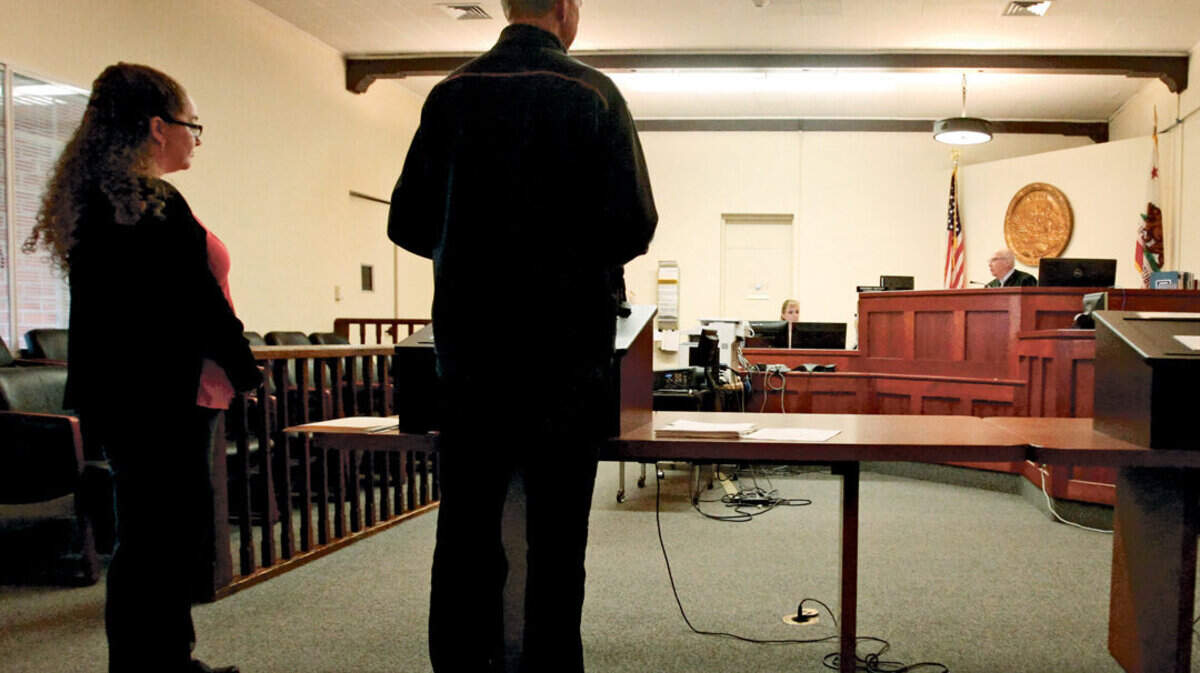
The plaintiff, David Daguerre, says his wife was walking their dog Pebbles past a Pismo Beach restaurant last April when an American bulldog jumped out of a parked Corvette convertible and attacked their chocolate Lab.
Standing at a podium a few feet away, the defendant, Frank Caran, says he didn’t see Pebbles get attacked. But he says his dog had been in the car, with the windows up, when he went inside the restaurant, and his dog was in the car when he returned.
“I don’t see how in the world she jumped out,” Caran says in court. “And if she did jump out, how in the world she got back in the car.”
But the fact that he had previously paid much of Pebbles’ $462 vet bills seems to suggest some admission of guilt to the judge pro tem, Jere Sullivan. So Sullivan awarded Daguerre the remaining $140.
Case closed.
The award for the small claims court victory pales in comparison to some of the multimillion-dollar civil judgments that have been handed down in San Luis Obispo Superior Court. But, Daguerre told The Tribune later, the decision gave him closure.
“I’m an ornery guy — right is right,” Daguerre said. “It’s not about the money.”
Small claims court in San Luis Obispo County plays out like the old “People’s Court” TV show, with a variety of cases herded through in 15-minute segments. Sometimes one or both parties may leave disappointed, but at least their dispute is legally resolved.
“The forum’s there,” said Sullivan, a local attorney who has presided over small claims cases since 1996. “It’s cheap to get into the door. It’s relatively quick to get heard. And you get some resolution, one way or the other.”
On a recent Friday morning, cases heard in small claims included the biting bulldog, a woman seeking $3,500 she gave a man to post his bail, and a man who claimed a trash truck damaged his driveway.
In San Luis Obispo County, small claims cases are heard in two places: the Paso Robles courthouse on Mondays and the Veterans Memorial Building in San Luis Obispo on Fridays. But the process begins at the County Government Center in San Luis Obispo. There, any individual who believes he is owed money — less than $10,000 — can file a small claims lawsuit with the Superior Court.
“The filing fees aren’t very high,” said Debbie Grafft, an economic crime officer with the San Luis Obispo County District Attorney’s Office, who also advises people on small claims court.
After a fee is assessed — $30, $50 or $75, depending on the amount sought — a court date will be set. The plaintiff, or person filing the suit, has to notify the defendant, either by certified mail sent by the court, the Sheriff’s Office or a private process server, 15 to 25 days before the court date.
Before the court date, mediators will call both parties to see whether they are interested in resolving the issue out of court.
“It’s entirely voluntary,” said Steffanie Medina, director of corporate and community relations for Creative Mediation, which is contracted to handle mediation — free of charge — to small claims participants. “We need two yeses in order to mediate.”
Landlord-tenant disputes over deposits are the most common small claims issue, Grafft said, though small claims court features a variety of conflicts. While thousands of dollars can sometimes be at stake, other times, plaintiffs merely want their day in court.
“I’ve had people sue people for five bucks,” Grafft said.
While she can’t give legal advice, Grafft does advise parties on the small claims process and rules. Her office deals with other consumer and economic issues, but small claims cases take up much of her time. In April, she had 117 calls and 31 walk-ins asking about small claims court, she said. February featured 186 calls and 40 walk-ins.
Local small claims cases are heard by a court commissioner, Stephen Sefton, or a pro tem judge. Before cases are heard, the commissioner orders the litigants to leave the courtroom and show the other party the evidence they plan to present. He also asks whether they want to mediate beforehand.
Funded by statewide court fees, Creative Mediation will have mediators on hand. Unlike the small claims trial, mediation can last longer, Medina said, with parties having an opportunity to speak more.
“The judge gives you about five minutes,” she said.
Going to trial is also a risk: “You never know what you’re going to get,” Sullivan said.
But in mediation, he added, the parties can decide whether they accept a proposed solution. “People get to be invested much more in the resolution of their case,” Sullivan said.
If mediation efforts fail, the parties can still have their case heard that day.
“You really have nothing to lose,” Medina said.
Typically, she said, between 75 percent to 90 percent of cases that go to mediation are resolved.
With such a small amount at stake, Daguerre said he wasn’t interested in settling. Caran’s dog, Tuckus, bit Pebbles, he said, creating a wound in Pebbles’ leg. That resulted in vet visits and further supplies.
“I had to get three different cones to keep her from biting it,” he said.
Caran said dogs can be aggressive with other dogs, but he questions how Tuckus could have attacked Pebbles.
“I can’t say that my dog wouldn’t bite another dog,” said Caran, of Arroyo Grande. But he doubted his dog could jump out of his car given that Tuckus uses a ramp. “My dog is an old, broken-down dog.”
When he and Daguerre’s wife first looked at Pebbles, he said, they didn’t see anything wrong with the dog. Still, when the initial vet bill came in for more than $300, he said, he agreed to pay it — and even offered to buy dinner for Pebbles’ owners — just to settle the issue.
Then he got a bill for a follow-up visit to the vet, he said, plus other charges. Then he learned that the incident was reported to animal control, which fined him $277 for not having a dog on a leash — even though he insisted Tuckus was leashed to the steering wheel.
So Caran refused to pay any more.
“It was, like, hey man, come on,” he said. “I find myself feeling pissy about it — taking it in a personal way.”
Daguerre said Caran gave him the run-around. And he wondered why they should have to pay anything for something Caran’s dog did.
“All my wife was doing was walking a dog on a leash,” said Daguerre of Pismo Beach.
As Pebbles continued to limp on her wounded leg, Daguerre notified Caran, via certified mail, that he was taking him to court.
While his day in court was short, Daguerre left pleased.
“I enjoyed it,” he said. “The results were fine.”
Disappointed but with a sense of humor, Caran said he is still considering the decision.
“I have been debating whether to appeal that or disguise myself as a very large dog and go stalking around Shell Beach,” he joked.
This story was originally published July 15, 2015 at 5:00 PM with the headline "What happens when you go to small claims court in SLO County."