
Q&A with cartoonist Jerry Scott
When The Tribune received a postcard announcing Jerry Scott’s art show, another syndicated cartoonist quickly came to mind.
The postcard featured an oil painting of a cow, and Leigh Rubin’s comic “Rubes” often features cows — usually in curious predicaments. So I thought it’d be fun to ask Rubin to interview Scott, who writes the scripts for both “Zits” and “Baby Blues.” (All three comics appear in The Tribune daily.) Rubin readily agreed.
Scott’s “Zits,” created with Jim Borgman, focuses mostly on teenager Jeremy Duncan, while “Baby Blues,” with Rick Kirkman, is centered on the MacPhersons and their three young children. “Rubes,” a single panel strip, features an assortment of characters, both in human and animal form.
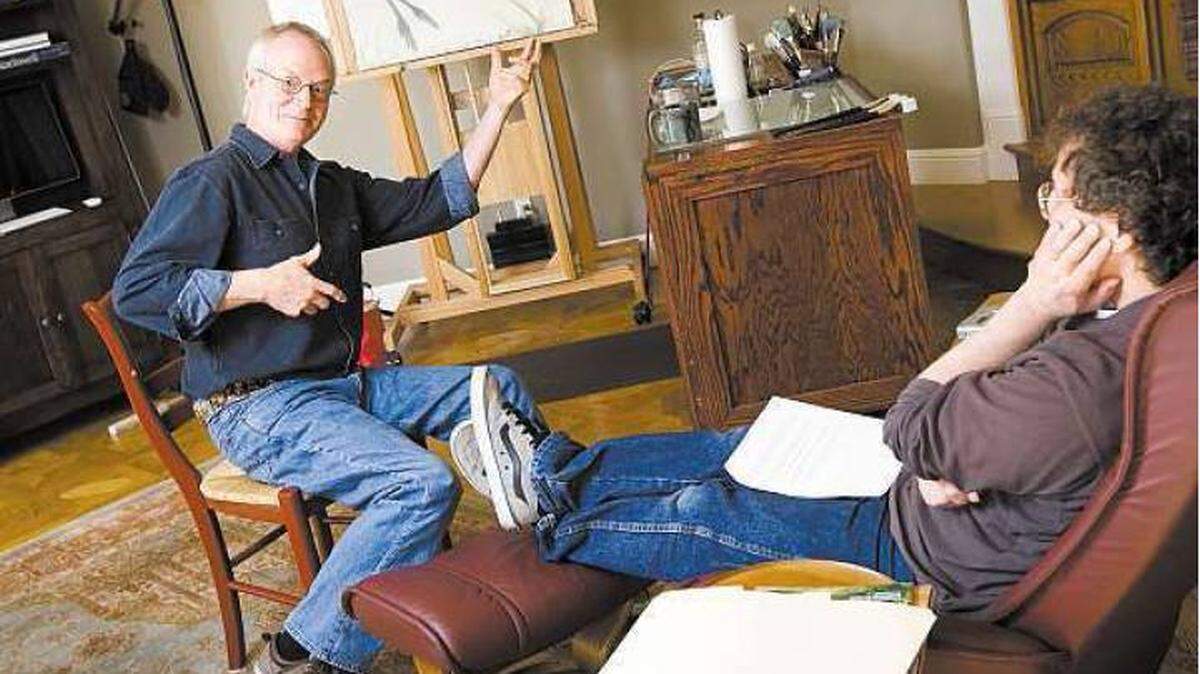
For the interview, Rubin, of Nipomo, met Scott, a friend, at his Arroyo Grande home. The house, surrounded by hills and cattle, provide the inspiration for most of Scott’s oil paintings, which are on display until June 15 at Frame Works in San Luis Obispo.
Rubin asked him about his paintings, the strips and a possible side career in music. Here’s what they had to say.
Q. So Jeremy and (his best friend) Hector take a road trip in their restored VW Microbus. Where do they go and what real-life experiences from your own trip would you most likely not put into the trip?
A. They would go with some money so they could actually shower and eat regularly. I took a motorcycle trip when I was in high school with a couple of friends. We went from Arizona to Montana on three little motorcycles, each with $300 in our pockets. The plan was to sleep on the side of the road in our sleeping bags, just like Dennis Hopper and Peter Fonda.
We ate Campbell’s soup out of the can. Cold. The first time I opened a can of cream of mushroom soup and got a look at the big gelatinous glop inside, I thought, “There must be a better way.” So we ended up eating potato chips until we arrived in Montana, where my buddy’s aunt fed us real food.
Q. It doesn’t seem like Jeremy and his friends are politically active. What are the odds of them developing some political consciousness and instead of just occupying the couch, joining the Occupy movement?
A. Uh none.
Jeremy is going to get a job this summer. That should be a growth experience. Jim and I aren’t ready to face another “I’m bored” summer from this comic strip kid, so Jeremy is going to dive into the summer workforce. I’m really looking forward to writing these strips.
Q. Do you ever see Jeremy going to college and, like many adult children these days, moving back home?
A. You know, Jeremy has an older brother (Chad), and I’ve lost him — I misplaced him. He was in the strip several times in the first year, then we shipped him off to Notre Dame and we hardly ever hear from him. That was about 15 years ago. The tuition bill must be killing his parents.
Jeremy was 15 for about 12 years. We ratcheted his age up to 16 so he could get a driver’s license, and it’s opened up a whole new world for the script.
It wouldn’t surprise me if someday Jeremy went off to college, but it’s not going to happen soon.
Q. Some people have the notion that cartoonists are really lucky and just get to sit around all day, sipping expensive wine by the pool and drawing pictures. What is your average work day like?
A. There’s no heavy lifting involved. And when you break it down to what the job really is, it does sounds kind of easy: think of one idea every day. In my case draw a rough sketch of it (for “Zits”), and email it to your partner.
But in reality, keeping a comic strip going involves a lot more — promotion, publishing, contract negotiations, charitable donations, and more. Probably the toughest thing about the job is the constant deadline. It’s a little like being chased by zombies. Zombies aren’t really very fast — you can get away. But they’re persistent, like deadlines. If you don’t stay ahead of deadlines, they’re going to catch up with you and eat your brain.
Q. I would equate it to slaying the dragon. Ah, the deadline is done. The dragon hath been slayed for another week. Speaking of jobs, what’s the worst one you have ever had?
A. When Kim and I first moved to California about 35 years ago we landed in Santa Maria because her parents lived there. I was working for an art service in Los Angeles designing and illustrating Yellow Page ads. I would drive to L.A. and pick up a packet of instructions, then drive home, where I would spend the next few days putting the ad layouts together, then drive back to L.A. to have the art director reject most of them and refuse to pay me. Then I’d start the whole process over again. I don’t think I ever made enough money to pay for the gas on those trips, so I quit after a few weeks.
Q. In addition to the cartooning, you’re also a fine artist. How did that come about, and how do you select your subject matter?
A. When I was in high school, I played football on the offensive line. Linemen are the guys who get hit first on every play. They do the groundwork, creating opportunities for the backfield players to score touchdowns.
And that is kind of how I see my job in the comics business. I can draw, but I’m the writer on both “Baby Blues” and “Zits,” the guy who plows forward first, creating the idea and opportunities for my comic strip partners to embellish with artwork. Both aspects of the comic strip — the writing and the drawing — are completely interdependent, and one is not more or less important than the other. But the artwork is what comes to mind when a comic strip is mentioned because it’s the more visible aspect of what we do. I started painting to satisfy an itch I had to be the artist for a change. I love it.
Right now I’m just painting anything that seems interesting to me. Landscapes, people, cows — lots of cows. I’m fortunate to live on a ranch and I’m surrounded by great landscape and, yeah cows.
Q. And there are no deadlines, either.
A. No deadline. Yet.
Q. So you’re living the retirement at the same time you’re working.
A. I’m a genius. I figured it out.
Q. I’ve got to figure this out.
A. I am capable of turning this into a job, though. That’s why I’m really being careful —
Q. You don’t want to turn it into a job.
A. Right. I already have two. Who needs three?
Q. But you’re having a gallery opening. Plug, plug, plug.
A. The Frame Works Gallery in San Luis Obispo asked if I would like to have a show, and I did and I am. It’s really exciting not because I’m expecting to sell a bunch of paintings, but because I’m kind of declaring myself as apainter. It takes a certain amount of courage to put myself out there in a different way than I do with cartooning, but I like a challenge.
Q. You draw, you paint. Do you have any other hidden talents we should know about? Should we be expecting an evening at the Clark Center of “Jerry Unplugged” any time soon?
A. Uh, no.
Q. Is that the short answer?
A. I’ve started and stopped taking guitar lessons so many times. Rick Kirkman, who draws “Baby Blues,” is an excellent guitar player, and he taught me how to play just a little. I enjoy the instrument, but I’m better at buying them than I am at playing them.
This story was originally published April 23, 2012 at 4:36 AM.