
Southern California's Social Distortion to play at Pozo Saloon this weekend
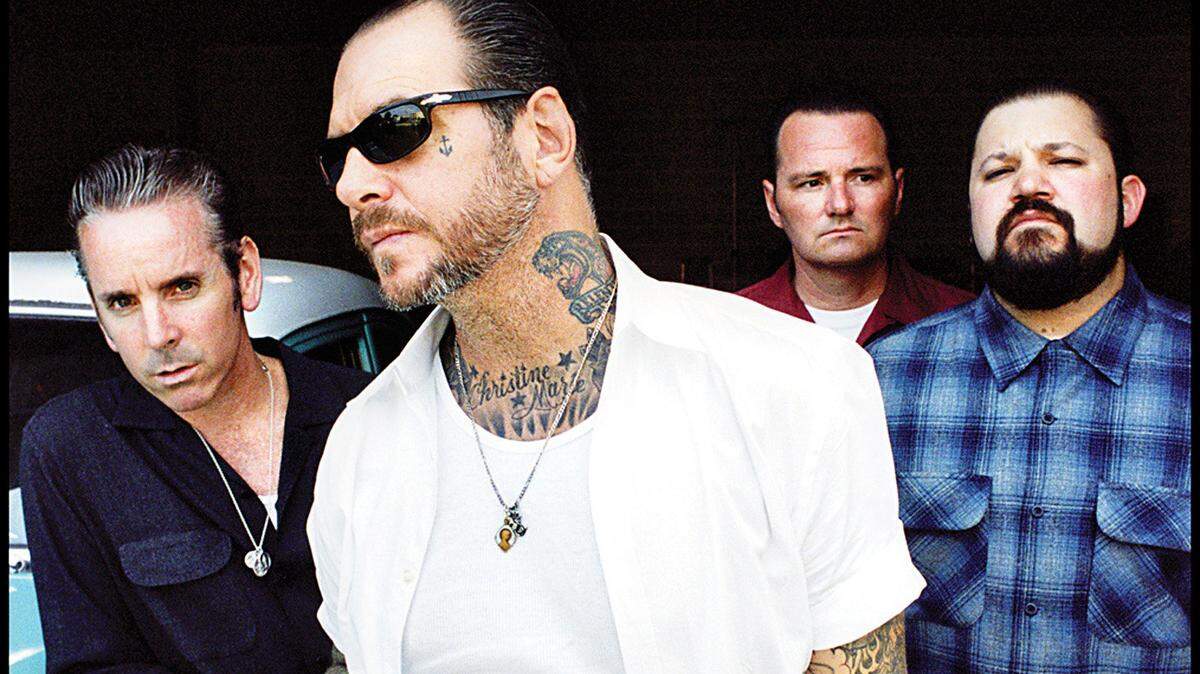
Social Distortion frontman Mike Ness is a survivor.
Over the past three decades, he’s gone from troublemaking teenager to heroin-addicted rock star to clean-and-sober father of two. He’s spent stints in jail and rehab, and dealt with the death of his childhood friend and band mate, guitarist Dennis Danell.
“As bad as things ever got there was always a part of me that was positive and optimistic,” said Ness, the sole remaining member of the pioneering punk band. “It was like, ‘What else am I going to do?’ I just never accepted ‘no’ as an answer.”
On Sunday, Social Distortion performs at the Pozo Saloon alongside alternative rock band Toadies and alt-country crooner Lindi Ortega.
Formed in Orange County in 1979, Social Distortion released its debut album, “Mommy’s Little Monster,” in 1982 following its first cross-country tour with Southern California punk band Youth Brigade — chronicled in the 1984 documentary “Another State of Mind.” But Ness’s struggles with drug addiction forced the band to go on hiatus in 1985.
Following the release of 1988’s “Prison Bound,” Social Distortion signed with Epic Records and released three well-received albums: 1990’s “Social Distortion,” 1992’s “Somewhere Between Heaven and Hell” and 1996’s “White Light, White Heat, White Trash.”
The band suffered another setback when Danell died of a brain aneurysm in 2000.
Social Distortion’s current lineup — Ness, guitarist Jonny Wickersham, bassist Brent Harding and drummer David Hidalgo Jr. — appears on 2011’s “Hard Times and Nursery Rhymes.”
According to Ness, the album showcases Social Distortion’s unique blend of punk, country, rockabilly and the blues.
“By the mid-’80s, (punk) was really starting to stereotype itself. I didn’t want any part of that,” Ness recalled. “That’s when I started thinking, ‘I’m an American. I really need to grab ahold of my American roots.’ ”
He sees punk rock as part of a musical progression that dates back to folk legend Woody Guthrie and jazz icon Billie Holliday.
“This is working-class music about working-class issues. It’s very honest and heartfelt,” said Ness, who explored his roots in two solo albums, “Cheating at Solitaire” and “Under the Influences.” “Yeah, (punk) might be louder or faster or more snotty, but it’s the same as blues or country.”
Below, Ness talks about his personal path to punk stardom.
Q: Musically, you’ve always been rooted in rock and the blues.
A: I grew up with a lot of that stuff. At 4 years old, I was listening to the radio. By third grade, I had albums by The Beatles, The Rolling Stones, Creedence Clearwater Revival. That ’60s, ’70s rock was embedded in me long before I heard the (Sex) Pistols or the Ramones.
Q: What attracted you to the Southern California punk scene? A: At first it was the music, but it was also the lifestyle — what ultimately almost killed me. I think (the punk lifestyle) had a lot of false promises similar to the gang lifestyle: You don’t have to work. You can be violent. You can destroy stuff. You can do whatever you want.
Coming from where I grew up, it was what I needed at the time. I had suppressed a lot of feelings over a lot of years, and now I had an outlet to express them.
Q: When did you realize that lifestyle was poisonous?
A: It was after I got cleaned up. Once I realized that I could do music and stay clean, it was a big deal. (Music) was so hand-inhand with destruction that I really thought Imight have to give it up.
I just realized that if I wanted to do this, I had to be serious and look at it as a job and practice and write and tour and give people 150 percent every night. It’s just stayed that way.
Q: How have your audiences changed over the years? Are you seeing more grey hairs and beer bellies in the crowd?
A: I try not to think about that (laughs). I love the diversity in that crowd. We’ve always had skaters and surfers and college kids. I get firemen, I get police, I get outlaw bikers — this incredibly wide spectrum of fans from the age of 5 to 70.
For me, punk is not now what you look like on the outside. Punk is rebellion and it’s something that comes from the inside. I have friends who are corporate lawyers who are more punk than any street kid I’ve ever met.
Q: You’re a good example of that dichotomy between public persona and private life. You’re this tough tattooed guy, and yet
A: I’m a vegetarian who has three Chihuahuas, who does yoga and boxes.
Somewhere along the line, I realized that if I cared about what people thought, I’d still be pushing a mop. I’m not worried about my masculinity. I do know the difference between the things that make you a real man and the fallacy of what people think make you a man.
Q: Do you think your 17-year-old self would grasp that distinction?
A: When you’re 17, you’re looking at life through a straw. You can’t see anything outside that little pinhole. I think that 17-year-old kid would like the 51-year-old me.
Q: What keeps Social Distortion going after 30-plus years?
A: We all love what we do, whether it’s touring or writing or recording. There are times when I look at these guys in the middle of a set and I see (they) would be doing it if we were making 20 bucks a night.
That’s what separates “guys in bands” and true musicians. Guys in bands are the first to bail out when the going gets tough.
Reach Sarah Linn at 781-7903.
This story was originally published May 17, 2012 at 6:13 AM with the headline "Southern California's Social Distortion to play at Pozo Saloon this weekend."