
Local pelican named Morro makes big-screen debut
About three decades ago, Bay Area filmmaker Judy Irving journeyed to the Central Coast to capture a scene described by the Los Angeles Times as “the Normandy Invasion of civil protests.”
As thousands of protesters flocked to the entrance of the Diablo Canyon nuclear power plant, “We filmed people being arrested at the front gates and handcuffed and put in buses and driven off to (Camp San Luis Obispo),” recalled Irving, who featured the footage in her Emmy Award-winning documentary about nuclear power, 1983’s “Dark Circle.” “It was one of the more intense experiences I’ve ever had in my life.”
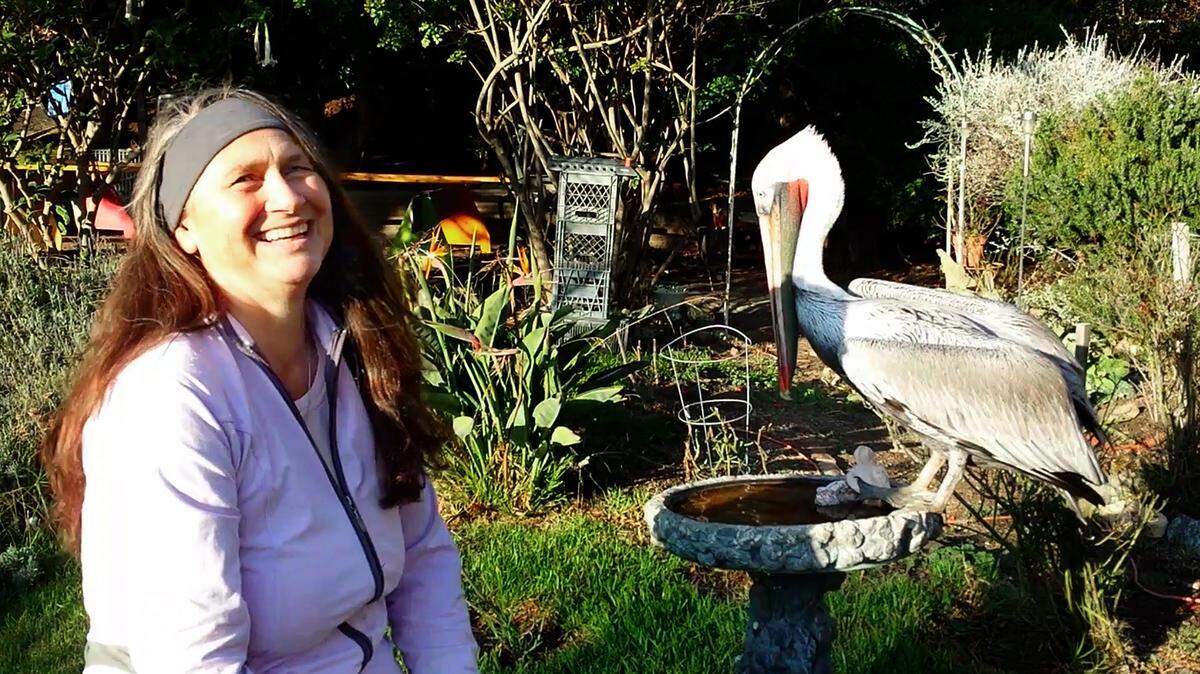
Irving, best known for her indie hit “The Wild Parrots of Telegraph Hill,” recently returned to San Luis Obispo County to shoot footage for her new documentary “Pelican Dreams,” a soaring love letter to the California brown pelican. She’ll attend two screenings of the movie at the Palm Theatre in San Luis Obispo — accompanied on Saturday by Morro the pelican and his Cayucos caretakers, Bill and Dani Nicholson.
Irving spotted her first brown pelicans at age 5 while visiting her grandparents in Florida, watching as the birds dived headlong into the ocean waves in pursuit of their prey.
“I really loved them because they looked so weird,” she recalled, resembling “flying dinosaurs” with their massive bills and wide wingspans. “They could soar so gracefully and yet be so clumsy on land. They had both an elegant and a comical aspect.”
Over the years, the filmmaker’s fascination with the ungainly seabirds grew.
In fact, she started work on a pelican documentary in 1998 but put the project on hold to make 2003’s “The Wild Parrots of Telegraph Hill,” which chronicles the relationship between San Francisco street musician Mark Bittner and the flock of feral parrots he cares for. An arthouse smash, the movie spawned a book, a DVD and even a marriage; Irving and Bittner wed in 2007.
Then an avian misadventure put Irving back on track.
On Aug. 10, 2008, a 4-month-old California brown pelican landed on the roadway of the Golden Gate Bridge, snarling traffic before being captured by Bridge Patrol and transferred to the International Bird Rescue Research Center in Fairfield. Rescuers named the tired, hungry and disoriented bird “Gigi,” after “Golden Gate.”
“I made a bunch of phone calls … found out where Gigi had been taken, and I followed her,” Irving said. “I was able to film her going into human hands from the wild.”
Gigi’s journey to recovery became the basis of “Pelican Dreams,” written, directed, produced, shot and edited by Irving. The documentary, which includes interviews with scientists, fishermen and rehabilitation experts, also explores California brown pelicans’ breeding habits, migratory patterns and the many challenges that threaten their survival — from pesticides to abandoned fishing lines and hooks.
In addition to Gigi, “Pelican Dreams” introduces viewers to Morro, a California brown pelican who spends his days in the bustling “bird yard” at the Nicholsons’ Cayucos home. Likely born in Baja, Mexico, where the majority of California’s pelicans come from, he was found with an injured wing in Morro Bay, Dani Nicholson said.
“Pelicans just really grabbed my heart. I love them the most of all the birds,” said the former Pacific Wildlife Care president, who ran the Morro Bay rehabilitation center for five years. She now volunteers as a Pacific Wildlife Care educator and rehabilitates dozens of baby songbirds at her home each spring.
Asked what makes pelicans so special, Nicholson described the birds as “cool customers” whose laidback attitudes invite a deeper connection.
“They just hang out. They look at you like they’re curious about you,” she said of her feathered friends. “It allows you to have a relationship with them.”
Irving jokingly describes herself as Morro’s aunt. “I just do really adore that bird,” she said.
According to the filmmaker, making “Pelican Dreams” turned her into an even bigger pelican fan.
“I just have tremendous respect for them … (and) what they go through to survive,” she said.
By watching “Pelican Dreams,” Irving hopes audiences will gain a similar “appreciation for these ancient, charismatic birds … and become motivated to help them out a little bit,” she said, by protecting coastal areas from overfishing, pollution and habitat destruction. “There’s a lot of things people can do to make life easier for pelicans along our coasts.”
This story was originally published November 13, 2014 at 7:15 PM with the headline "Local pelican named Morro makes big-screen debut."