
Hollywood insider opens film, TV production studio in Creston
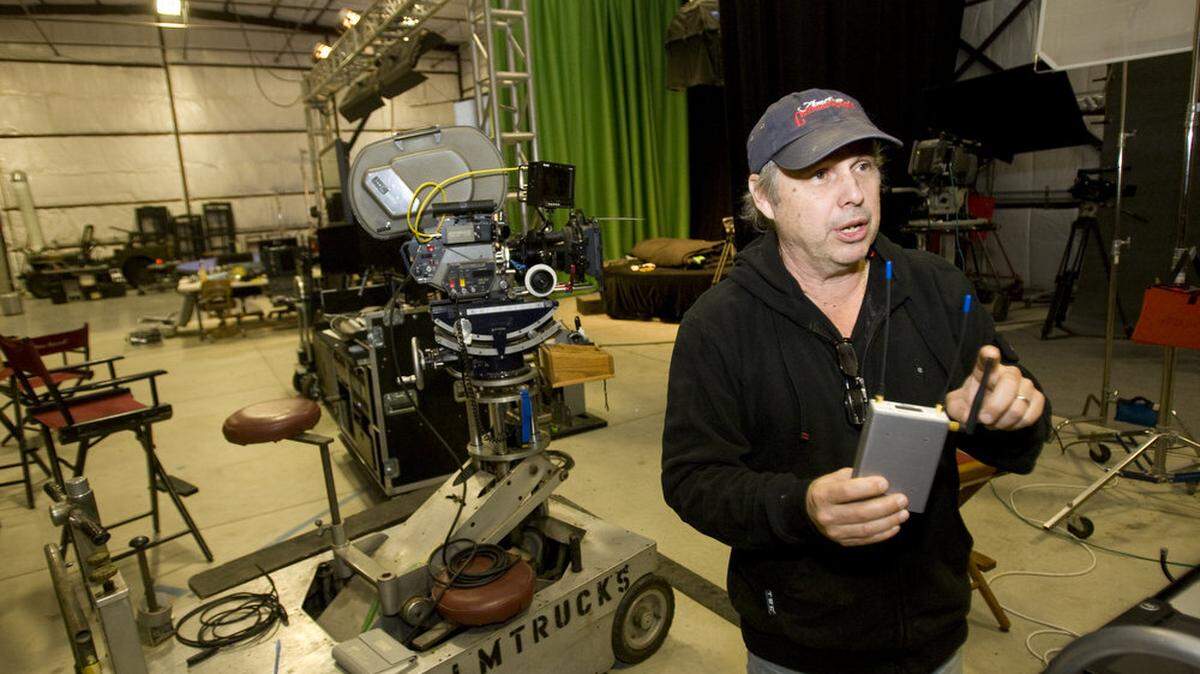
By his own admission, Todd Fisher grew up on the bustling back lots of MGM Studios.
The son of “Singin’ in the Rain” star Debbie Reynolds and pop singer Eddie Fisher, the fledgling filmmaker spent much of his childhood hanging out behind the scenes with his sister, “Star Wars” actress, author and screenwriter Carrie Fisher.
“My sister says that she and I are the product of Hollywood in-breeding,” Todd Fisher, 56, joked. “That’s because all we think about is making movies.”
These days, Fisher is putting his lifelong love of cinema into practice as chief executive officer of the Hollywood Motion Picture Experience (HMPE), a film and television production company with state-of-the-art facilities in Las Vegas; Ennis, Mont.; and the Central Coast.
Situated on 44 acres of rolling Creston ranchland, Fisher’s Freedom Farms encompasses a 6,000-square-foot sound stage and a 10,000-square-foot support building housing offices, workshops, editing bays, a recording studio and hair, makeup, wardrobe and prop departments.
Fisher estimates the entire Creston operation is worth $6 million to $7 million, plus about $3 million of equipment. And the solar-powered complex could expand as the production company grows.
“We want to bring filmmaking to this area in a bigger way,” said Fisher, who is seeking local talent to work on HMPE’s first feature film, “Emerald Bay.” Principal photography is scheduled to begin in April at locations across the Central Coast, including spots in Morro Bay, Paso Robles and San Luis Obispo.
“Why not be in Paso Robles?” HMPE cinematographer Roy Wagner asked. “It has a moderate climate. It’s absolutely gorgeous. It’s everything that Hollywood used to be.”
A life behind the scenes
Unlike his scene-stealing sister, Fisher said he’s always preferred to stay behind the camera.
At age 7 or 8, he remembers arriving on the set of the 1969 TV movie “Debbie Reynolds and the Sound of Children” and spotting his friends in the crew.
“I immediately started to walk in the midst of the production— as I normally would do — and I was stopped,” he recalled, and whisked away to the actors’ trailer with the rest of the young cast members. “I’m looking out the window at all the fun. The guys are out there with the special effects and the cameras and the lights and I’m saying, ‘Well, that’s where the action is.’…
“It was like I was another piece of equipment. (I thought) ‘I don’t want to be a piece of equipment. I want to work with the equipment,’ ” he said. “That was my epiphany right there.”
Fisher, who attended Beverly Hills High School and the Southern California Institute of Architecture, has a handful of acting credits.
But he’s spent most of his career behind the scenes as a camera operator, sound engineer, writer, director and producer. He was trained by mentors including cinematographer Harry Stradling Sr. and director George Sidney, namesake of the San Luis Obispo International Film Festival’s independent film competition.
“They knew how to pass down information and passion about the craft of making film,” Fisher said.
Fisher lived in Beverly Hills until 1988, when he and his late wife, artist Christi Fisher, headed north in search of a new home.
“We wanted to raise our children in a place that didn’t have the L.A. vibe,” he said, a location with cheap land and plenty of water. They eventually found what they were seeking in rural North County.
These days, Fisher divides his time between Las Vegas and Creston, where he has a 7,800-square-foot home. He shares the Central Coast ranch with his wife, “One Life to Live” actress, celebrity hypnotist and self-help author Catherine Hickland. (She’s also the creator and chief executive officer of Cat Cosmetics.)
But Freedom Farms is more than a rural retreat.
In 1998, Fisher built a 10,000-square-foot facility to house his mother’s collection of Hollywood memorabilia — costumes, props and other cinematic treasures valued at about $30 million. Those items, which included Judy Garland’s ruby slippers from “The Wizard of Oz” and the white dress worn by Marilyn Monroe in “The Seven Year Itch,” were moved to the ranch after bankruptcy forced the actress to sell her eponymous Las Vegas hotel.
In 2004, Fisher added Stage 32, a sound stage dedicated to producing commercials, television specials and other projects for the nonprofit corporation he and his mother formed, the Hollywood Motion Picture and Television Museum. (The building’s name is a tribute to MGM Studios, which once had 31 sound stages.)
Plans to build a museum in Los Angeles, and then in Pigeon Forge, Tenn., eventually fell through and the collection was sold in a series of three auctions ending in May 2014.
Re-inventing the Hollywood studio system
“When it became apparent we weren’t doing the museum, we decided to rebrand the whole company back to film production, which is what we all know best anyway,” Fisher said. He’s joined forces with a team of Hollywood professionals that includes Wagner, producer Emmett Alston, composer Henry Cutrona, editor Dustin Ebsen and screenwriter Jon Nappa.
Their goal, Fisher and Wagner said, is to get back to the classic Hollywood studio system — when a handful of producers oversaw hundreds of productions each year, relying on a small in-house army of actors, screenwriters, set builders and other craftspeople.
“If somebody had the idea to make a project, they had all the materials and personnel to make it. It was astonishingly simple,” Wagner said. “Now, basically, you assemble a new studio every time you make a project.”
With HMPE, Fisher hopes to recapture that old entrepreneurial spirit while taking advantage of everything modern movie-making can offer. “I make movies the old-fashioned way … but I employ all the new technologies we can,” he said.
Whether Fisher’s strategy works remains to be seen, independent film producer Glenn Williamson said, but he admires Fisher’s ambition in attempting to revive “a paradigm that worked a really long time ago.”
“I love the idea of what he’s trying to do,” said the producer, a lecturer at the UCLA School of Theater, Film and Television. “I hope he’s extremely successful.”
Through his Los Angeles-based production company, Back Lot Pictures, Williamson has produced such films as “Hollywoodland,” “Sunshine Cleaning” and “Happythankyoumoreplease.” He also worked as a senior production executive at DreamWorks Studios, where he supervised movies including “American Beauty,” “Road to Perdition” and “Almost Famous.”
“Every film has the same two challenges, which is not enough money and not enough (production) days,” Williamson said. “It’s the same with a budget of $2 to $3 million or a budget of $100 million.”
“The biggest challenge for anyone is developing really good scripts that make really good movies,” he added, particularly ones that appeal to wider audiences. If HMPE is able to keep overhead costs low while maintaining a full slate of projects in the pipeline, Williamson said, “That sounds like a sound plan.”
Getting underway with family drama
HMPE’s first major undertaking is “Emerald Bay,” a family drama budgeted for $2 million to $3 million.
According to producer Irene Gottlieb, the film follows a troubled teenage girl who rescues a Central Park carriage horse, hides it in her barn and helps it heal. Later, she discovers the horse, Emerald Bay, is actually a champion jumper whose owners put it out to pasture to collect insurance money.
Although the story was originally set on the East Coast — the initial script was penned by New Haven, Conn., equestrian Paula Kennedy and her husband, attorney Francis Harrigan — Nappa has adapted “Emerald Bay” for a Central Coast setting.
To produce “Emerald Bay,” HMPE is teaming up with a Chinese company, Qingdao Three Crown Film and Media Co., which will distribute the film in Asia. (HMPE will handle domestic distribution.)
Hongxin Fu, president of Qingdao Three Crown Film and Media Company, explained his interest in “Emerald Bay” through an English-speaking interpreter.
“I really like this story because it’s about the (relationship) between animals and humans and the environment,” Fu said, explaining that the movies he makes in China center on similar themes.
Fu added that he wants to showcase the Central Coast’s beauty and to promote cultural understanding between his country and the United States. “Compared to other media formats, film is the most popular way in China for younger people to see the world,” he said.
Like Fu, Fisher considers San Luis Obispo County an ideal place to make movies. In fact, he’s been talking to Josh Machamer, chair of Cal Poly’s Theatre and Dance Department, about creating a partnership between HMPE and the school that would enable students to gain experience in the cinematic arts.
“What we’re looking to do is find talent in the area,” Fisher said. “I want to find the other artists in this region so I don’t have to draw on L.A. for the larger production work.”
According to Fisher, each project on HMPE’s current five-film slate has the potential to generate 50 jobs – from electricians to script supervisors to prop masters. He’s brought aboard two local equestrians as consultants on “Emerald Bay”: Olympic medalist Gina Miles of Creston and Atascadero resident Donna Marie Cheek, the first black member of the U.S. Equestrian Team.
Also in the works for HMPE is “813 Greenway,” a coming-of-age movie inspired by Fisher’s own upbringing. The title refers to his family’s former address in Beverly Hills.
“Part of the reason you leave L.A. is to do away with the traffic and all the bureaucracy,” Fisher said. “You come to a community where people understand and appreciate what you’re doing. And they want to produce (movies) in the community in a way that benefits everything and shows off the lifestyle.”
This story was originally published February 28, 2015 at 8:40 PM.