Atascadero defenders surround Arroyo Grande running back during an game in October.
Joe Johnston
jjohnston@thetribunenews.com
With its theatrical release on Christmas Day, “Concussion” was the exclamation point on a year in which the talk and media attention surrounding head injuries and football reached a deafening tone.
A new state law that took effect at the beginning of this year limits the length and frequency of full-contact football practices at the high-school and middle-school levels in a continued effort to reduce concussions and other head-related injuries — part of a nationwide trend.
In light of the new law and Lindsey’s injury, The Tribune asked high school coaches in the county and officials at Templeton High School whether they believe further changes are needed.
Templeton High
Templeton High School athletic director Lindsay Campana and other athletic directors said local high schools carefully reviewed player safety after Lindsey was injured and eventually diagnosed with second impact syndrome, meaning that he had sustained a previously unknown concussion and was playing without being completely healed from it.
Campana said last week that in the moments following Lindsey’s injury, “things just went really right, as right as they could.”
Campana said Templeton assistant coach Tim Alvord noticed something was wrong with Lindsey, as did Templeton trainer Shelby LaMendola, and she had team doctors call 911. Meanwhile, several members of the Fire Department who volunteer to oversee every game worked to stabilize Lindsey on the sideline. Campana credited LaMendola for helping to pin down a plan that would expedite those emergency situations.
“We did talk about making sure that we had more physical access to the field,” Templeton principal Kari Fisher-Gibson said of the aftermath. “Not only making sure the fire lane is cleared, but we had some bleachers that weren’t used very often. We had those removed to make sure there is even more room.”
Campana said she shared information about what went right and what could be improved with other athletic directors in the county, and she added that most schools already use similar methods.
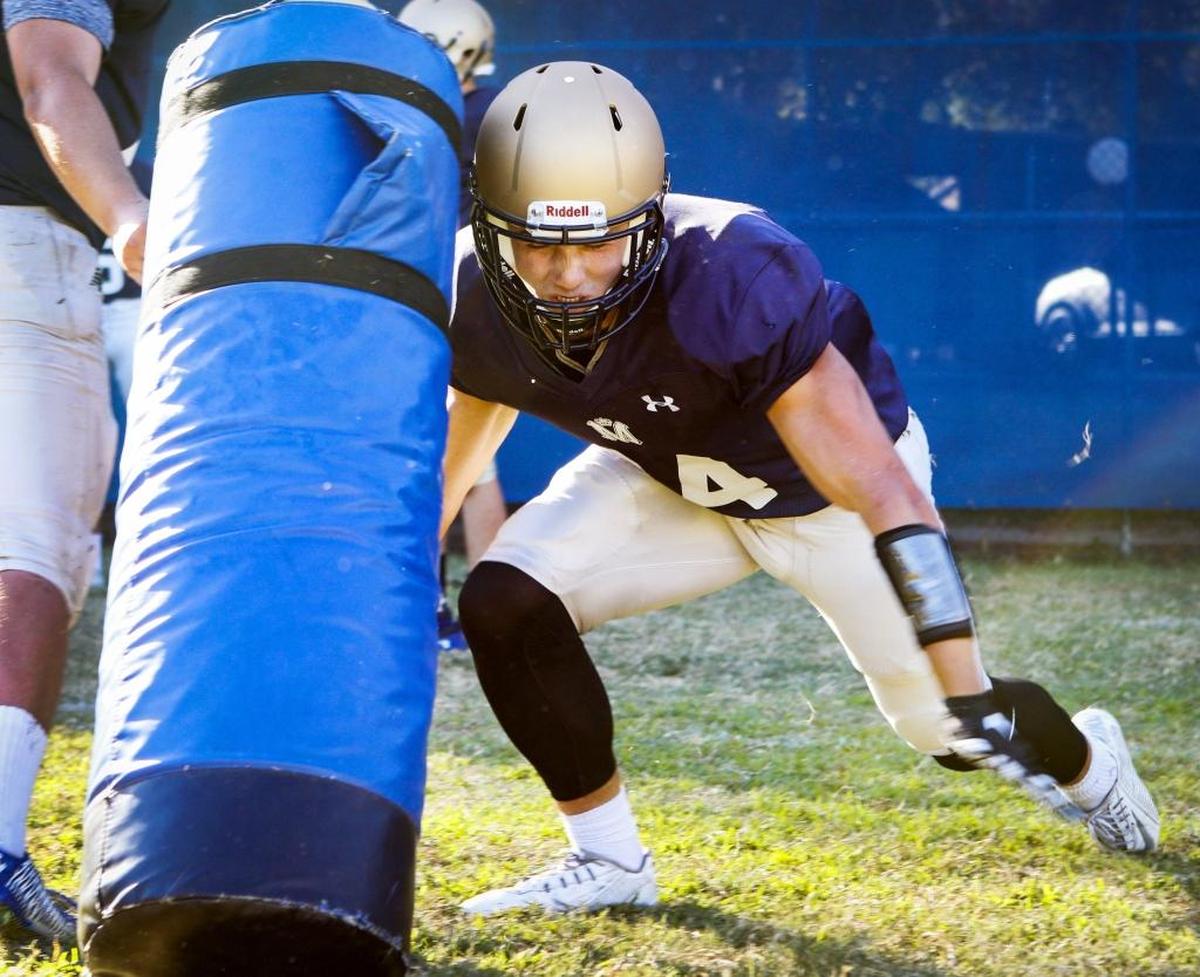
Patrick Miller hits a tackling dummy during a Mission Prep football practice. Joe Johnston jjohnston@thetribunenews.com
Athletic trainers
All eight major San Luis Obispo County high schools — San Luis Obispo, Mission College Prep, Paso Robles, Templeton, Morro Bay, Arroyo Grande, Nipomo and Atascadero — have trainers on their campuses daily, but that’s not the case for many schools in the state.
In an interview with Sports Illustrated, Roger Blake, executive director of the California Interscholastic Federation, the governing body for California high school sports, said that only 19 percent of athletic programs have daily access to a trainer.
“We listen to research, and we move swiftly,” Blake told Sports Illustrated. “It has been a tragic year with eight deaths. And although many might say that this is down from how many football-related deaths there were 10, 20 years ago, if that player is a player in your community, or your son, one is too many.”
Campana said that LaMendola’s daily presence at Templeton improves player safety, especially when it comes to concussions, because LaMendola knows the students well enough to detect changes in personality.
But even with trainers at games and practices,players must strive to prevent injuries and secondary injuries.
“Shelby saved Isaac’s life that night,” Isaac Lindsey’s mother, Jenny Lindsey, said recently, “but a lot of kids don’t want to tell Shelby about an ankle pain or a bump or a bruise, because she might take them out. Kids need to realize she isn’t always going to take them out. She might say, ‘OK, you have a headache, but I ran all the concussion protocol and you’re fine. When’s the last time you ate?’ ”
“Isaac’s concussion could have been the same game, could have been practice, could have been a game before,” she said. “We don’t know.”
It is not impossible for a concussion to go unnoticed by the player. It is believed to have happened to NFL running back Bernard Pierce, a member of the Jacksonville Jaguars. Pierce blocked an opposing player the wrong direction during a game and was later diagnosed with an unrecognized concussion. In an effort to prevent occurrences like this at Templeton, Campana says that LaMendola has employed an “equipment buddy system.”
We just need to start looking at self-preservation ahead of being tough and being strong and playing through injuries.
Jenny Lindsey
Isaac Lindsey’s mother
“Kids pick each other that they know very well and while they are on the field with helmets on, they can help identify issues, if someone isn’t looking right,” Campana said, adding that teammates help point out problems with all equipment.
Campana and Jenny Lindsey said seeing NFL players like Ben Roethlisberger of the Pittsburgh Steelers, who self-reported a concussion this season, will help players feel more comfortable about being honest with parents, trainers and coaches. In a study published by the American Academy of Pediatrics in October 2012, 32 percent of high school football players reported that they had experienced symptoms of concussion but did not pursue medical attention.
Even when athletes are diagnosed with a concussion by a doctor, many want to rush back.
Campana said that one of the biggest parts of her job includes telling athletes that “the doctor’s note does not clear you for participation, it clears you to start your graduated return of play, which has to be at least seven days, no less.” Before the new law was introduced, the graduated time of return was five days.
“We just need to start looking at self-preservation ahead of being tough and being strong and playing through injuries,” Jenny Lindsey said. “All they want to do is play. If they say they have a headache, they don’t want other kids to go, ‘Oh, you’re being a baby.’ They don’t want to lose their position if they have to sit out for a couple weeks.”
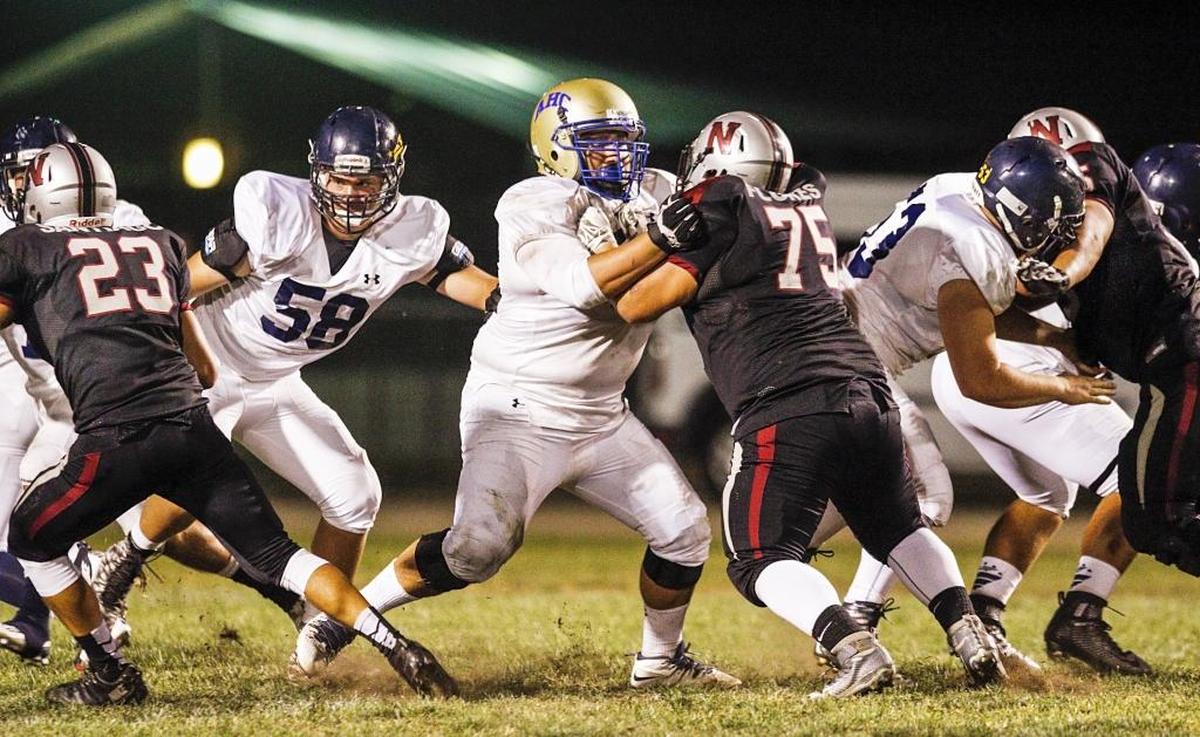
Danny Shiraishi, center, goes up against Nipomo’s defense wearing a borrowed helmet from Allan Hancock College after a crack was found in his normal helmet. Joe Johnston jjohnston@thetribunenews.com
Local coaches
Two weeks after Isaac Lindsey’sinjury, Arroyo Grande football coach Tom Goossen ordered a midseason check of each helmet.
The result: A previously undetected crack was found on the ear hole of the helmet of senior offensive lineman Danny Shiraishi one day before a game against Nipomo. The helmet was sent away for repairs, and Shiraishi wore a helmet on loan from Hancock College during the game.
“Those are the little things you can do that hopefully will protect kids as much as possible given the sport they have chosen to play,” Goossen said.
Heading into next season, Goossen said he will look at the possibility of cutting back practice hitting at a level below the time mandated by law. According to Assembly Bill 2127, which took effect Jan. 1, 2015, full-contact practices can be held only twice a week during the regular season and preseason, and they cannot exceed 90 minutes on a single day. In addition, full-contact practices in the offseason are prohibited.
“We will probably start off with the allowable number of practice hours, then as the season progresses, cut back to where we don’t even wear shoulder pads,” Goossen said.
All of the coaches The Tribune spoke to said the new law limiting practice didn’t effectively change their practices, noting that they were already headed in the direction of less hitting.
“The school of thought has shifted,” said San Luis Obispo High coach Pat Johnston, who was on the opposite sideline when Isaac Lindsey was injured. “Decades ago, it was believed that you want to toughen guys up as much as possible. You still do, but the newer school of thought and what most coaches will tell you nowadays is that they would much rather have their team fresh for Friday nights.”
If we aren’t looking at doing more, we are doing a disservice to kids.
Tom Goossen
Arroyo Grande football coach, on efforts to keep players safe
At Mission Prep, players practiced tackling techniques on padded dummies in preseason drills and eventually won a Northern League title. Nipomo coach Tony Dodge said that just one player sustained a concussion on his team this season.
“You just have to repeatedly teach correct technique,” Dodge said, adding that the challenge is making sure that players are practicing at full speed, whether there is hitting or not. “Injuries occur when you’re not going full speed and someone else is.”
For the past six years, Sierra Vista has funded preseason, baseline concussion testing for nearly all high school student-athletes participating in impact sports at all public county high schools, as well as Mission Prep and Orcutt Academy, according to Sierra Vista Regional Medical Center spokesperson Ron Yukelson. San Luis Sports Therapy administers the tests and keeps the database, Yukelson said.
“Because of this protocol, high school student-athletes in San Luis Obispo County have a baseline exam each season on record that can be helpful in returning, or not, to the field of play any athlete who sustains a concussion,” Yukelson said.
However, there is no database that tracks how many concussions occur locally, so the total number of head injuries that were diagnosed this season is unknown. About half of the estimated 1.1 million kids who played high school football nationwide in the 2014-15 season were injured, with 25 percent of those injuries being concussions, according to the National High School Sports-Related Injury Surveillance Study.
On Aug. 25, Twin Cities Community Hospital hosted a preseason sports injury clinic attended by nearly 60 coaches, athletic directors and athletic trainers under the direction of Dr. Mark Kowall, a Templeton-based orthopedist, and LaMendola. Topics included signs, symptoms and treatment of sports-related injuries, concussion identification and game protocols.
Goossen said that in doing research after Lindsey’s injury, he found that researchers at Orlando Health have developed a blood test that can detect signs of a concussion in children, correctly identifying the presence of TBIs 94 percent of the time in a recent study. But the technology may not be available for a few years.
“Just because it has been done this way for 50 years, doesn’t mean it has to continue to be done this way,” Goossen said. “We need to look in the future, we need to look to protect kids even more than we do now.”
“If we aren’t looking at doing more, we are doing a disservice to kids.”
After hearing of his death, Jenny Lindsey reached out to the family, and they shared their experiences. Lindsey knows her family could have been in the Schemm family’s shoes.
“If your kid comes home with a headache or a sprained ankle, whatever it may be, maybe they should sit out anyway,” Lindsey said. “It didn’t happen with Isaac, but a lot of times parents encourage them to play through it.”
Parents should strive to be the trainer at home, she added. “Notice everything, not just what happens in practice or on Friday night when everybody is looking.”
Isaac Lindsey’s doctors recommend resources like MomsTeam.com, Brainline.org and CDC.gov/headsup for further education on brain and other sports injuries, Jenny Lindsey said.
“There’s some good things to learn from Isaac’s injury,” she said. “There are so many good things that we are starting to do right with concussions and TBIs, but there is still a lot more that we can do.”