
Concussions in high school football are not uncommon
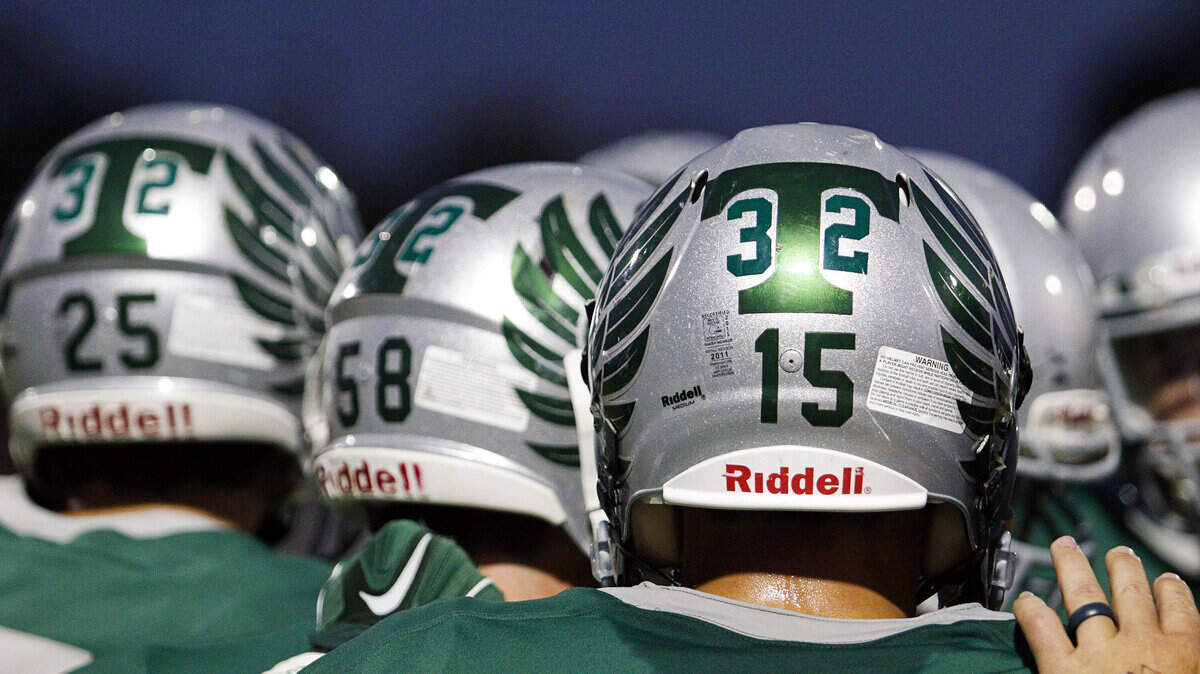
While the life-threatening brain injury that Templeton High School football player Isaac Lindsey suffered on the playing field less than two weeks ago shocked the community, serious head injuries are not rare in high school football.
About half of the estimated 1.1 million kids who played high school football in the 2014-15 season were injured, with 25 percent of those injuries being concussions, according to the National High School Sports-Related Injury Surveillance Study.
Head injuries on the field can also turn deadly, although rarely.
Five high school players died last year, all of them from head injuries sustained during practice or games, according to the National Survey of Catastrophic Football Injuries compiled annually at the University of North Carolina at Chapel Hill.
“Concussion is always serious,” said Dr. Robert Cantu, a leading national expert on sports-related brain injuries and medical director of UNC’s National Center for Catastrophic Sports Injury Research.
“The most important thing is for the kids to be educated to know what a concussion is, how to recognize it, and to know that if they play with one, they are risking death,” he said Monday.
A concussion happens from a blow to the head or body or from a fall that shakes the brain so that it bangs against the inside of the skull. The person may or may not lose consciousness. With proper rest, a single concussion won’t cause permanent damage.
But suffering a second concussion or head injury before the first one has healed can cause permanent disability or death, warns the American Association of Neurological Surgeons.
That may be what occurred with Lindsey. The family has declined to be interviewed, but in describing her son’s injury on Facebook, Jenny Lindsey wrote “we believe that Isaac simply played through what he thought was a mere headache or minor injury.”
It’s not unusual for football players to say nothing when they’ve been injured. A 2012 study by the American Academy of Pediatrics found that 32 percent of high school football players didn’t report concussion symptoms.
Cantu said he’s seen this at every level of play, from kids to pros.
“They don’t want to lose their place on the team, or piss off their coach, or be considered wimpy by their team,” he said. “They don’t understand the symptoms, the dangers and the consequences” of continuing to play with a head injury.
Cantu is no stranger to the issue. A clinical professor in the department of neurosurgery at Boston University School of Medicine, Cantu is co-director of its CTE Center, the leading research center analyzing the brains of deceased NFL players. He also is senior adviser to the NFL Head, Neck and Spine Committee.
He is author of the book “Concussions and Our Kids,” published in 2012.
Continuing to play injured puts a football player at risk for second impact syndrome, which happens when a player gets a second concussion before completely recovering from a previous one. Cantu says regulation of blood flow in the brain is disrupted, causing more blood to flow in than out. Acute brain swelling occurs, which can have fatal or disabling consequences.
The player may come off the field and collapse after what may have seemed to be an unremarkable play, Cantu said.
“The last impact that causes the collapse is often trivial,” he said. The previous concussion may have happened before the game or earlier in the play.
“It can happen in the same game,” he said. “There are cases of individuals not being symptomatic before the game.”
Players may feel a sense of confusion, ringing ears, dizziness, headache, vision problems or other symptoms with that first concussion.
Concerns about concussion and second impact syndrome in youth football led the Centers for Disease Control to launch the Heads Up program a decade ago, which initially focused on helping healthcare providers diagnose and treat concussion before shifting attention to coaches, players and their families.
Even the name promotes the best way for players to avoid brutal head-to-head contact by looking ahead instead of down during play.
“Kids have to learn not to use the head when blocking or tackling,” said Cantu. “Use your shoulder, back people up with your arm, use a bear hug. This is easier said than done, but it can be learned.”
Youth sports coaches need to limit the number of full-contact practices, just as professional teams have done, Cantu said. In the NFL, players have no full-contact practices in the offseason and set limits of 14 full-contact practices out of 18 weeks during the season — “less than one per week,” Cantu noted. “High schools often can have full-contact practices two or three times a week.”
Learning safe and effective tackling and blocking techniques can be taught using dummies and other training methods, he said.
“Football is a sport that will never be safe,” Cantu said, “but it can be made safer.”
Symptoms of a concussion
- Prolonged headache
- Vision disturbances
- Dizziness
- Nausea or vomiting
- Impaired balance
- Confusion
- Memory loss
- Ringing ears
- Difficulty concentrating
- Sensitivity to light
- Loss of smell or taste
If any of these occur after a blow to the head, a health-care professional should be consulted as soon as possible.
Source: American Association of Neurological Surgeons
This story was originally published September 29, 2015 at 6:22 PM with the headline "Concussions in high school football are not uncommon."