
Cal Poly men’s basketball team heads into Big West play with 6-6 record. What’s next?
With an even 6-6 record heading into conference play, the Cal Poly men’s basketball team is in the best position it’s been in during Mustangs head coach John Smith’s tenure.
“This is the first time the program’s (had a .500 record) in I don’t know how long,” junior point guard Carmen Pierce said. “We’re moving in the right direction. The last two games been tough, but ... I think it’s gonna set us up well for conference, and get ready to make a run for the tournament.”
The Mustangs opened the season with three losses to Division 1 opponents, but bounced back with four wins in a row.
Most recently, the team went on a three-game skid that ended with a win over a non-Division 1 opponent, San Diego Christian.
Defense has been a main pillar to the team in the last few seasons.
The offense, however, has held the Mustangs back.
In four of the team’s six losses, the offense has put up less than 50 points.
There have been flashes of potential including a hot shooting first half against Washington on Dec. 13 and an 82-point performance versus Idaho on Nov. 23, but there’s other times the offense has ground to a halt.
Striking a balance between defense and offense will determine the if the team can finally break into the upper half of the Big West.
Cal Poly struggles with offense
Last year’s leading scorer, Alimamy Koroma, hasn’t found his rhythm on the offensive end.
His scoring is down to 11.7 points per game from 13.3 the previous season.
It’s not Koroma missing shots that’s the issue. His field goal percentage is up to 53%, and he is hitting 77% of his free throws.
Instead, opponents are doubling the center from Sierra Leone in the post to get the ball out of his hands.
Brantly Stevenson has taken advantage of Koroma drawing two defenders. He scored 23 and 20 points respectively against Pacific and Idaho. However, he’s only had one double-digit outing since those two performances.
One way the Mustangs can get easy offense in transition.
For a stout defense, the Mustangs score only 7.5 points per game on fastbreaks, ranking 275th in the country.
Typically teams can turn defensive stops into pushing the ball the other way, but that connection between defense and offense hasn’t clicked.
“Anytime we get stops, we need to be able to put pressure on the rim in the first seven seconds, and we’re not doing that at the level that I would like,” Smith said. “I don’t like to call and control the game and call plays and have them looking at me. I want them to be able to play free flowing and, and be able to read concepts and play out of those concepts.”
The return of junior guard Kobe Sanders could help the team’s transition play. He’s missed the last two games in concussion protocols.
Standing at 6-foot-8 with the mobility of a guard, Sanders is a pesky on-ball defender. He can disrupt opposing players’ vision of the court and create steals, which he leads the team in with 17.
Sanders is also a key component to the other end of the floor.
“You gotta put the defense in peril,” Smith said. “You gotta put them in rotation as much as possible by getting a paint touch or a post touch and ... we struggle with that.”
Mustangs craft defensive identity
Offensive trouble aside, the defense for the Mustangs has remained the identity of the team.
“We definitely have a number of players that have length in athleticism and it affords us the ability to, to guard multiple positions. And anytime you can do that, it, it poses problems for the offense,” Smith said. “We have a great deal of guys that are, are willing. put forth the effort that it takes to, to be a great defensive team.”
The Mustangs rank 77th in the nation in points allowed (64.6). They do so with their activity and staying disciplined with their principles combined with their length across the board.
“If you wanna stay on the court, you gotta defend,” Pierce said. “Everybody wants to play. Everybody wants a shot. So if you want to do that, then you gotta guard.”
The strength of the unit is having multiple long, athletic defenders. Their versatility allows them to employ a switching scheme that slows down opposing offenses.
Switching is sometimes regarded as a lazy scheme, but the Mustangs maintain a high level of activity. Defenders pressure ball handlers and push them away from the middle of the floor.
Off the ball, players are active in help and anticipate skip passes to the weakside of the floor to contest shots.
“We’re just using our length and athleticism to be more so in the gaps and really just stunt and really help each other and just keep the ball in front of you and make people score over the top of us,” Pierce said.
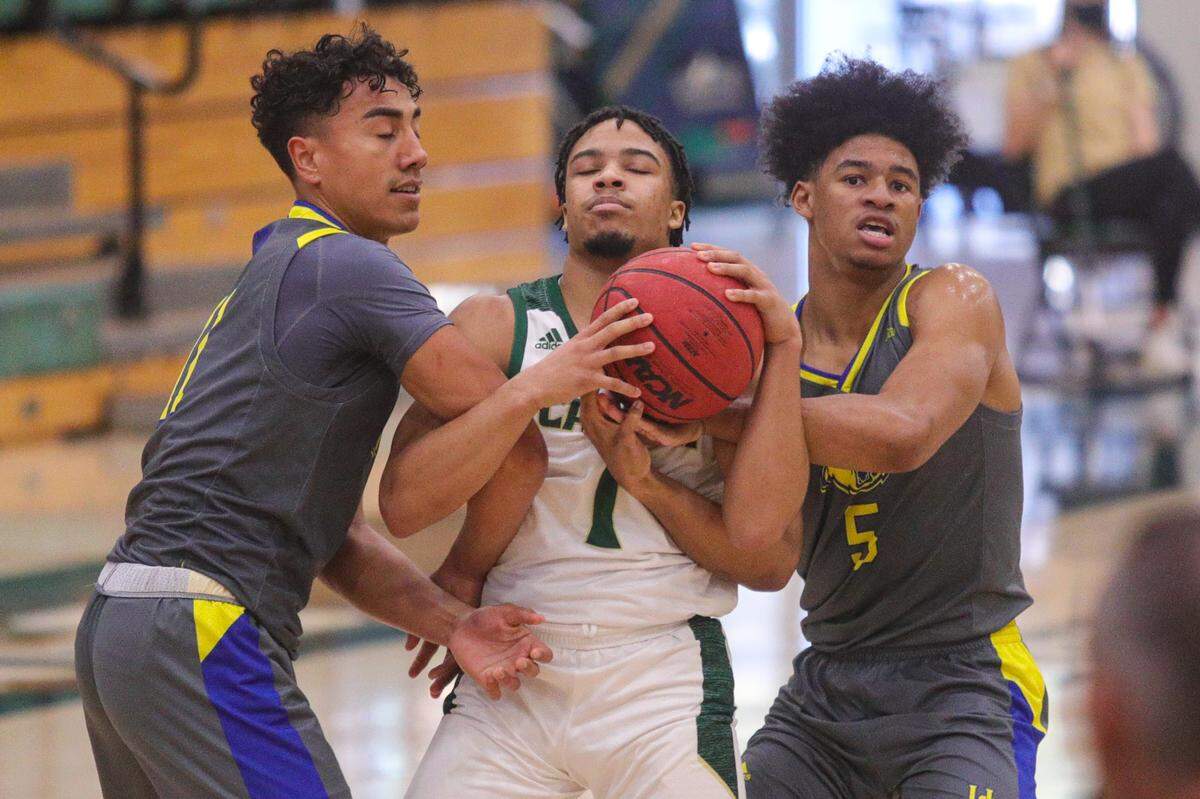
Point guard is crucial to defense
The team has recruited for positional length and athleticism, but there is one player that doesn’t fit the mold: Pierce. He’s still crucial to the Mustangs’ defense.
Pierce hails from Etiwanda High School in Los Angeles, known for its defensive intensity.
“(Etiwanda) is known nationally to be a very good defensive team and that’s why we prioritized taking charges and stuff like that,” Pierce said. “It is something that I’ve always been raised to do.”
What the 5-foot-10 point guard lacks in conventional size and athleticism, he makes up for it with his defensive IQ, strength, and grit.
Those traits show up in his ability to take charges. Pierce has impeccable timing on when to slide over and draw charges on opponent’s whether he’s coming from the help side or guarding on-ball.
In the team’s switching scheme, Pierce is tasked with guarding opposing big men until one of his teammates can bump him off and take the matchup.
Pierce’s job is to not let the opposing big man get deep position in the post. Sometimes the player he is guarding has more than a foot of height on him.
“I’ve always been undersized on the court,” Pierce said. “I’m a lot stronger now too than I was my freshman year, my sophomore year. I’m able to hold off the bigs for a little bit longer than needed. ...
“I don’t care who you are. I don’t care how big you are. I’m, I’m always small, so you’re bigger than me. That’s nothing out the norm for me.”
On the other end of the floor, Pierce leads the team in assists with 28. Pierce can get into the lane out of pick and roll and make plays for his teammates or take floaters over his defender.
As a team, Pierce believes the Mustangs can move with more intent on offense.
“If you gonna set a screen, set the hardest screen. If you’re gonna make a cut, you make the hardest cut. .. You do what you gotta do to get open,” Pierce said. “The little things that we need to do offensively is not, we’re not doing it on a consistent basis.”
Now the Mustangs must build on their defensive foundation to create more steady play.
Cal Poly takes on the Cal State Northridge Matadors at 7 p.m. Thursday at Mott Athletic Center in San Luis Obispo.