
In praise of SLO’s architectural wonders, starting with — what else? — the Madonna Inn
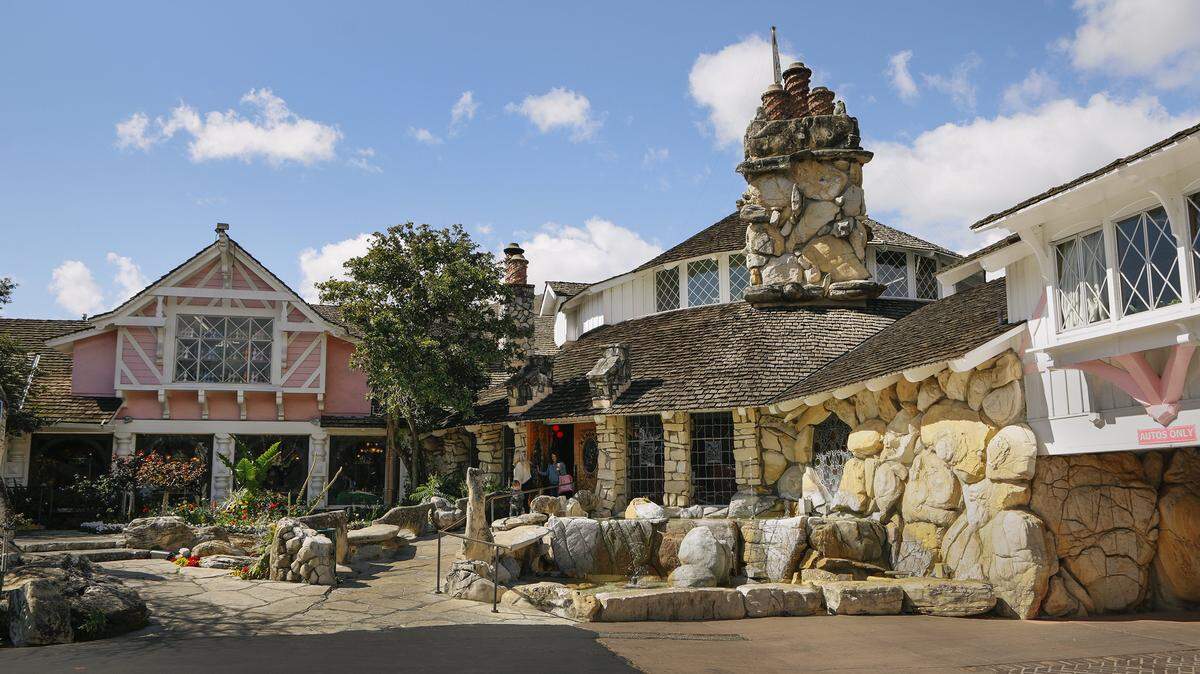
I was thinking of writing a tribute to the brilliant buildings of San Luis, the world one-offs that deserve to take their place on the National Register of Historic Places.
Then, minutes after I was booted from the Cultural Heritage Committee, John Madonna texted his best wishes. John’s proposing a development that the CHC has been a royal pain about, in terms of saving important buildings of the Froom Ranch and keeping them in a historic setting. But John also embodies the honesty, ingenuity and generosity that have made the Madonnas so well loved here and their inn such an institution, and he’s been incredibly responsive to CHC concerns. We ended up at lunch in the coffee shop, one of California’s iconic interior spaces, where he regaled me with stories of how his father created its form and details —nfrom the efficiency of the kitchen axis to the copper table tops from Alex’s own mine. And I remembered it’s not the places or the people but the interplay between them that’s the thrilling thing about architectural history.
“We shape our buildings, and afterwards our buildings shape us,” Winston Churchill said as he called upon the House of Commons to “be restored to its old form, convenience and dignity” after it was destroyed by a German bomb. Churchill attributed the nature of British democracy to the Commons’ oblong shape and opposing benches, which encouraged “the conversation style, quick informal interruptions and interchanges” rather than “harangues from the rostrum.”
The Madonna Inn is a setting for the conversation style, from the coffee shop’s circular counter to the movie-set vistas. Its lines and curves encourage flow, surrounded by eddying inlets. Alex melded three architectural styles that embodied his personality: the “Swiss Homeland” (needle spires and timbering) of his ancestry, the “Ranch House” (low buildings and overhangs) of his childhood and the “National Park Service Rustic” (beams and boulders) of his profession as highway builder. But if Phyllis hadn’t dipped it in pink and decorated every room, Alex’s “super motel” would never have become the favorite of the New York and LA Times and visitors from the world over. It took a quintessentially California couple — one rural nostalgist, the other big city optimist; one hardscrabble, the other with a touch of Hollywood — to shape this masterpiece, a building that shapes everyone who steps inside.
Rob Rossi likes to shock people by saying he’s planning a 70-foot-tall building and painting it pink; then he remembers he already has one. The Fremont was the brainchild of Chicago-born Simeon Levi, who arrived in LA as S. Charles Lee and became one of the great movie palace architects.
His tower-and-auditorium designs spanned every revival style (he even designed one as a windmill and barn). But the Fremont is his only Greek Revival movie palace. A temple frieze — Greek keys, Vitruvian waves, lotus blossoms, acanthus leaves, palmettes — are reborn as Streamline Moderne in neon, paint, glass and plaster, while a tower shaped like an ancient stringed lyre rises over all. The original carpet had ultraviolet acanthus; when projectionist Young Louis turned on the black light, the crowd went nuts. Built in 1942 opposite the 1935–41 County Courthouse — a Roman Revival building in PWA (Public Works Administration) Moderne — the Fremont is Ginger to the Courthouse’s Fred.
Cut to our least seen work of a master: Julia Morgan’s Zegar Children’s Playhouse. A tiny Craftsman, it stood at Monterey and Johnson, then up the hill at Johnson and Mill (where Ken Schwartz would peek at it through the fence). It’s now hidden behind a house on Purple Sage. Morgan designed it on a lunch bag circa 1925 when Zegar — who drove her every fortnight from the San Luis train station to the Hearst Castle site — said he was planning a playhouse for his daughters. I know of only one other children’s playhouse on the National Register — but it’s not a Morgan.
San Luis has preserved a remarkable proportion of its brilliant buildings and added remarkably few to the National Register. We are as significant for our historic architecture as Santa Barbara or Monterey; we should be as proud and famous. Poet John Betjeman called street buildings “a public art gallery that is always open.” (Virus-safe, too). I’m heartened that the 1939 Heyd Adobe — which the city pretended was insignificant so they could tear it down — has gone viral; I’ve spent weeks working with a writer from This Old House Magazine on its place in architectural history. And I’m betting the parking garage that was to seal its destruction will never be built—not unless the Heyd goes so viral we need 400 more spaces for the visitors.
Columnist James Papp, co-owner of Historicities LLC, has announced his candidacy for San Luis Obispo City Council. This is his final column for The Tribune.
This story was originally published August 10, 2020 at 9:56 AM.