
A look at SLO County’s history of white supremacy — as revealed in Tribune archives
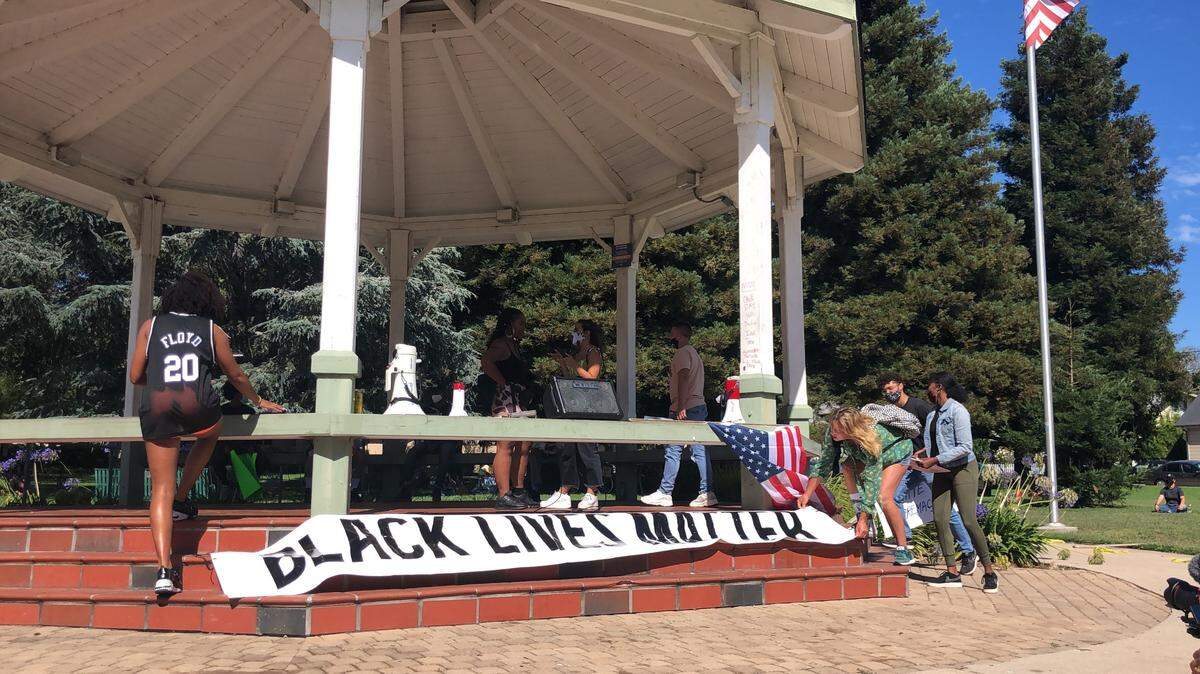
The Black Lives Matter protests have prompted many of us in SLO County to rethink our personal relationship to historic racism. Local protests have inspired counter groups and sparked debate over tear gas and freeway shutdowns. The removal of the Junipero Serra statue in SLO echoes William Faulkner’s pronouncement that “the past is never dead. It’s not even past.”
Thanks to Cal Poly’s Kennedy Library, the past is now alive and online via a digitized archive of the SLO Tribune from 1869-2001. A survey of reporting by The Tribune over more than a century shows how the Central Coast received news about racial violence and highlights the white supremacy within the reporting that helped shape American attitudes and society.
“Race riot” and “race war” commonly referred to racial violence from Reconstruction well into the 20th century, and are mentioned in over 400 Tribune articles between 1907 and 2001. As a white high school teacher about to start a new year, I reviewed them while trying to imagine how to discuss this history with my students. (Note: racially offensive language is cited here.)
The term “race riots” was first used in the SLO Daily Telegram on Sept. 6, 1907. An editorial supporting a ban on Japanese immigration to the U.S. cited the threat of “race riots” due to large importations of “Asiatics” from “yellow nations.” On Sept. 18, an article cautioned “if no restrictions are placed on coolie labor the eventual result will be a race war of extermination.”
On Sept. 25, 1907, a Telegram article on alcohol prohibition laws argued that “liquor is largely responsible for the shiftlessness, laziness and crime of the black race.”
On Aug. 19, 1908, under the headline “Whisky Caused the Rioting,” a candidate for U.S. President is quoted as saying the sale of whiskey in Chicago is “bringing the bad negroes up from the south.”
An article on May 23, 1911, criticized a high-profile interracial boxing match between a “Caucasion and a Coon,” arguing that boxing matches between “two races” can only lead to “race riots” and “bloodshed.”
During the “Red Summer of 1919,” racial violence erupted across the U.S. as white mobs attacked Black neighborhoods, burning many to the ground and killing hundreds. On Aug. 26, 1919, the front page warned of the grave threat of race riots, saying they were engineered by “anarchists and bomb throwers.” The article asserts “no community where different races abound in any number” is free from danger.
The first mention of race riots in California appeared in a Jan. 22, 1930, article headlined “Race Riots of Monterey.” In Watsonville, a mob of white men converged on a Filipino social club, incensed about “white girls” working there as entertainers. The mob attacked the club and threatened to run all Filipinos out of the valley. Two died in the violence. Another article called the violence an “inevitable result of the … invasion of California Oriental labor.” On Jan. 26, a California official stated “the fact is that white men, in a white country, will not allow their jobs or their women to be taken by Asiatics.”
Any doubt about the connection between racist intent and government action need only look to early 1942. Two months after the attack on Pearl Harbor, a Jan. 30 article warned of “race riots” if Japanese and Japanese-Americans “of alien sympathies” were not removed from the West Coast. Three weeks later, President Roosevelt signed the Executive Order 9066 that would condemn 120,000 of Japanese ancestry to mass incarceration throughout the West.
Decades later, it is easy to condemn the hate and xenophobia so clearly on display. Some might even conclude that the absence of overt racial language in today’s news media is proof of a post racial America. The “silencing” of racist language, however, has not “silenced” the systemic injustices that are the backbone of our American body, and which these archival writings were working to protect.
Nationally, and in SLO County, the institutions of power (local government, churches, banks, news media, public schools and universities) are overwhelmingly white. For generations, white Americans like me have benefited from access to such power, inheritance and privileged status. People of color continue to remain more likely to experience employment discrimination, incarceration, violence, substandard schools and death at the hands of law enforcement.
The Tribune’s archives show us how racist ideas and institutions can be normalized and preserved. We now have a chance to consider the extent to which power and privilege stem from historical injustices that perpetuate racial inequality. As an educator of future voters and leaders, I am feeling the heavy weight of responsibility during this hopeful movement toward a more equitable society. Whether we get it right depends on our collective actions. I hope we’re all up to the challenge.
Geoffrey Land lives in San Luis Obispo and teaches history and government at Paso Robles High School.