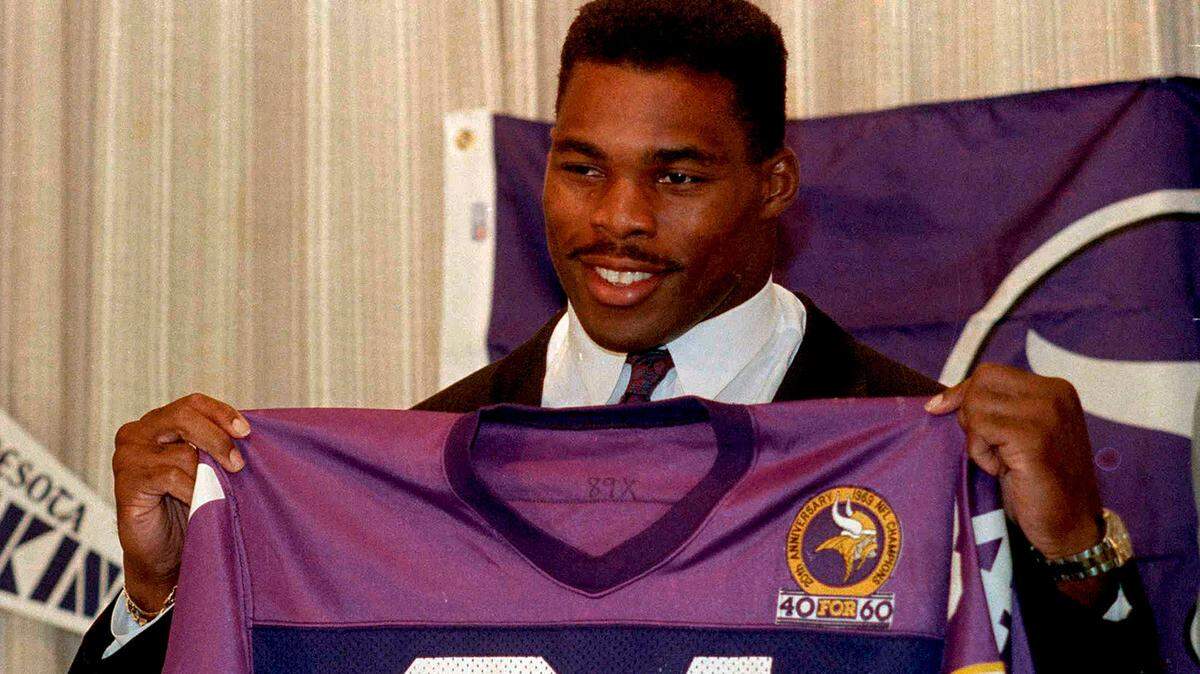
I thought I was done getting political text messages. Then Herschel Walker reached out
For a while there, I was super popular.
Val Demings was texting me two or three times a day. So was Mark Kelly. I even heard from two former presidents — 44 and 45! (I’m lucky enough to have friends from both sides of the aisle.)
Now that the election is over, though, those friendships are waning.
They no longer need my vote or my campaign contributions — not that I ever gave them money anyway.
It’s just as well; to be honest, it’s been a relief to not have to respond every time my phone beeps.
Join the team
But then this happened: On Thursday, Herschel Walker, the U.S. Senate candidate from Georgia, texted me.
He wants me to join Team Herschel and he’d also really appreciate it if I chipped in “$5, $10, or even $34.” (In case you’re not into football, that was his jersey number back in the day.)
If I could commit to making a monthly donation that would be even better because, as Herschel points out, “this is the most important election of our lifetime.”
That may be a slight exaggeration, but yes, next month’s Georgia runoff election between Walker and his Democratic opponent, U.S. Sen. Raphael Warnock, is a Big Deal. The outcome could decide which party controls the Senate.
Herschel (we’re on a first-name basis) seems to believe that my $5 could make a difference: “It comes down to YOU,” is how he phrased it.
But I’m not taking this too personally; that exact same text message no doubt went out to millions of other prospective Team Herschel members across the nation, if not the globe.
And therein lies the problem: Not everyone is happy to be on the receiving end of a barrage of “urgent” texts from politicians they may never have heard of before and aren’t even eligible to vote for. (Herschel, of course, has plenty of name recognition, and not just due to his athletic career. Among other revelations, two women have accused him of paying for their abortions — a scandal, given that he opposes abortion under all circumstances .)
The Wild West
Unfortunately, there’s not a whole lot that you can do to prevent political texts from blowing up your phone. This is sort of like the Wild West when it comes to regulating this particular form of communication.
According to the Federal Communications Commission website, campaign calls and texts are exempt from “Do Not Call List” requirements.
They are subject to robocall rules, though, but only if the sender uses auto-dialing technology. Manual dialing is OK.
That opens the door to all sorts of political spam, according to Scott Goodstein, CEO of Catalyst Campaigns, which focuses on “building authentic messaging and winning strategies.”
“These spam messages are not intended to be two-way conversations among peers to help increase political discourse,” Goodstein wrote in The Hill. “They are not originated from humans texting their ‘friends,’ Instead, they are simply uploaded lists, crowd-sourced through a mobile app.”
He’s also worried that unregulated political texts can be used to spread misleading information, “adding chaos and stress to an already divided electorate.”
Of course, false information could be fed to voters in all sorts of ways: social media, email, television and radio talk shows.
But here’s why text messages are so effective: They reach us directly, and we almost always respond by checking our phones.
After all, that’s how we make plans to meet up, check on our kids, let somebody know if we’re running late. We might not check our emails, but we’re not about to ignore a text message.
That’s what makes these political messages so effective and yet, at the same time, such a turnoff to many — if not most — voters who don’t want to be bothered by yet another text pleading for just $5 from a politician who may be 20 states away.
Sure, the ads include an opt-out notice, but that’s not always effective. I’m still getting texts from Donald Trump after opting out months ago.
Here’s the latest: “Please, Friend. President Trump needs YOU to update your Voter Verification Canvass survey IMMEDIATELY.” (Whoever is writing these things is a big fan of ALL CAPS.)
So get your act together, FCC.
The next big election is two years away, and that should give you enough time to close the loopholes that are allowing these unwanted messages to drive us even more bonkers than we already are at election time.
In the meantime, for me it’s a hard no to Team Herschel.