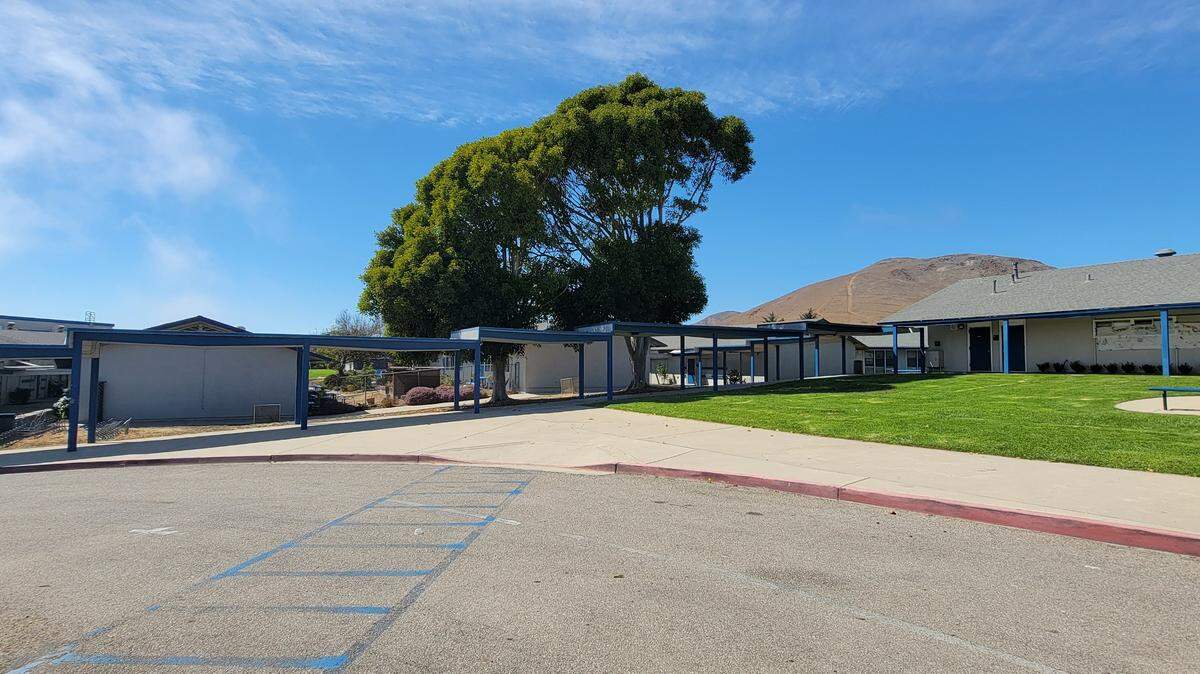
Parents are asking for security fences at two San Luis Coastal school, including Del Mar Elementary, seen here, and Pacheco Elementary in San Luis Obispo.
Laura Dickinson
Florida resident Medford Bragg was stunned the first time he drove past his grandson’s school in Morro Bay.
There was no fence around Del Mar Elementary School, making it easy for anyone to walk onto campus.
A mass school shooting had just occurred in Uvalde, Texas, and Bragg was convinced the lack of a fence at Del Mar Elementary — together with what he perceived as other security lapses — put his grandson in danger.
Bragg, who describes himself as “just an outsider grandfather,” shared his concerns with the mayor of Morro Bay, the school principal and the school district.
He even reached out to Lowe’s and Home Depot to ask for donations of materials for a 6-foot fence. He figured he could put together a group of volunteers to provide the labor.
“My son-in-law is a contractor. He knows how to do it. I know how to do it. You’re not building an airplane or designing an atomic bomb,” he told The Tribune.
But that’s not the way things are done, at least not here in California.
Bragg’s DIY-style fencing project is in direct conflict with rules and regulations that govern school construction.
“We can’t just put up a fence. Everything, even a temporary fence, must be carefully considered,” said Eric Prater, superintendent of the San Luis Coastal Unified School District.
Florida resident Medford Bragg, a former airline pilot, offered to install a security fence at his grandson’s elementary school in San Luis Obispo County. The school district declined the offer, citing the many rules overseeing all school construction. Courtesy photo
‘Anyone and anything can enter our campus’
Bragg, a 79-year-old former airline pilot, isn’t alone in worrying about school safety in the San Luis Coastal district, which includes San Luis Obispo, Avila Beach, Edna Valley, Los Osos and Morro Bay.
Families at Pacheco Elementary School in San Luis Obispo have similar concerns about their campus. Following the Uvalde shooting, several wrote to the district, stressing the urgent need to install a perimeter fence around the school.
“For those that are not aware, our campus is open on all sides,” one parent wrote. “Anyone and anything can enter our campus at any time.”
Prater agrees fences are important.
“If you do it correctly, what they effectively do is create a boundary where kids belong and where adult citizens should not go,” he said. “It acknowledges that this is a place you should not cross into unless you have a really good reason.
The district has already installed perimeter fences at some schools, including Morro Bay and San Luis Obispo high schools, while other campuses have partial barriers.
Pacheco and Del Mar, however, are wide open — so much so that the district is looking into installing some temporary barriers.
The ultimate goal, though, is a full security upgrade at every campus in the district.
That includes not only fencing, but also interlocking doors that keep out intruders, additional security cameras and other safety measures such as smoothing out rutted playing fields that pose a trip hazard.
The upgrade will be hugely expensive.
San Luis Coastal Assistant Superintendent Ryan Pinkerton estimates it will cost around $200,000 just for perimeter fencing for an elementary school and more for a middle school.
Among other steps, the district must prepare a design and submit it to the Division of the State Architect to ensure the fence meets structural code, is compliant with the Americans with Disabilities Act and doesn’t impede emergency access.
Plus, the fence needs to be visually appealing.
“We don’t want our schools looking like prison,” Prater said.
School bond measure on November ballot
The district hopes to finance the work with new tax revenue; it’s placing a $349 million school modernization bond measure on the November ballot.
Bragg says it shouldn’t take a bond measure to build a fence.
“We get a little architect to come in and get the drawings of how we’re going to do it, and we go from there,” he said. “That’s not a bond. That’s called ‘free.’ I can get it put up.”
But security upgrades would be just one of many improvements covered by the bond. It also would fund new classrooms to replace portables; repair or replace leaky roofs; improve technology and energy efficiency; and provide new classrooms for the district’s transitional kindergarten program, among other items.
The bond would primarily benefit elementary and middle schools. Measure D, passed in 2014, funded improvements at the high schools and an ongoing cost to homeowners of $39 a year per $100,000 of assessed home value.
If it passes, the new bond will add $49 per $100,000 assessed value, or $245 a year for a home valued at $500,000.
Security experts: Fencing is not enough
Security experts say fencing, security cameras and interlocking doors are just one facet of school safety.
Prevention is important too. That includes counseling and anti-bullying programs, training for faculty and staff and encouraging the “see something, say something” mentality.
San Luis Coastal officials say their security program has all those elements and more. Yet many of those efforts — which aren’t as visible as a fence or a security camera — go unnoticed
“We’re not shouting from the rooftops everything we’re doing,” Prater said.
For Bragg, that’s a problem.
He would like to know more about the training that’s required not just for school staff, but also for law enforcement officers who would respond to an incident. He’s also curious about the number of safety drills conducted each year, how video surveillance is used and what it would cost to staff each campus with a school resource officer.
Bragg — the quintessential squeaky wheel — suspects district officials would just as soon wash their hands of him.
“I am an outsider and the people in charge of the school would like for Medford Bragg to go away,” he wrote.
Prater, though, diplomatically described Bragg as “a super well-intentioned guy.”
“I do appreciate anyone who cares enough to say ‘Hey, I want to make our campuses safer,’ ” he said.
While their methods differ, the two men are on the same page when it comes to wanting to make schools as safe as possible for children in an America where gun violence is a full-blown epidemic.
For Prater, who is responsible for 7,500 students, that means asking voters to approve a massive bond to upgrade security at every school — or finding another way to fund the work in the event the measure fails.
For Bragg, it means rolling up his sleeves and building a fence around the school his grandson attends.
“He’s a very good kid,” he said, “and I don’t want to visit his grave.”
This story was originally published July 24, 2022 at 6:00 AM.
Opinion Editor Stephanie Finucane is a native of San Luis Obispo County and a graduate of Cal Poly. Before joining The Tribune, she worked at the Santa Barbara News-Press and the Santa Maria Times.