It’s time, people. Let’s trade in those cloth masks for some genuine N95s
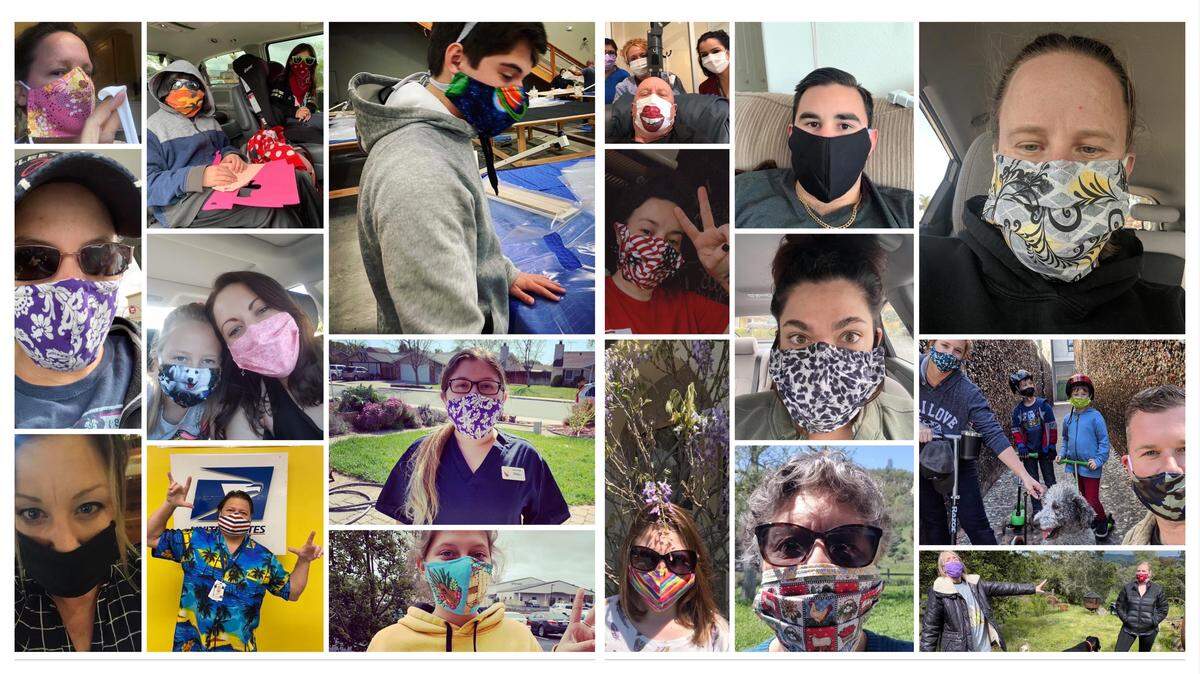
It was the day after Christmas in downtown SLO, and we were shoulder-to-shoulder with other bargain hunters at a popular alt-leisure clothing store, scoping out the marked-down leggings and sports bras and T-shirts.
An employee approached a woman standing near us.
“Did you forget your mask?” she asked politely. (To be honest, up until that point I hadn’t even noticed the bare-faced shopper.)
“I don’t wear a mask,” the woman answered, with just a hint of belligerence. “I’m exempt.”
Well, OK.
At least the sales associate raised the issue. And kudos to the store for having a pile of surgical masks available for customers who did indeed forget their face coverings.
Some other businesses are looking the other way, even as more and more people are ignoring mask mandates.
I can’t say I blame them, though if no one is even attempting to enforce the mandates, what good are they?
There was a time, earlier on in the pandemic, when I might have said something.
“Your mask has slipped,” I would casually mention to the person whose mask had drifted down below their chin.
Or if the person had no mask at all, I would feign innocence and ask, “Oh, aren’t masks required here?”
No more.
I’m burned out. Besides, nothing I say is going embarrass the anti-maskers, let alone change their minds.
At this point in the pandemic, minds seem pretty made up.
Ironically, experts are telling us masks are more important than ever as protection from the fast-spreading Omicron variant.
Not only that, they are also saying that those cloth masks we depended on before aren’t good enough.
“Cloth masks are little more than facial decorations,” medical analyst Dr. Leana Wen said on CNN — a remark that was picked up by dozens of other news outlets.
In other words, time to ditch all those cute designer face masks we’ve been accumulating over the past couple of years — unless we double them up with a surgical mask.
This is more than a little confusing and could be interpreted as an about-face on the part of medical experts.
Initially, they told us we didn’t need masks.
Then they said to wear face coverings, but to leave the N95 masks for medical workers. Instead, we were advised to wear cloth masks, or scarves or neck gaiters.
But now that N95s and KN95s are more plentiful, we’re encouraged to switch to those — but watch out for counterfeits.
That’s easier said than done.
The National Institute for Occupational Safety and Health (NIOSH) offers this advice: “NIOSH urges purchasers of masks and respirators that may have questions about the authenticity of these products to contact directly the manufacturers and others in the supply chain as needed to verify that they are obtaining legitimate products.”
Well that’s reassuring!
But there is good reason for all the caution. The more contagious the strain, the more important it is to block as many respiratory droplets as possible.
Dr. Shira Abeles, infectious disease specialist at UC San Diego Health, put it this way for NBC news in San Diego: “You have an indoor location, not good circulation, maybe you don’t know if people are vaccinated or not and you just have cloth masks and you’re in kind of a stuffy room, yeah, it’s gonna fail sooner than a very tightly fitted filtering mask.”
If it’s any consolation, those N95 masks offer a good level of protection, even if you find yourself in close proximity to an unmasked stranger at an after-Christmas sale.
Joseph G. Allen, director of the Healthy Buildings program at Harvard’s T.H. Chan School of Public Health, assured us of that in an op-ed in The Washington Post: “For anyone who fears moving away from universal masking, the great news is that they can continue to wear an N95 mask — along with being vaccinated and boosted — and live a low-risk life regardless of what others around them are doing.”
Just make sure your N95 is the real deal, and not some counterfeit.
This story was originally published December 29, 2021 at 5:30 AM.