
SLO County may have to zone for 15,284 more homes. ‘Seems like a slap in the face’ | Opinion
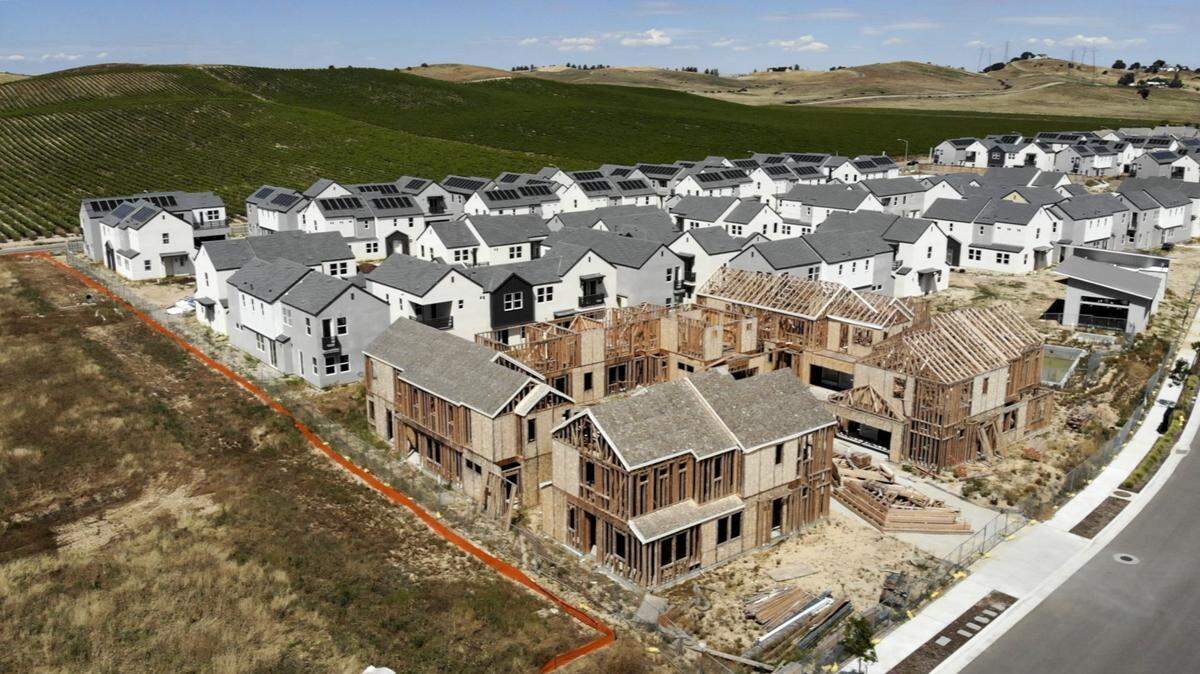
San Luis Obispo County is locked in another tug-of-war with state housing officials over a torturous process called the Regional Housing Needs Allocation, or RHNA — an exercise that’s supposed to help ensure our county has all the housing it needs.
Except, that’s not really the case. There is no guarantee that any of this housing will actually be built, which raises questions about a process that’s more aspirational than achievable.
Here’s how it works: Every multi-year cycle (lthe exact number of years has varied) the state Department of Housing and Community Development (HCD) calculates how many additional residential units each county will need, based on population projections and pent-up demand. Each county is assigned a goal, and from there, cities within the county are given their own targets.
The state does not require any of the units to be built — it’s left to developers to do the heavy lifting. But cities and counties must show the state that they can accommodate the units, which can mean rezoning neighborhoods to allow greater density or taller buildings. Jurisdictions that don’t comply can face fines and the loss of local control over new projects.
Another wrinkle: The state doesn’t factor in building constraints, which means a city can zone a piece of land for a mega-development, but if there’s no water available, it won’t be built.
SLO County asks the state to reconsider
SLO County has been through the RHNA process for six cycles and is now approaching its seventh, which runs from 2029 through 2036.
The state has set the county’s goal at 15,284 additional units. Half of those must be low-income.
The target was initially even higher; officials at the Council of Governments (SLOCOG) negotiated with the state to reduce it by 2,000 units.
Some local officials say 15,000 is still too big an ask. It’s been hard enough to meet the current goal of 11,000 units over a 10-year period. Now they’re looking at 15,000 over eight years?
It’s especially challenging for Grover Beach, which is very close to meeting its goal of 369 units for the current cycle, which runs from 2019 to 2028.
“This new number that we’re receiving kind of seems like ... almost like a slap in the face. It’s almost like we’re being punished for the efforts that we are making to hit these housing numbers,” Grover Beach Mayor Kassi Dee said at a recent SLOCOG meeting.
The regional council, which includes representatives from the seven cities and the county, unanimously directed SLOCOG staff to write a letter to the state, making a case for a further reduction.
Population gains didn’t happen
SLOCOG says 7,023 is a more realistic number.
Among other arguments, staff points out that the county hasn’t seen the population gains that had been projected. State officials expected the county’s population to be close to 300,000 by this point, but as of July 2025, it was around 282,000. For the upcoming RHNA cycle, the state is projecting a countywide population of 278,000. Yet it’s requiring substantially more housing, making it a harder sell.
“It will be difficult to explain to our local communities why general plans need to be updated to accommodate 15,000 additional housing units without any additional population growth,” the SLOCOG letter says.
SLOCOG also claims the state did not properly credit the county for housing production that will occur between now and 2028, when the current cycle ends.
“On average, our region produced over 1,000 units (per year). That is at least 3,000 units not accounted for in the 7th Cycle calculation.”
SLO County needs real houses — not just numbers in a plan
If this all sounds too much like bean counting, it is.
Sure, It makes sense to estimate the amount and types of housing a community is going to need and to then plan accordingly. But the county doesn’t have a problem building housing overall. The challenge is adding the low-income housing it so desperately needs.
Between 2019 and 2025, for example, San Luis Obispo County permitted 1,815 new units in the unincorporated areas, but the majority — 1,336 — were in the highest-income category. In the very-low-income category, only seven housing units were permitted.
That’s where the state should focus its attention.
Instead, we have this back-and-forth dithering over how many units will be needed over X number of years, knowing full well that many of those will never be built.
That’s beyond frustrating. People struggling to find housing need real homes, rather than ones that exist only on paper.
The RHNA process needs an overhaul that will reward cities for actually producing housing, not for submitting fancy reports that tick all the right boxes.
In the meantime, give SLO County a break.
Mayor Dee is right. Cities that make the effort to follow state direction should not be expected to take on more than their fair share.