
Illegal Cal Poly frat houses have created hell for SLO neighbors. It can’t continue | Opinion
Wake up, Cal Poly.
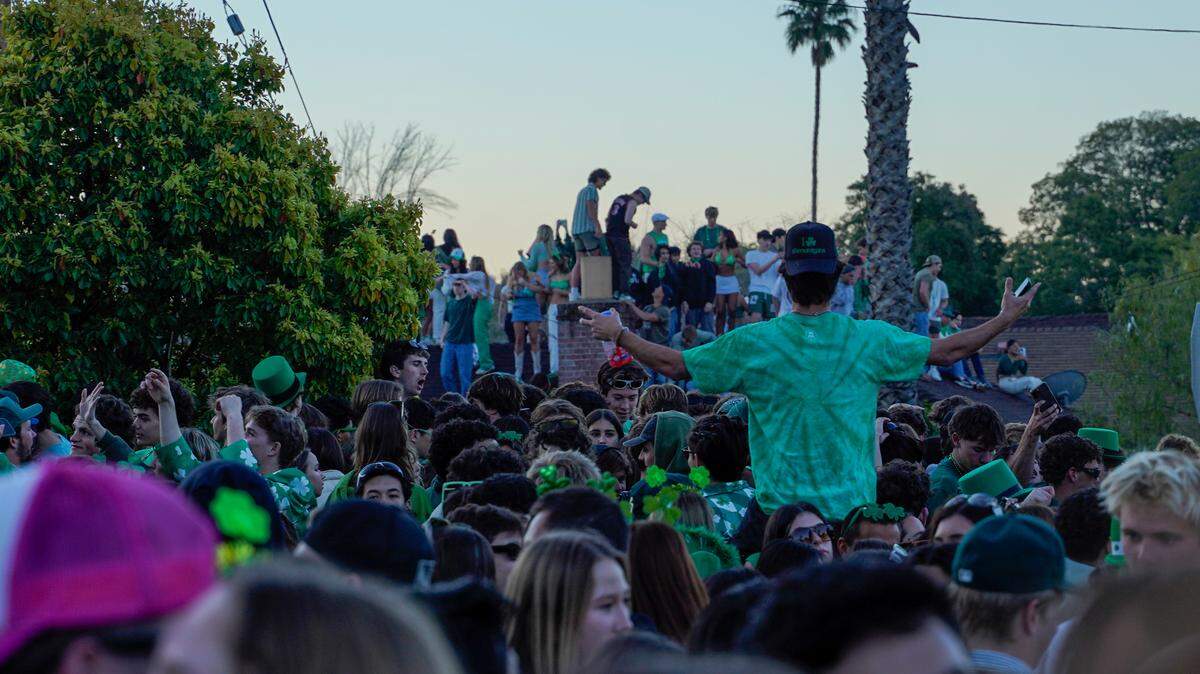
Illegal fraternity houses have taken over residential neighborhoods near campus, turning those areas into weekend-long party zones and depriving residents of the right to enjoy their own property.
Consider what they have to put up with: “From Thursday to Sunday, hundreds of screaming partygoers wander the streets to find the next hot spot as loud music and thumping bass reverberate through the neighborhood — sometimes until 3 or 4 in the morning,” described Tribune journalist Sadie Dittenber, who spent two months researching the issue.
The city has attempted to control the situation through zoning laws, by allowing frat houses only in multi-family zones. Yet residents of single-family neighborhoods say dozens of frats are operating illegally in what are supposed to be quiet residential areas. One resident who tracks fraternity events has documented what she believes are more than 60 illegal frat houses in the city.
The situation is blatantly unfair, yet officials seem at a loss as to how to deal with it.
Cal Poly claims it is not responsible: “Where organizations might operate houses is a matter between the city of SLO and the property owners, residents and organizations,” a campus spokesperson said via email.
The city of San Luis Obispo does have the power to issue noise citations and to investigate complaints of zoning violations, but residents say enforcement is lax, in part because of understaffing.
They’re asking the City Council to intervene and make things right.
The council should listen.
If this were happening in other parts of the city, it would never fly.
So why allow it in the Cal Poly neighborhoods?
Disappearing addresses
Cal Poly claims it cooperates with the city on enforcing zoning violations, but residents accuse the university of making it harder to track illegal frat houses by failing to disclose addresses of off-campus Greek events.
Under the state’s Sorority and Fraternity Transparency Act, AB 524, Greek organizations are required to report all events they’ve hosted over the previous year, along with the addresses where the activities took place. That information is made available to the public in an annual report.
According to residents who closely monitor the situation, the list used to include the exact street addresses where events were held. The city was then able to use that information to notify property owners that violations may have occurred at their residences — a first step in making a case against illegal fraternity houses.
Except, the report no longer includes the street addresses. Now, event locations are listed as “San Luis Obispo,” unless they were held at a third-party venue like a restaurant or brewery.
Here’s the university’s explanation:
“The university included addresses of events in its first AB524 report but made the decision to remove them from subsequent reports out of growing concerns in the legal landscape pertaining to student privacy (other CSU campuses are similarly moving in this direction). AB524 requires the university to publish addresses of chapter houses, which the university does. As to events, publication of addresses is required only for events where misconduct has occurred, which the university also complies with,” spokesperson Matt Lazier wrote in an email.
We’re not buying it.
Many CSUs do continue to list street addresses of off-campus events, including Sacramento State, Chico State and Fresno State. Also, shouldn’t openly defying city zoning laws qualify as misconduct?
Next steps
At a recent San Luis Obispo City Council meeting, attorney Stewart Jenkins suggested that the city subpoena Cal Poly for the records — a step that wouldn’t be necessary if the university were truly willing to cooperate.
If Cal Poly remains unwilling to disclose addresses, there are other ways to keep tabs on what’s happening in neighborhoods near Cal Poly. For example, fraternities often advertise their parties on social media — information the city could use to crack down on illegal frat houses.
But that again raises the other issue: short staffing.
At a recent City Council meeting, residents asked the city to hire two additional code enforcement officers to help regain control of the campus neighborhoods.
That is not a big ask.
The city should absolutely do so, and Cal Poly should pick up at least part of the tab.
Issuing noise and zoning citations is not a long-term fix, however, since violators can simply pay a fine to resolve the case.
Filing a nuisance abatement case is another option the could carry more serious consequences. Such a case can be pursued when more than two loud or unruly gatherings are held within a 60-day period that “threaten the public peace, health, safety or general welfare and require a police response.”
Yet the city hasn’t elected to go that route.
“I am not aware of any recorded examples of the nuisance process being used in this manner,” interim deputy building official John Mezzapesa said in an email.
‘Feral frat boys’
If citations aren’t effective — and it appears they aren’t — the city should use every enforcement tool at its disposal before this cycles even more out of control.
The situation already is bad enough that it’s caught the attention of national media; even talk show host Dr. Phil has expressed interest.
The Daily Mail, a publication based in the U.K., printed this: “The quaint California town Oprah once dubbed ‘the happiest place in America’ has been plagued by a deluge of feral frat boys hellbent on causing neighborhood carnage.”
Not exactly the image Cal Poly, or San Luis Obispo, wants to promote.
Is a Greek row the answer?
Building a Greek row on campus — a project that appears in the university’s master plan — often is viewed as the holy grail that will solve neighborhood conflicts forever.
Not so fast. Not even Cal Poly’s administration necessarily sees it that way.
“Even with on-campus student organization housing, it is not realistic to expect all fraternity and sorority chapters, houses, or members to then live on campus. As new chapters continue to join the community, we do not expect to build a new house on campus for each organization. We also expect there are some organizations who are excited and willing to support an on-campus facility, and others who will not be ready to do so for a variety of reasons,” Lazier said in an email.
That being the case, it’s highly likely that there will continue to be tension between permanent residents and fraternities.
The best long-term solution may be for Cal Poly to buy out willing sellers and use the residences either for faculty or fraternity housing.
In the meantime, the situation can no longer be ignored.
Both Cal Poly and the city of San Luis Obispo are failing the residents who have been putting up with conditions that are simply unlivable.
Immediate steps must be taken, beginning with real cooperation between the university and the city.
Step up patrols on the weekends. Enforce ordinances already on the books. File nuisance abatement cases if that’s what it takes.
Stop indulging fraternity members and send a clear message that disrespecting their neighbors will not be tolerated.
This isn’t just a Cal Poly problem or a city problem. It’s a community problem.
And it’s way past time to start treating it that way.
This story was originally published January 19, 2025 at 5:00 AM.