
What are ‘pallet houses’? And could they ease SLO County’s homeless crisis?
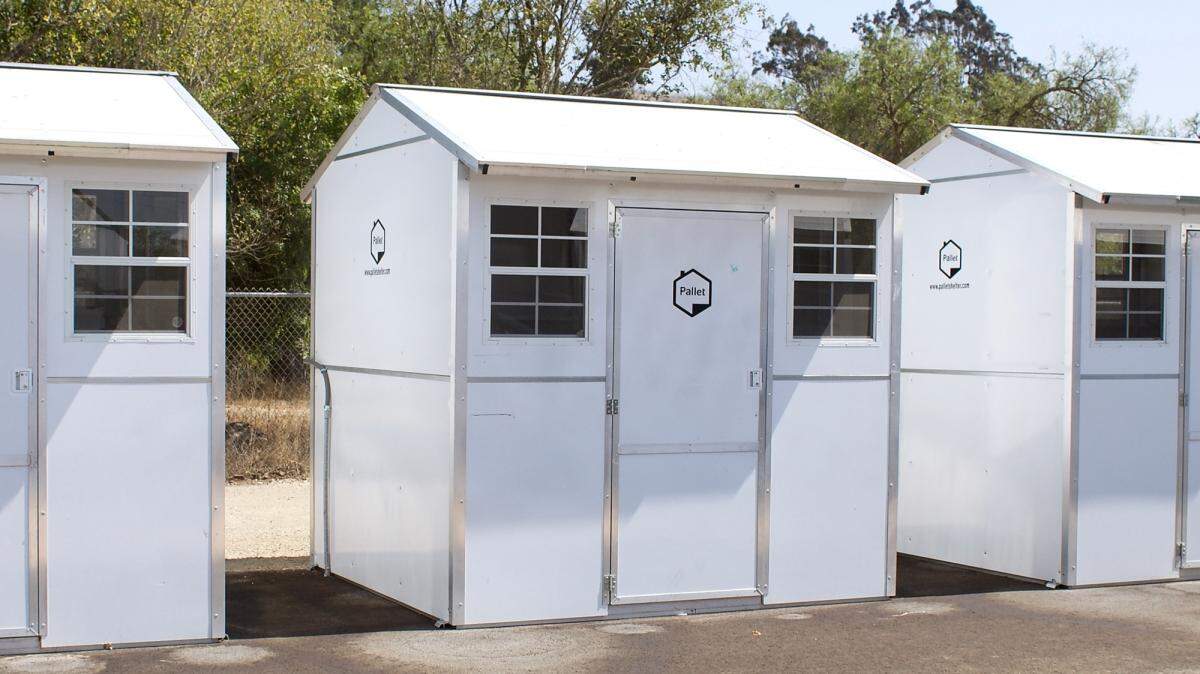
A new type of homeless shelter could be coming soon to South County.
The 5Cities Homeless Coalition (5CHC) is proposing to install 20 small sleeping cabins on county-owned property on South 16th Street in Grover Beach.
The units are sometimes called pallet houses — some models are built from wooden pallets — and are becoming a go-to alternative for communities looking for a quick, inexpensive way to provide temporary shelter.
On Tuesday, the Board of Supervisors will be asked to approve the installation as a one-year pilot program, with the option of extending the deadline if it proves successful.
If supervisors OK it, this will be the first project of its kind in San Luis Obispo County, and could serve as a model for other local communities.
That’s promising, not only because it will bring emergency shelter to an area of the county that’s been woefully underserved, but also because it signals that local agencies are willing to try something different.
Lack of emergency beds
We’re under no illusion that this will be a perfect solution.
Nearby residents and businesses may object. Potential clients may find security measures — which include cameras and fencing — too restrictive. Who knows what other issues might arise.
But clearly something must be done to provide more emergency beds — the South County currently has none — especially in a pandemic.
And this project has advantages:
- Unlike the county’s safe parking program on Kansas Avenue — which has been criticized as being “in the middle of nowhere” — the Grover Beach site is in a central location. It’s next door to a county health clinic and drug and alcohol services and is directly behind a shopping center. And there’s public transportation readily available.
- Residents don’t have to own a working vehicle, as they do with safe parking.
- The pop-up cabins — the type proposed for Grover are fiberglass reinforced plastic with aluminum framing — provide better protection than a tent or a makeshift shelter. And residents don’t have to worry about being driven out by authorities.
- They offer more privacy than congregate shelters.
- They still allow for community; there are shared spaces, including restroom and dining facilities.
- They are inexpensive; according to Pallet Shelter — the company 5CHC plans to use — the average cost per shelter is under $10,000. The accommodations are bare-bones, containing two beds and a shelving unit, but they do have electricity, heat and a door that locks.
- The units are portable, which means the can be moved from location to location as needs change. For example, 20 cabins were set up in Isla Vista as a six-month emergency program during COVID, and when the time was up, they were moved to Lompoc.
Big step for nonprofit
This is a milestone for 5CHC, which has been working for years to open some form of shelter but has been stymied by community opposition and other roadblocks.
Janna Nichols, executive director of the nonprofit, says this project is much different from others proposed in the past.
“It is going to be a controlled campus, not a drop-in,” she said. “The whole thing will be fenced, with one entrance. Only folks enrolled will be living on site.”
The site will be staffed at all times. There will be security cameras linked to the Grover Beach Police Department, a complaint line locals can call if they have concerns, and residents will have a curfew.
While there’s a low barrier for eligibility — residents don’t have to be sober when they enter the program, Nichols said — they must want to get into permanent housing and agree to take the necessary steps to make that happen. And they can’t have a history of violence or sexual offenses.
Similar programs are up and running in other communities, including Los Angeles, Ventura and Redondo Beach.
“It’s an incredibly popular and successful model,” said Nichols. “We are giving people a cabin to live in in order to figure out their other challenges.”
Because the project is on county land, it has jurisdiction even though the project is within the city of Grover Beach.
Grover Beach supports the idea: “Housing and homelessness initiatives are a priority for Grover Beach, and we are looking forward to helping advance a solution that can make a difference for individuals experiencing homelessness and our community as a whole,” City Manager Matthew Bronson said in a statement.
The county already allocated $1.2 million in federal emergency housing funds for the project in March — with the understanding that 5CHC would forfeit the money if it couldn’t find a suitable location for the cabins.
Now that a site is secured, the Board of Supervisors should give its blessing to a housing program that could open the door to new ways of providing shelter.