
SLO County DA is ‘pissed off’ at governor’s treatment of crime victims. Here’s why

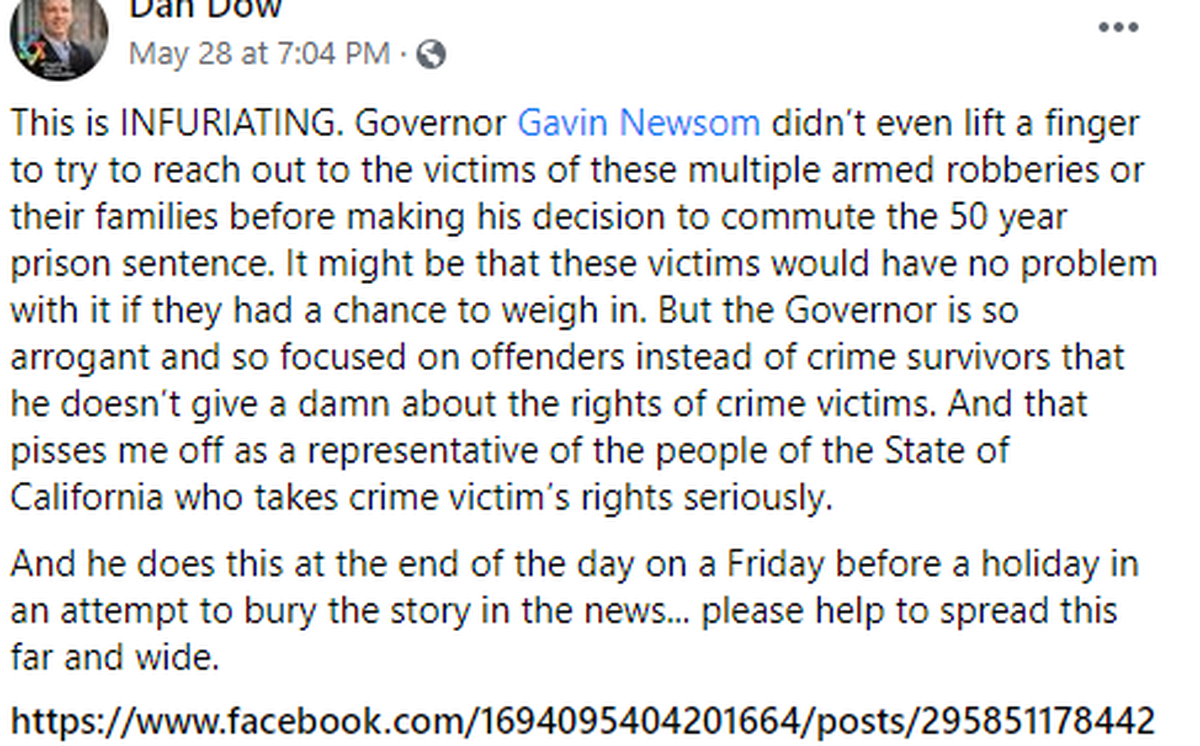
San Luis Obispo County District Attorney Dan Dow is claiming Gov. Gavin Newsom doesn’t give a “damn” about victims of crime — an accusation that stems from the governor’s recent grant of clemency to an inmate convicted of two armed robberies.
Dow says Newsom’s office didn’t make enough of an effort to contact the victims of those crimes in advance of announcing the clemency decision.
“And that pisses me off as a representative of the people of the State of California who take crime victim’s rights seriously,” he wrote on Facebook — uncharacteristically strong language from a DA given to posting patriotic messages and inspirational quotes from the Bible.
Newsom’s office granted a medical reprieve of sentence to Tracey Pabon, who received a term of 50 years to life in prison in 1994 for using a pellet gun to hold up two San Luis Obispo businesses — a GNC store in San Luis Obispo and a Baskin-Robbins in Grover Beach.
Because Pabon had two prior robbery convictions out of San Diego County, the SLO County crimes were treated as three-strikes-and-you’re-out offenses. According to Tribune archives, it was the first “three strikes” case in the county.
Pabon, who is now 58, has served 27 years. According to state officials, he’s maintained a record of good conduct in prison, and he has a high-risk medical condition; he’s suffered multiple strokes and uses a wheelchair. Both the Board of Parole Hearings and State Supreme Court recommended in favor of clemency.
If ever there was a candidate for clemency, Pabon is one.
DA says process was mishandled
Dow said he doesn’t necessarily oppose Pabon’s release, but he does object to the way it was handled.
He posted documents showing the Governor’s Office waited until late in the day on May 28 — the Friday before Memorial Day weekend — to send him an email requesting information about the victims’ whereabouts, in order to notify them of the clemency.
That email was sent just 25 minutes in advance of the announcement of the governor’s decision.
According to Dow, the Governor’s Office violated several sections of California’s Victims’ Bill of Rights, including a requirement that victims “be informed of all parole procedures.”
And he says it’s happened to other counties as well.
Governor’s response
This does sound like a royal screwup on the part of the Governor’s Office — except there’s more to the story, according to Newsom spokeswoman Erin Mellon.
Mellon says the District Attorney’s Office was contacted early on in the process.
“In November 2019, upon receiving an application for commutation for Mr. Pabon, our office reached out to Mr. Dow’s office seeking input for a possible clemency grant and asked for their help in connecting with victims and crime survivors to incorporate their input into the clemency consideration,” she said in an email. “This is standard protocol under the Newsom administration. Unfortunately, Governor Newsom’s office did not receive a response to this communication.”
She continued: “Additionally, we have requested the assistance of all DAs, including Mr. Dow, in registering victims to CDCR’s (California Department of Corrections and Rehabilitation) Office of Victim and Survivor Rights and Services. Victims can register by using this link: www.cdcr.ca.gov/victim-services/application/ to ensure victims receive notifications.”
Dow said he did receive an email in 2019, but it indicated only that the Governor’s Office “is now processing the application and may refer it for investigation.” He was not contacted again until the day the decision was announced, he said.
‘Boilerplate’ correspondence
Also, he described the initial email as “nondescript” and “boilerplate” — very different from the official-looking letters that Gov. Jerry Brown used to send.
Dow has asked that future correspondence on important matters like pardons or clemency be sent via personally addressed mail, rather than email. And he wants enough time to do necessary research.
“I would like to make this email a formal request for my office and other District Attorney’s Offices to receive adequate notice and opportunity to find old case files, locate and contact victims, and research the commutation candidates,” he wrote in a letter to the Governor’s Office.
The district attorney did speak to one of Pabon’s three victims on Thursday — a woman, now 79, who worked at the GNC store.
“She still is afraid and carries a knife on her person whenever she goes anywhere,” said Dow, who was still trying to get in touch with the other two victims, who both worked at Baskin-Robbins.
He told The Tribune Editorial Board it’s unfair to minimize the crimes; although the weapon used in the robberies was a pellet gun, he added, to the victims it looked like the real thing.
Who’s to blame?
There should be a more fail-safe system to ensure every effort is made to reach the victims when the governor is considering a pardon or clemency. The state registry is a good step, but it’s obviously not enough.
But laying all the blame on Newsom is a stretch; he can’t be held responsible for every single government shortcoming.
That, however, is par for the course in state politics — especially in the middle of a recall campaign.
Dow said advancing the effort to recall Newsom wasn’t his motivation when he fired off his Facebook post.
“I don’t believe I even signed the (recall) petition. That’s clearly not my agenda,” he said.
Yet several of his Facebook followers saw this as more evidence against Newsom.
“I’ll be remembering this & a lot of other things about this HORRIBLE Governor when I’m at the voting booth in November,” one post says.
“It’s heartbreaking watching him destroy California one bad decision after the next. When will people wake up and vote him out?” says another.
Is a breakdown in communications between government agencies a reason to recall Newsom?
Of course not.
But it does point to the need for state agencies to keep local governments in the loop — and for local agencies to cooperate in providing information.
Crime victims deserve to have accurate and timely updates on cases, especially when it’s possible that inmates will be out of prison decades earlier than their original release dates.
That can be difficult in cases that are decades old, but that’s not an excuse.
We strongly urge the Governor’s Office to double down on its efforts to reach out to victims with information they have every right to know, and for district attorney’s offices to do their part as well.
Instead of pointing fingers, figure out how to make this right.
This story was originally published June 4, 2021 at 9:35 AM.