
SLO County is not part of Southern California. Please don’t shut us down, Governor
With all due respect, Gov. Gavin Newsom needs to take another look at the map of California.
San Luis Obispo County is clearly not part of Southern California.
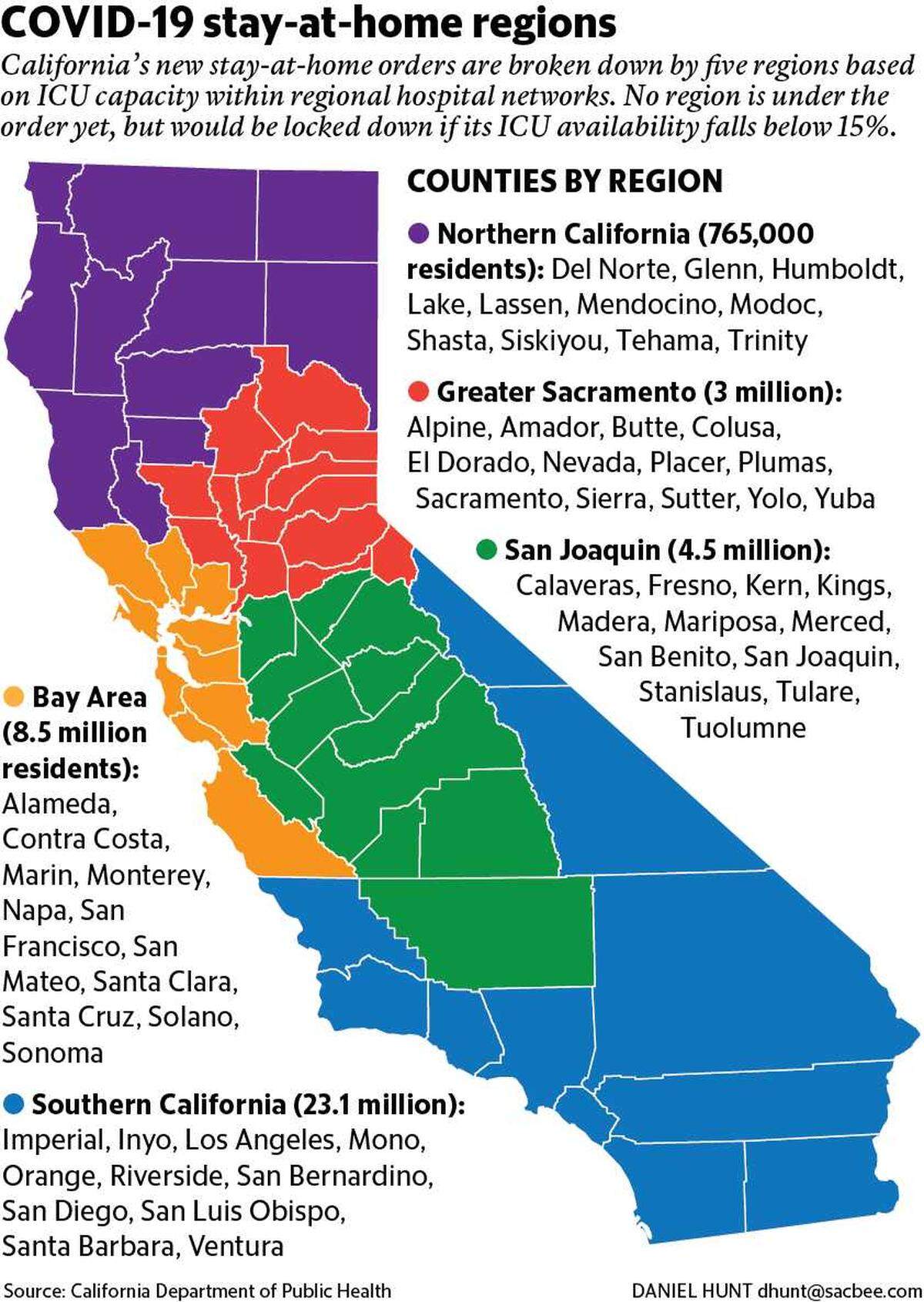
Yet with no explanation, that’s where the governor has placed us under his latest COVID-19 shutdown order.
As a result, local restaurants, bars, wineries, hair salons, barbershops and many other businesses once again are preparing to either close completely or dramatically scale back operations.
Restaurants, for instance, will be limited to offering take-out and delivery, and will no longer be able to offer outdoor dining. That’s a huge hit for an industry already struggling to survive.
The new round of shutdowns is anticipated because the state has now layered on a new regional approach to controlling COVID-19 outbreaks — a change from the county-by-county system that has been in place until now. The new order is intended to preserve capacity in hospital intensive care units, which is in dangerously short supply in many metro areas.
But the sudden switch to a regional approach makes it appear the state is simply throwing everything at a wall in a desperate attempt to see what sticks.
That’s not reassuring, and it’s not the way to gain compliance.
What’s more, the governor has failed to make a case for why counties like San Luis Obispo, which have plenty of ICU capacity, are being subjected to the same restrictions as Los Angeles and Sacramento, where the virus is raging out of control.
It appears arbitrary and unfair, and puts local officials in the awful position of having to enforce a mandate they find puzzling and unnecessary.
“SLO County being grouped with such a large Southern California region does not make sense,” SLO County Administrator Wade Horton said via email Friday. “We are advocating to the state to reconsider our regional assignment to be more representative of local conditions.”
If the governor can’t convince a highly competent and reasonable official like Wade Horton that this is a necessary step, good luck getting the general public to buy into that.
Some businesses already were openly defying COVID-19 orders by allowing indoor dining and indoor workouts, and now this?
Of course, everything must be done to ensure available medical care for those who need it.
Who wouldn’t be willing to give up getting a hair cut or dining at an outdoor restaurant if that might possibly save a life?
But the governor has failed to connect the dots.
He has vaguely alluded to a hospital mutual aid system that allows patients to be transferred from a hard-hit region to hospitals with more capacity.
But what, if anything, does that mean for San Luis Obispo County, which is located some 200 miles from Los Angeles?
In other words, how would shutting down outdoor dining in SLO help people suffering in L.A.?
The governor has some explaining to do, but his office is notoriously bad about communicating. (We’re reached out to the Governor’s Press Office but have yet to hear back.)
Keep in mind, it’s not just San Luis Obispo County that stands to be hurt by this latest order; other small and mid-size counties also face shutdowns because they happen to be lumped into regions with large metro areas.
That’s the consequence of a broad-brush approach that divided a huge state into only five regions.
Why just five? Why not eight or nine?
And why not create, for example, a Central Coast region?
Or for that matter, why not consider ICU capacity in each individual county, rather than lumping us together?
Based on the little information the governor has shared, we see no justification for such an shotgun approach.
A majority of Californians have, for the most part, cooperated with COVID-19 mandates, but a system that simply uses lines on a map — rather than considering each county’s actual situation — is grossly unfair to counties like San Luis Obispo.
Gov. Newsom must either scrap the regional system or greatly refine it.
This story was originally published December 4, 2020 at 12:56 PM.