
A ‘whites only’ clause remains in some SLO County property deeds. It’s past time to remove it
Judy Hemenway is one of those rare individuals who actually reads all the fine print.
When she and her husband — both retired engineers — bought a house in Atascadero in 2010, Hemenway didn’t just scan the lengthy Codes, Covenants and Restrictions. She went over them word-by-word-by-word.
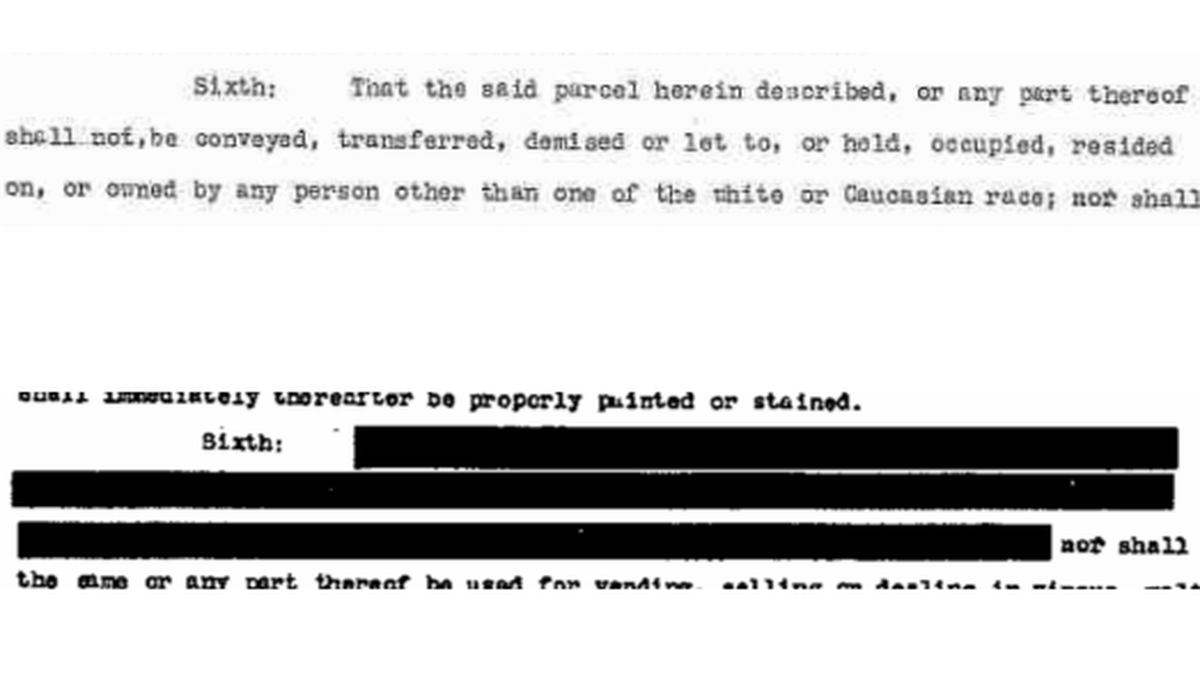
That’s how she discovered the CC&Rs still included this repugnant — and now blatantly illegal — “whites only” clause that dates back to the founding of Atascadero.
“That the said parcel herein described, or any part thereof, shall not be conveyed, transferred or demised or let to, or held, occupied, resided on, or owned by any other than one of the white or Caucasian race.”
Hemenway isn’t the first homeowner to stumble upon this hateful language, but she’s among the few who decided to do something about it, prompted in part by the recent racial justice protests.
First, she wrote a letter to the editor, pointing to the practice as further proof of systemic racism in San Luis Obispo County. The letter was a direct rebuke of Sheriff Ian Parkinson, who had spoken to a Tea Party gathering about recent Black Lives Matter protests and told The Tribune afterward that he’d never seen evidence of systemic racism here.
Next, Hemenway contacted the County Recorder’s Office to have the offensive language stricken from the deed.
And finally, she approached the city of Atascadero and asked that it consider passing a resolution acknowledging this low point in the city’s history.
That’s been suggested before — most recently in 2013, when Vision Atascadero, a promotional group, posted this on Facebook: “How can we get past this “Whites Only” issue? Should our City Council vote on an official proclamation to address this issue? Or should we continue to try to avoid even talking about it?”
It appears the city is now ready to confront its past.
“There are many great things about Atascadero’s history, including the support of women and women owning property. What stands out as a moral shortcoming is that people of color were not allowed to own property,” Atascadero Mayor Heather Moreno told The Tribune.
“We were very progressive with equality for women and, in looking back, what a missed opportunity that we weren’t also on the forefront of being progressive in advocating for people of color. Now there is the chance to change that and do the right thing moving forward.”
R.A.C.E. Matters SLO County also is working to shine a light on this shameful chapter in San Luis Obispo County history.
It’s teamed with local journalist Jaime Lewis — who also discovered the “whites only” restriction in her property deed — to produce a short documentary film about exclusionary CC&Rs in SLO County.
“These CC&Rs give one clear, well-documented reason why this county is predominantly white,” R.A.C.E. Matters told The Tribune.
“R.A.C.E. Matters SLO County and the filmmakers believe this language must be removed from all property documentation for home sales in the future.”
Agreed.
Racist language in property deeds may not be as visible as, say, a “whites only” sign at a public drinking fountain, but the ugly message of exclusion is exactly the same. It’s hate speech, and it has no place in today’s legal documents.
What’s being done about it
Some state lawmakers plan to introduce a bill at the end of the year that would require counties to strike the racist language whenever a property changes hands.
A similar bill passed in 2009, but according to the Los Angeles Times, real estate agents, title companies and some county recorders complained it would create a bureaucratic nightmare, and the bill wound up being vetoed by then-Gov. Arnold Schwarzenegger.
“While the goal of this measure is a worthy one, the practical legal effect is negligible,” the governor wrote in his veto message. “The restrictive covenants this bill would redact from certain recorded documents are already illegal and void under existing law.”
Thanks to Black Lives Matter and other racial justice movements, the proposal stands a better chance of success this time.
Still, there’s no reason to wait for Sacramento to act.
It’s possible for individuals to have the clause redacted from their deeds by contacting the County Clerk-Recorder’s Office and filing a Restrictive Covenant Modification to strike out the wording. The county doesn’t charge for that service, though applicants do have to pay a fee to have their signatures notarized.
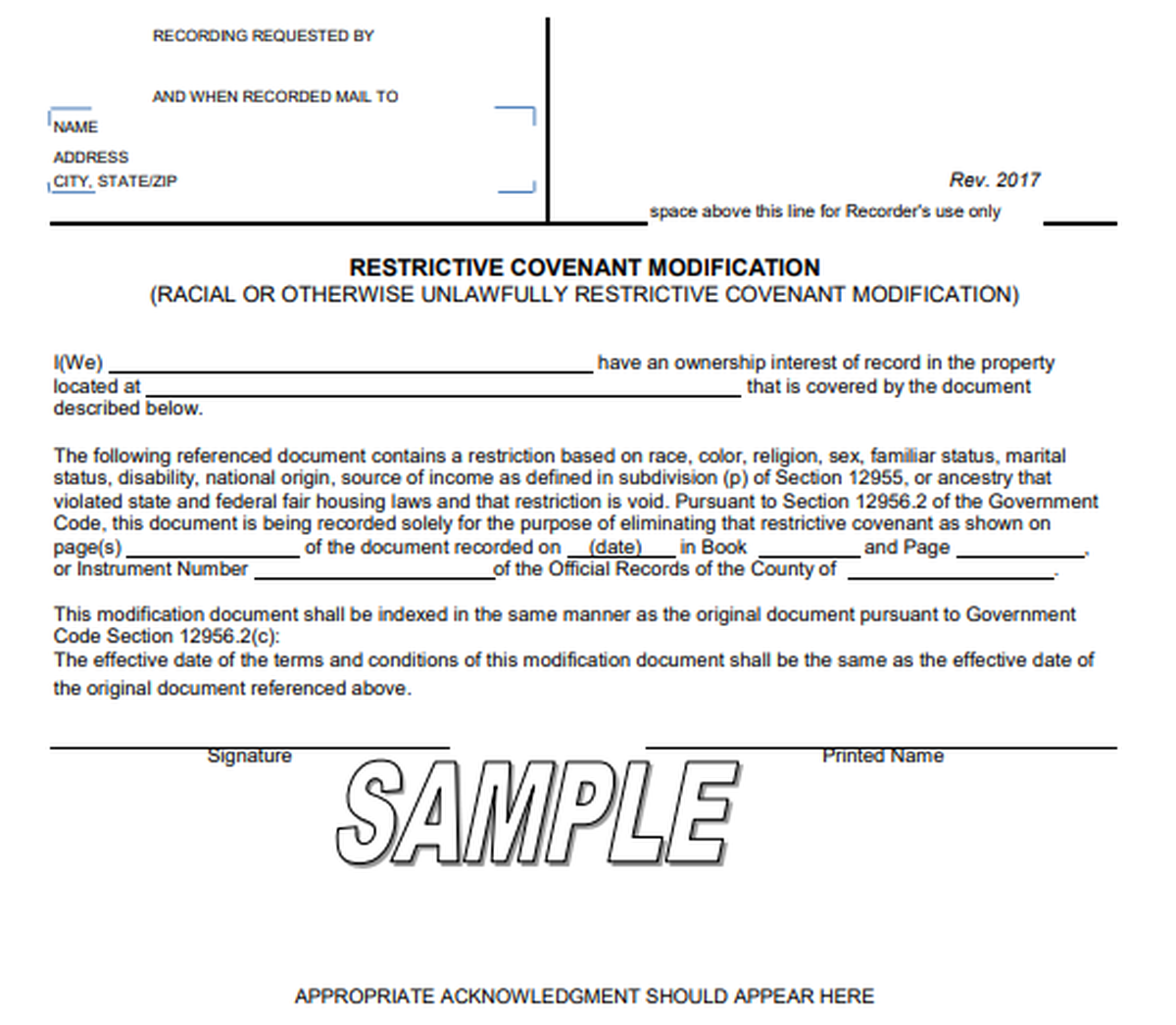
The language won’t be removed completely, but it will be crossed out to make it unreadable.
When Hemenway went through the process, she wasn’t sure what to expect. It turned out to be easy and took only a couple of days to complete.
“Piece of cake!” she wrote in an email.
Even so, not many homeowners have taken the step; only four in the past three years, according to Shannon Negrete of the County Recorder’s Office.
‘Whites only’ subdivisions were everywhere
Keep in mind, it wasn’t just a few scattered communities like Atascadero that banned people of color from buying homes in certain neighborhoods.
It was a pervasive practice, and it wasn’t until 1948 that the U.S. Supreme Court declared it unconstitutional. By then, it had taken a huge toll on people of color that persists to this day.
“You block people from purchasing property in desirable neighborhoods,” Hemenway said, “and they do not have that wealth-generating engine of real estate.”
Today, Black families have only one-tenth the median net worth that white families have, and are half as likely to own a home, according to Reuters.
Striking out the offensive language in property deeds isn’t going to change that history, but it will signal a repudiation of the past.
Like nooses, Confederate flags and statues of bigoted “heroes,” racial covenants are emblematic of white supremacy. They belong in museums and history books, not in official documents still in use.
There’s really no justification for that, so please, no more lame excuses like these:
It’s too much of a hassle to strike them out.
The covenants can’t be enforced anyway.
Not that many people actually read them.
None of those are good reasons to shirk our moral responsibility on this issue.
We strongly urge the California Legislature to pass and the governor to sign a bill phasing out “whites only” language in real estate documents.
We urge the city of Atascadero to move forward with a resolution acknowledging its history of segregation — and other local governments across the state to consider doing the same.
And finally, we suggest homeowners contact the County Clerk-Recorder’s Office about modifying their property deeds to remove the racist language.
As Judy Hemenway will tell you, it’s easy — and long overdue.
This story was originally published August 23, 2020 at 5:05 AM.