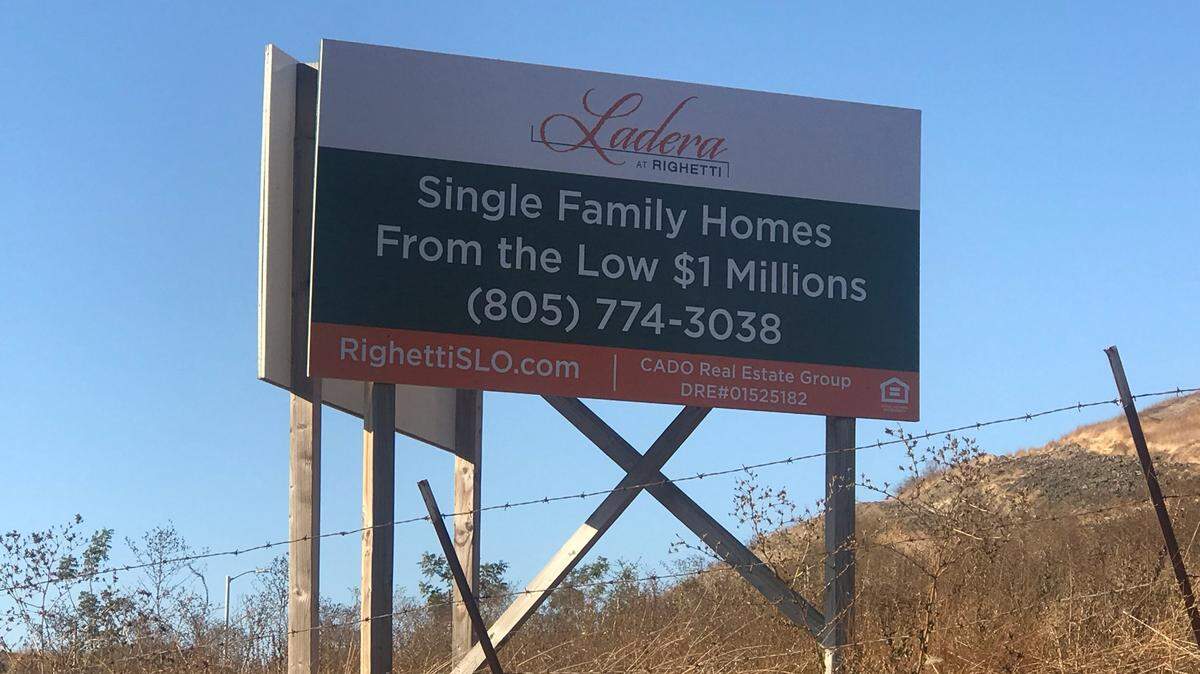
Homes in this new SLO subdivision start in the ‘low $1 millions’ — who can afford that?
Well, there goes the neighborhood.
Here we are, in the midst of a housing affordability crisis, and the new, 64-unit Ladera phase of Righetti Ranch has billboards up, advertising hillside homes priced “from the low $1 millions.”
Reactions have ranged from incredulity to how-can-they-get-away-with-that?
Here’s a sample from Facebook:
“Holy s---!”
“Guess I won’t be moving back!”
“I can’t believe they had the nerve ... to put this on a sign.”
“Why would the city even allow zoning for this?”
The answer is simple: This is America. The city of San Luis Obispo can’t ban million-dollar homes, any more than it can tell downtown boutiques to stop selling jeans for $250.
Cities can require builders to include a percentage of affordable homes in their projects, or pay fees used to help finance low-cost housing in other locations — San Luis Obispo has been doing that for years.
(For the record, Righetti Ranch developers are meeting the requirement by providing a graded building site for Tiburon Place, an apartment project that will include 67 units for low, very low and extremely low-income residents.)
But there’s currently no requirement for builders to include homes in the mid-price range, say $500,000-$600,000.
As a result, many families find themselves caught in the middle. They earn too much to qualify for subsidized housing, but not enough to afford market-rate homes typically priced at $700,000 and up.
We don’t begrudge home builders a profit — or buyers their dream homes — but charging more than $1 million for 3- and 4-bedroom homes on average-sized lots is a scary new benchmark..
Is ‘workforce’ housing the answer?
A couple of decades ago, a new category of housing entered the urban planning vernacular: “workforce.”
The designation is generally applied to households earning between 120% and 160% of an area’s median income. In San Luis Obispo County, that works out to $73,500 to $98,000 a year for a single person.
Workforce housing has become a buzzword that homebuilders often use to help persuade planning commissions and city councils to approve their projects. It’s also used to market homes to prospective buyers.
For example, Avila Ranch, an approved, 720-unit development in San Luis Obispo, advertises “real affordability, with 550 homes affordable to the local workforce” on its website.
When the project was approved in 2017, the applicants projected houses would range from $250,000 to $750,000 in 2017 dollars, with most priced from $350,000 to $650,000 — right in the ballpark for workforce housing.
Sounds promising, right?
But since then, the project has changed ownership, and the new owners have yet to release any firm prices.
If it follows a pattern we’ve seen on the Central Coast, prices will be considerably higher than the original estimates.
One example: When the Creekstone project was approved in Arroyo Grande in 2017, a representative of the builder said prices would start at $500,000.
The project changed hands — it’s now owned by the same company that purchased Avila Ranch — and the smallest market-rate home is starting at $749,990. For that, you get two bedrooms, two baths and a two-car garage.
What can be done?
Local agencies have tried various methods to encourage builders to keep prices down, such as offering density bonuses to home builders who include workforce housing in their projects.
Results have been underwhelming. For instance, San Luis Obispo County passed a workforce housing ordinance in 2016. Not a single applicant has taken advantage of it.
At the state level, California has passed a raft of new housing laws, mostly aimed at protecting renters and increasing the supply of affordable homes.
Not as much attention has been paid to keeping home prices affordable for middle-income earners, and as a result, entire generations have been priced out of the market.
On the Central Coast, hundreds of high-priced homes have been purchased not by local families, but by retirees from SoCal and NorCal looking to cash out and settle in a more laid-back community like San Luis Obispo, Nipomo or Arroyo Grande.
We’ve got to do better.
California already requires every city and county in the state to zone enough land for low-income and moderate-income housing, but doesn’t do much to ensure an adequate supply for households earning slightly above-average wages.
That’s a huge oversight.
It’s time housing laws at every level — city, county and state — truly addressed the need to provide housing for a segment of the population that’s been largely ignored.
We can’t allow homes starting in the low-$1 millions to become the new normal.
This story was originally published November 21, 2019 at 6:15 AM.