
A crazy race for California governor where experts have been anything but | Opinion
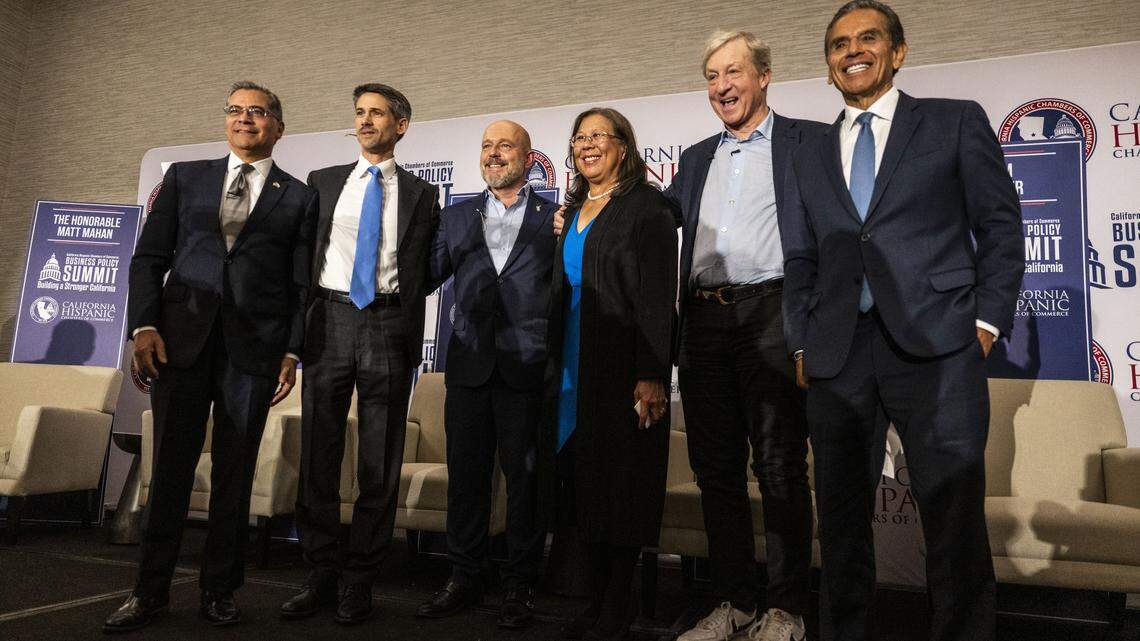
If recent history has taught us anything, it’s that we should beware predictions from pundits about California’s race for governor.
Not too long ago, some were panicking that two Republicans would advance to the general election while a large field of Democrats were left in the cold. Then President Donald Trump endorsed one of the two Republicans and BOOM, suddenly some thought the idea of two Republicans vying for the top office in liberal California was dead.
Then Democratic Rep. Eric Swalwell suddenly became a front-runner before just as suddenly dropping out amid allegations he sexually assaulted young female staffers.
This is in addition to older, moldier hot takes, such as former Rep. Katie Porter’s campaign being effectively over after videos of her being mean to staff and a reporter were leaked. We were also told that billionaire Tom Steyer’s campaign was a $100-million flop. But now, with Swalwell gone, Porter and Steyer are still hanging around while the once-pronounced dead Xavier Becerra has vaulted to the top.
It’s clear no one really has a clue what they’re talking about.
The only thing we seem to know is that there will be a new governor soon. But who among a softball team of candidates has the best plan to help the homeless? Or the best idea to spur housing production? Or lessen the cost of living? And so on.
We hear so often how boring the race is, but maybe it would be more interesting if there was more talk about improving Californians’ lives and less fortune telling.
The coalescing around Swalwell in recent weeks appeared to have been largely a result of a prevailing narrative that Democrats were in danger of being locked out of the general election. It was, and is, a possibility — but a slight one, and one that has not warranted the attention paid to it.
Contributing to the narrative was a prediction model created by Paul Mitchell, a Democratic data vendor. Sure, Mitchell’s model is fun to play with, but how could anyone take its results too seriously? Before Trump’s endorsement, Mitchell’s tool predicted a mere 17% chance that two Republicans would make it through to the general election. Then again, voters had not really been paying attention, and very little money had been spent on mail and advertising in the race. To be fair, Mitchell was transparent about the flaws in his own predictor in an article for Capitol Weekly.
But others took Mitchell as gospel, as when candidate Antonio Villaraigosa cited Mitchell’s prediction tool in a March 3 Facebook post as the reason rival Xavier Becerra should drop out or risk a 27.6% chance of sending two Republicans to the general election. At the moment, polling in front, Becerra is probably glad he didn’t listen.
Fortune tellers can’t possibly account for the random events that happen in campaigns, like Trump’s endorsement, Swalwell’s fall or how direct voter contact might influence public opinion.
Yet two Republicans advancing was all we heard about for weeks, even though it was unlikely. So unlikely, in fact, that Mitchell tweeted a year ago: “Uhm, no. Mathematically, yes… but in reality, no.”
California Democratic Party Chairman Rusty Hicks has helped fuel the narrative by sending a letter to Democratic candidates urging lower performing candidates to drop out and by publishing consistent tracking polls.
“If you do not have a viable path to make it to the general election, do not file to place your name on the ballot for the primary election,” Hicks wrote.
Who can say which candidate is viable a few months out, with such a large field of hopefuls? Many of the people Hicks tried to ease out of the race are current or recent former statewide office holders and current or former large city mayors.
When Trump endorsed former Fox News host Steve Hilton, it seemed everyone was convinced it would end Riverside Sheriff Chad Bianco’s race. And yet Trump was not enough to help Hilton secure an endorsement by the California Republican Party. Neither one got the endorsement but Bianco came in first.
Of course, Becerra, Porter or Steyer might pull away. Maybe two of them advance to the general election and Republicans fail to make it through the top two. Or maybe the opposite happens, where some of the lower-performing candidates pick up steam and split the vote enough that two Republicans make it through. Or maybe the next governor ascends from the ranks of poor poll performers lacking a “clear path to victory,” that Hicks has been harping on.
The recent push for Swalwell among many current office holders and powerful special interest groups like the California Teachers Association and SEIU California shows the pitfalls of hasty endorsements of unvetted candidates.
Do we want the race determined by insiders making predictions or voters making good, informed decisions?
Let voters decide.
Matt Fleming is an opinion writer living in Placer County. You can follow him on X @Flemingwords or connect via email: flemingwords@gmail.com.
This story was originally published April 22, 2026 at 5:00 AM with the headline "A crazy race for California governor where experts have been anything but | Opinion."