One SLO County supervisor compared ICE to the Gestapo. So how do we stay safe? | Opinion
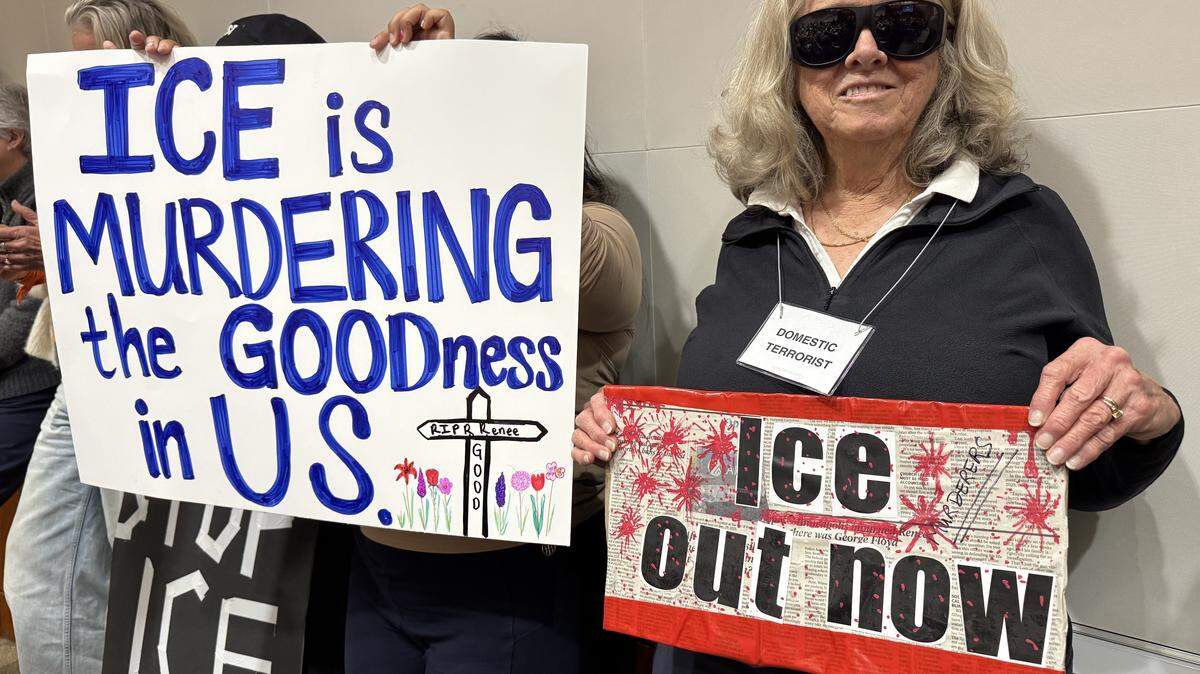
Retired nurse Peggy Sharpe left Tuesday’s marathon TRUTH Act meeting early — and in disgust.
“It’s a waste of time,” she said. “The issue is, we want ICE out of our county.”
That sums up the disconnect between the elected leaders of San Luis Obispo County and the overwhelming majority of attendees at the state-mandated meeting — basically an annual recap of interactions between federal immigration officers and the Sheriff’s Office.
Throughout roughly four hours of public comment, the Board of Supervisors listened to pleas to push back harder against ICE, as counties such as Santa Clara, San Mateo, Santa Cruz, Los Angeles, San Francisco and Alameda have done.
Those counties refuse to cooperate with ICE, even to the limited extent allowed under California law.
They rarely provide advance notice when jail inmates are released, refuse ICE transfer requests entirely, and require a warrant signed by a judge before they allow ICE to take someone into custody. (Counties cannot refuse to follow a valid judicial order.)
San Luis Obispo County, on the other hand, is more willing to cooperate with ICE when serious crimes are involved; 69 inmates were released into ICE custody last year.
Sheriff Parkinson: ‘We have no involvement’
On the spectrum of how California counties have reacted to ICE, SLO’s response could be described as limited cooperation.
Sheriff Ian Parkinson assured the board that his office does follow all state mandates that prohibit counties from assisting ICE with routine immigration enforcement.
“We have no involvement in what they’re doing,” he said.
None of the supervisors accused Parkinson of acting inappropriately. That included Bruce Gibson, who raised some of the most pointed questions about the sheriff’s dealings with ICE.
The Sheriff’s Office, Gibson said, is not an “arm of the immigration authorities. ICE, border patrol or any others.”
To many who testified Tuesday, though, it appeared the Sheriff’s Office is far too cozy with immigration officers. For instance, ICE had been allowed to enter the lobby of the jail, where they can immediately intercept newly released inmates as they walk out the door.
A purple county with a Republican sheriff
Realistically speaking, limited cooperation — versus a hard-line, no cooperation approach — appears to be about as far as San Luis Obispo County is willing to go.
Unlike Santa Clara, San Mateo or Santa Cruz, San Luis Obispo is a purple county with a Republican sheriff, and while Democrats hold a majority of seats on the board, as an elected official himself, Parkinson calls the shots.
That means he uses his discretion to turn some inmates over to ICE on account of serious, prior convictions such as murder, assault, rape, domestic violence and robbery.
Supervisors did not object to that — most residents probably wouldn’t, either. In fact, the majority would almost certainly welcome it.
The concern is for immigrants who have not committed serious crimes yet are unwittingly caught up in ICE raids — as well as for children who may be left behind when a parent is deported.
“ICE, in particular, is violating constitutional rights. They are taking people without due process,” said Supervisor Dawn Ortiz-Legg. “For me, the most important thing is what we are doing for our immigrant community who is under attack.”
While the board had limited options, it did take some action, which could be described as either a glimmer of hope or, as one Facebook poster expressed, “kicking the can down the road.”
A task force and a study
Ultimately, after about seven hours of hearing from the sheriff and the public and sharing their own concerns, supervisors voted 5-0 to ask county staff to investigate the following proposals and to report back in 60 days:
- Ban immigration officers from “nonpublic facilities” and prohibit them from “commandeering” county spaces for their operations. (Designating ICE-free zones is apparently off the table, since local public safety officials say their officers would have to enforce it, putting them in harm’s way.)
- Require quarterly reporting of the sheriff’s responses to and interactions with ICE.
- Examine how other counties are dealing with immigration enforcement issues.
- Find ways to ensure that when a parent or guardian is deported, family members who are left behind are cared for.
The board also agreed to form a task force that would include the sheriff and Supervisors Ortiz-Legg and Jimmy Paulding.
Along with that, there was some acknowledgement of the danger ICE poses to the public — with the most damning words coming from Supervisor Gibson.
“It is absolutely repugnant to me that we have anonymous, mass paramilitary secret police who are engaged in a conscious campaign of intimidation, and they are out of control,” he said.
“They are, in fact, acting as the Gestapo. It took me some weeks to use that term, but it is evident in their recent absolute atrocities committed in Minneapolis and elsewhere across this country.”
A Latina citizen never goes out without her passport
Following such strong language, the direction the board ultimately took seemed mild by comparison.
Forming a task force and instructing staff to report back in 60 days does not meet the urgency of the moment — especially when ICE is gunning down people in the streets.
Besides, there’s no guarantee the board will ultimately approve any of the measures being considered.
But this does not rest solely with the board. Sheriff Parkinson could take some steps on his own, without a nudge from a task force.
Agreeing to release more information about interactions with ICE should not require a 60-day wait and a formal policy.
Nor should banning ICE from the jail lobby, both in the interest of public safety and to allow the sheriff’s staff to work in peace.
And if social service agencies and nonprofits aren’t already tuned in to help families that have been split apart by ICE, they have some immediate catching up to do.
Look, we can’t kick ICE out of SLO County.
Neither can the state. So far, it hasn’t even been able to enforce its ban on face coverings, which is still wending its way through court.
That doesn’t mean we should give up on civil remedies, but we also need more immediate measures.
We need guardrails to curb the excesses of ICE, especially for residents who are targeted based solely on race —a practice so pervasive that one Latina citizen told supervisors she never leaves home without her passport.
These are families living in constant fear, reluctant to contact law enforcement for any reason — even to report a minor crime, which is the exact opposite of what local law enforcement wants.
Wait two months? With all due respect, they should not have to wait even one more day.
This story was originally published January 29, 2026 at 5:00 AM with the headline "One SLO County supervisor compared ICE to the Gestapo. So how do we stay safe? | Opinion."