
‘Miracle on Ice’ spawned a patriotic myth that died when the red Trump hats came out
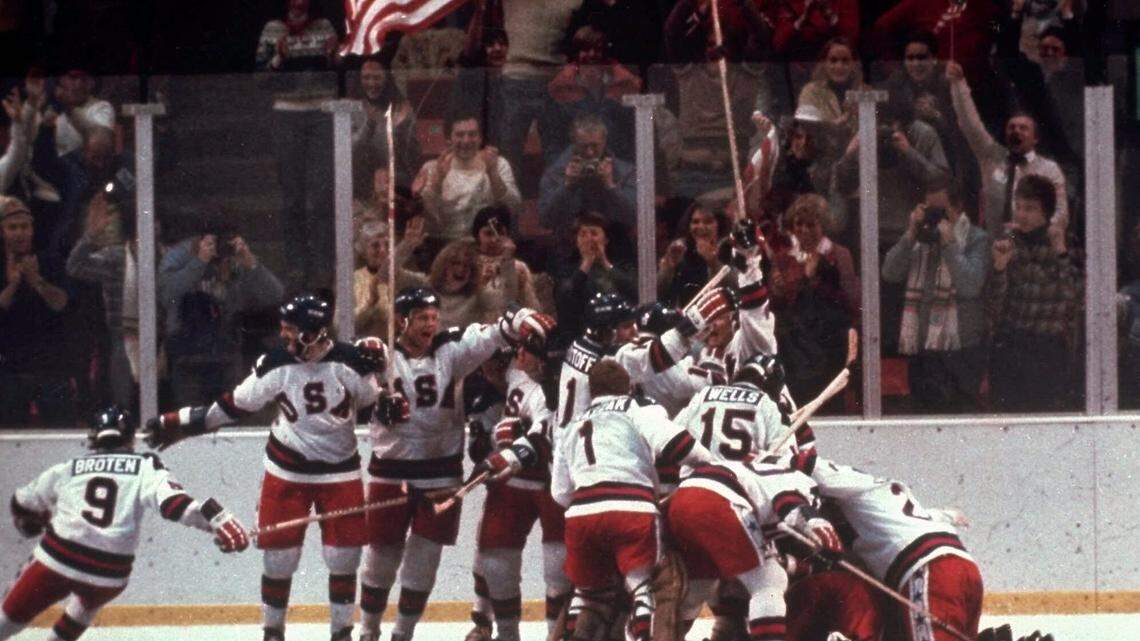
The sports event that had the biggest impact on my life was the “Miracle on Ice” triumph of a ragtag group of American college hockey players who – somehow, some way – defeated the mighty Soviet Union juggernaut of perpetual champions at the 1980 Winter Olympics. I have never reacted as viscerally to a sporting event or a cultural event as I did on that momentous night on Feb. 22, 1980.
At the time, I was a 17-year-old high school senior who was as impressionable as could be. I was preoccupied by the possibility that my country would soon go to war with Iran because that nation had kidnapped American diplomats and workers from the U.S. embassy in Tehran. Truthfully, my simplistic high school brain told me that I was ready and willing to fight Iran in order to avenge the capture of Americans by a hostile nation that thumbed its nose at us and chanted, “Death to America.”
Such chants were broadcast into our living rooms every day by then powerful national networks. They became derisive jeers from Iran after a U.S.-sanctioned attempt to rescue the American hostages failed miserably. With Watergate, the resignation of President Richard Nixon and the disaster of the Vietnam War still ringing in our ears, the winter of 1979-80 was a tough time for the American spirit.
That hockey win, a 4-3 triumph before a home crowd at Lake Placid, NY, made us all feel better. It created the feeling in our minds that, “Hey, we’re still tough. We’re still great.” That feeling was an illusion, of course. If our American boys had played the Soviets again in that tournament, it’s a safe bet they would have wiped the ice with us as they had in New York only days before the 1980 games.
The “Miracle on Ice” players, and their late coach Herb Brooks, became crossover celebrities like few sports figures do anymore. They were everywhere, from Main Street America to Madison Avenue to Hollywood.
For years, I would only have to think about their victory to get choked up all over again. Less than five months after the “Miracle on Ice,” President Jimmy Carter signed Proclamation 4771 – which started registration for military service for young men born after January 1, 1960. I was born in November of 1962 and when I got my notice, I went down to the local post office and registered immediately.
My inspiration was the “Miracle on Ice” team. They had filled me full of jingoistic passion that I was willing – I thought – to lay my life on the line for my country. I didn’t realize it then, but the “Miracle on Ice” was a shining example of how sports can serve as narcotic, filling us full of delusions that don’t hold up when the high has passed.
Sports, nationalism collide in the Cold War
It was a quintessential moment where sport and nationalism intersected like a match and a fuse. Can you imagine? In my mind, at that time time, I was willing to put my life on the line because of a hockey game? I didn’t know these hockey players. They were mostly from Minnesota and Boston, places I had never been to. I didn’t know anything about their lives or who they were. All I knew was that they beat the super power Soviet Union, our enemies in the Cold War that was still raging.
It didn’t matter that the U.S.-Soviet hockey game was not shown on live TV. It didn’t matter that all of us knew the final score before we tuned into ABC to watch the game that night. Just as people older than me remember where they were when JFK was assassinated, I remember exactly where I was when I learned of the “Miracle on Ice”: At my parents’ home in San Jose. I was watching a sports network that was less than a year old and called ESPN.
For years later, no matter where I was, I could bring myself to tears simply by recalling that victory. This was the case even after the Soviet Union fell. In fact, this feeling lasted for decades and I’d mark the major anniversaries of the “Miracle on Ice” with the same fervor as I had years ago.
I did so even though I had come to realize how lucky I was that my country never went to war when I was of the age to serve in the military. How lucky I was to have not been killed or maimed because of misplaced feelings of jingoism inspired by the “Miracle on Ice.” I hung onto my feelings of nostalgia for the “Miracle on Ice” even after I had come to despise the unholy alliance of sports and nationalism.
Kaepernick, Rapinoe trashed by Trump
The greatness of America, to me, is the ability to both celebrate and question our past. But in sports, this is not the case. Just ask Colin Kaepernick, the former 49ers quarterback who was blackballed by the NFL for kneeling during the Star Spangled banner in protest of police brutality. Ask Megan Rapinoe, the American women’s soccer hero, who was trashed by President Donald Trump and homophobes everywhere for speaking her mind about pay equity for female athletes.
Ask LeBron James, who is mocked routinely by Trump and his propaganda arm of Fox News. James is told to “Shut up and dribble.”
The “Miracle on Ice” guys were perfect for adulation because they were all white, fresh faced and eager to embrace the flag without question.
There is a saying in sports that demands that athletes, “Stick to sports.” But that’s a lie. The demand is only made of athletes who dare to ask questions about their country, as is their right. When the NFL wraps itself in the flag, it’s a political act and the “Stick to Sports” crowd has no problem with that. And it’s not just the NFL; every sports league does it. So does that once brand new network called ESPN that has rid itself of sports personalities for questioning Trump.
That’s why it should have come as no surprise to me or anyone else when, over the weekend, several of the “Miracle on Ice” guys appeared at a Trump rally wearing red hats. They happily allowed themselves to be used as props for a President who is popular with white nationalists and who denigrates people of color constantly.
When I saw the image of the team as old white men wearing red hats next to Trump, the spell was finally broken. The shelf life for this fantasy had run out for me.
These guys didn’t represent a unifying force in America. They represent a certain way of thinking in America that has only hardened and become weaponized. And those of us who thought we were in the big tent of patriotism when we were cheering those guys were clearly mistaken.
It wasn’t a miracle at all. It was a lucky win that spawned a myth that died when the red hats came out and the truth was revealed.
This story was originally published February 25, 2020 at 10:08 AM with the headline "‘Miracle on Ice’ spawned a patriotic myth that died when the red Trump hats came out."
