
Weather disasters can happen at any time. Here’s how SLO County prepares for the worst
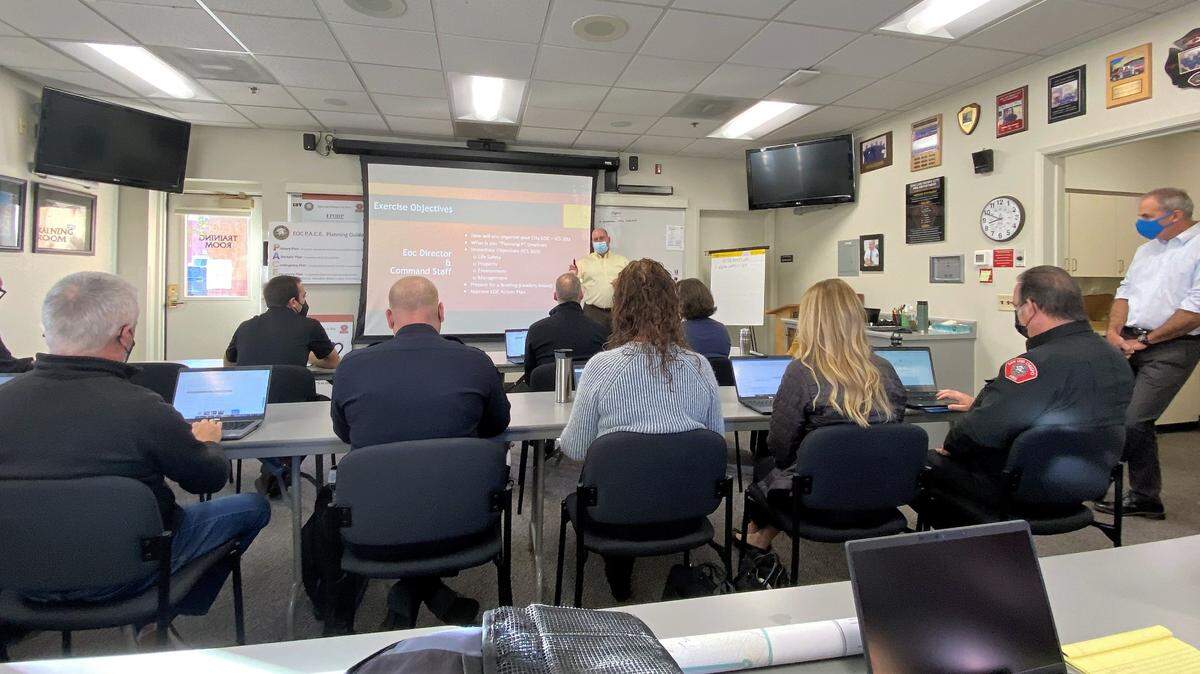
I got to participate in a severe-weather response drill for the city of San Luis Obispo last week with former fire chiefs Steve Knuckles and Robert Lewin. It was in preparation for their training at FEMA’s Emergency Management Institute to enhance their capabilities to minimize the impact of disasters on the public.
San Luis Obispo and Barbara counties have some of the best weather in the world. Because of our idyllic conditions, Central Coast residents are often lulled into a false sense of security about the possibility of a natural disaster, but they do occur.
For example, in March 1995, a storm developed about 900 miles off California’s Central Coast and caused an intense cold front to stall over our area. It tapped into a plume of subtropical moisture that stretched to Hawaii, which became a massive river of water vapor in the sky.
This atmospheric river (AR) hosed the Central Coast with enormous amounts of rain, which caused extensive flooding. Rainfall amounts ranged from a low of 3.0 inches at the Santa Maria Airport to 11.6 inches in Santa Margarita. The stalled cold front was accompanied by gale-force to storm-force (55- to 73-mph) southeasterly winds in the coastal regions of the Central Coast.
In 1969, nearly 40 inches of rain was recorded in San Luis Obispo during January and February. It turned the area where Costco and Home Depot are located along Highway 101 and Los Osos Valley Road into a vast lake.
Many years ago, my grandmother, Frances Graham, passed along this bit of family folklore to me from her mother about a deluge of biblical proportions. The flood devastated their farm in Colusa County. She said it was like nature taking revenge for the hydraulic mining during the California Gold Rush. Many called this flood the “Noachian deluge of California Floods.”
Toward the end of 1861, a series of storms produced nearly continuous rain that lasted through February over most of California. Los Angeles recorded about 36 inches of rain, while Sonora in the Sierra Nevada foothills measured more than 100 inches!
By February 1862, the Sacramento and San Joaquin valleys became almost an inland sea stretching nearly 300 miles in length, forcing the state capital in Sacramento to move to San Francisco. San Francisco and San Pablo Bay’s typically salty waters became almost fresh with a continuous and unimaginably heavy flow of silted water through the Golden Gate.
The Santa Ana River in Southern California became a raging torrent, laying waste to farms along its banks. River settlements throughout California were inundated.
Weather data from so long ago is sparse. However, a few weather experts believe that an AR stretching across the Pacific Ocean was responsible for channeling vast amounts of precipitation into the state.
Less than two years later, a terrible drought-ravaged California. Dan Krieger, professor emeritus of history at Cal Poly, wrote, “By the fall of 1863, many traditional watering holes were low. Nojoqui Falls (pronounced Naw-ho-wee) just south of Buellton disappeared for the first time. So, too, did the Santa Ynez, Cuyama, Nacimiento and San Antonio rivers. Santa Rosa Creek along the North Coast also dried up. The skies were unusually filled with buzzards. Grizzly bears and wolves that had virtually vanished for a decade began to appear out of the Santa Lucia and coast ranges, pursuing the helpless, dying cattle. Soon, they would also fall victim to the relentless drought.”
In 1863, none of our manmade lakes or reservoirs were built yet, dramatically adding to the drought’s severity.
The magnitude of the above perils put into sharp focus the need for all of us to prepare for natural disasters. As Rick London of United Way will tell you, the canard that “an ounce of prevention is worth many pounds of cure” certainly rings true.
However, the real trick is to bring community members with different experiences and skill sets together and work as a team to prepare, execute and recover from various emergencies that can occur simultaneously. I witnessed the importance of this type of preparedness firsthand when I attended a training event at FEMA’s Emergency Management Institute in Emmitsburg, Maryland, a few years ago.
Law enforcement, fire, medical, education, county and city officials, and representatives from the private sector came together to learn how to work as an integrated team.
This group of first responders began each training day with lectures taught by knowledgeable instructors with years of firsthand experiences, such as the 9-11 attacks, the Oakland Hills fire, and hurricanes Katrina and Sandy. These classes progressed into scenario-related, large-scale exercises of increasing complexity and threat that required participants to work as a team successfully. In other words, the FEMA instructors tossed various scenarios to the students, from wildfires to tsunamis and everything in between. The results were stunning.
Certified Emergency Management Specialist Dave Mathe was so impressed with the quality of training and the potential to save lives and property that he donated almost 1,000 hours of his own time to apply for the federal grant and coordinate participants. The federal funding covered the costs.
Tracey Vardas, manager of emergency management and public safety exercises with PG&E, told me, “It was some of the most comprehensive and coordinated training evolutions I’ve been involved with. This type of community-based interaction will certainly help all of us prepare for future emergencies.” This same praise was echoed by other attendees.
The federal grant covered the costs, which was particularly valuable when local training budgets were strained.
Training like this will be needed even more in the future, as the atmosphere and oceans continue to warm, and storms become more severe.
“We are living in a time of climate extremes; longer droughts, deadly wildfires in winter months, storms that confound meteorological modeling, and baking temperatures that are killing our elderly. So while we must reduce and reverse our carbon emissions, we must simultaneously change our paradigm and strengthen our preparation and increase our ability to respond to the devastating impacts of climate extreme induced disasters,” Lewin told me.