
Powerful king tides are coming to Central Coast beaches. This is why
Starting on Saturday, Nov. 14, and continuing through Tuesday, we will see the phenomenon of so-called “king tides” along our beaches.
King tides are the highest and lowest of the year, separated by less than 12 hours.
The term originated in Australia and spread throughout the rest of the nations that border the Pacific Ocean. It is now used in most coastal regions of the world to describe these extra-high tides.
King tides can occur any time of the year but tend to arise more often during late fall into early spring, and here is why.
Gravitational forces exerted by the moon and sun create the timeless tides. When the sun, earth and moon are closest together, the more extreme the tides will be.
Earth’s orbit around the sun is really an ellipse, a shape that can be thought of as a stretched-out circle or an oval. The Earth comes closest to the sun in the Northern Hemisphere’s winter, which is called perihelion. This will occur on Jan. 2, 2021, when the Earth is 3.1 million miles closer to the sun, as compared to aphelion when the Earth is farthest away on July 5, 2021.
Not only is the Earth’s orbit around the sun an oval, but so is the moon’s orbit around the Earth. The moon is about 30,000 miles closer to Earth at perigee than apogee when it is farther away.
During perihelion and perigee, the tides are the highest. The gravitational forces’ tugging produces a tidal bulge — an area of higher sea level on the ocean’s surface.
As Earth rotates eastward on its axis, the Central Coast moves into this bulge, which produces a flood tide and, eventually, a high tide.
As Earth continues to spin, we move into an area of below-normal sea level, or nodes, which produce an ebb tide, eventually reaching low tide. The slack tide is when the tide is not coming in or going out.
Overall, the maximum tidal range along the Central Coast ranges from more than two feet below the mean low water mark to more than seven feet above it, for a tidal range of more than nine feet. Typically, we experienced two low and two high tides per day.
When to expect king tides on California’s Central Coast
The highest predicted tides will happen on Friday through Tuesday during the morning when the predicted high tides will range between 6.5 and 6.7 feet. That will be followed by a minus low tide of 1.4 feet during the afternoon. In other words, the level of the sea will shift 8.1 feet in less than eight hours.
Those flood and ebb tides will create ripping currents in California’s bays and estuaries.
Not only will the currents be powerful, but the high sea and swell could cause minor tidal overflow during high tide, especially on Tuesday.
On that day, an 8- to 10-foot westerly swell (with an 8- to 12-second period) is forecast to arrive along the Central Coast and combined with increasing southerly winds and seas will create a low storm surge.
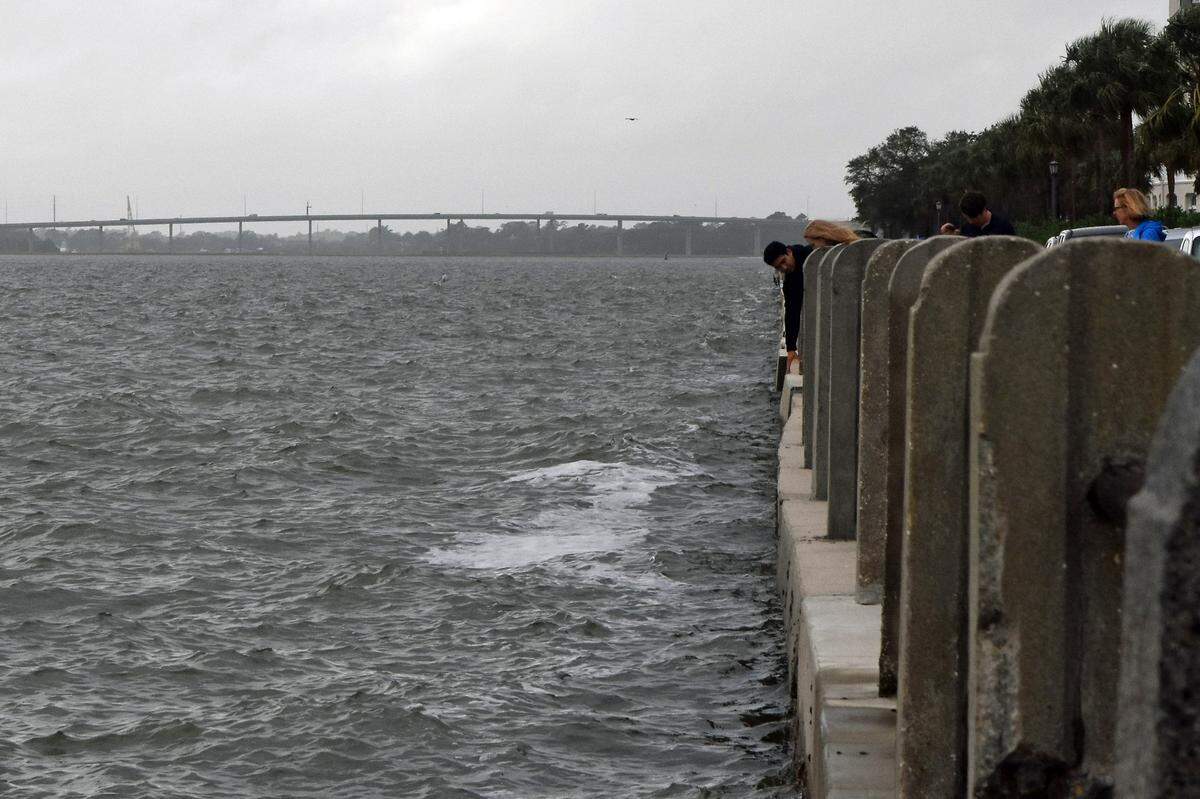
Flooding, rising sea level in South Carolina
On the East Coast, these high tides produce huge problems with nuisance flooding, which leads to public inconveniences such as streets and road closures. Unfortunately, as the sea level continues to rise, it is becoming progressively more common in the coastal regions.
In years past, this type of flooding only occurred during storms when fierce winds produced storm surge and large wind-generated waves combined to make seawater intrusion or during the king tides.
Our family visited Charleston, South Carolina, last week.
They call it the Low Country, and for good reason; much of this colonial-era city lies only a few feet above mean sea level. It has been estimated that nearly 8,000 homes could flood numerous times a year in the greater Charleston County area if the sea level rises by two feet.
Our tour guide told us that work to elevate and strengthen the entire Battery Seawall, which protects the Charleston Old and Historic District from the Atlantic Ocean, will continue for years.
How to avoid a utility bill scam
Every day, electric and natural gas customers throughout the country are being targeted by utility bill scams. These imposters typically target customers online, in person and by telephone.
This year is even worse due to the ongoing financial impacts of the COVID-19 pandemic.
PG&E is taking a stand against scammers by joining its fellow electric, natural gas, water utilities and Utilities United Against Scams (UUAS) in helping customers recognize potential bad actors during Utility Scam Awareness Week from Nov. 16 to 23.
To learn more, please visit www.pgecurrents.com.