
How much rain does SLO County get during the wet season? Check the rainfall records
During our wet season, the jet stream predominantly blows across the northern Pacific toward the east, helping to carve out storms and then pushes and drags them into the West Coast of the United States.
At our latitude, the jet stream, aka “the steering wind,” is typically a tubular ribbon of high-speed winds flowing in wavelike patterns for thousands of miles between 15,000 to 40,000 feet up. It is often about 300 miles wide at its core and averages about 100 mph in winter and 50 mph in summer.
During the late fall, winter and spring, the jet stream is more likely to be centered over Northern California and Oregon. For that reason, on average, Northern California receives two to seven times more precipitation than Southern California.
As you head from north to south along the California coast, Crescent City, near the Oregon border, receives about 71 inches of rain per year.
As you head south, Eureka annual rainfall is 40 inches, and Santa Rosa records about 30 inches. Farther south, San Luis Obispo records around 22 inches at Cal Poly and Santa Maria gets 13 inches at the airport. Los Angeles records 12 inches, while San Diego only receives about 10 inches per year.
Like Point Conception, which is frequently a boundary between the cold seawater of Northern California and the warmer waters of Southern California, the Central Coast is often the transition zone from wet to arid conditions.
We know this by reviewing rainfall records. It’s believed that the first weather observations that were written down and still exist in California were by Captain John C. Frémont’s exploration partly in New Helvetia, centered in present-day Sacramento in March 1844.
The longest continuous rainfall observations that I could locate in California are Monterey, San Francisco, Sacramento and San Diego from the late 1840s through the early 1850s during the Gold Rush.
Thomas Tennet started his daily rainfall observations in San Francisco in 1849. He had to relocate his weather station from one site to another through the years due to building fires that were common back then.
The longest continuous rainfall observations that I could find for the Central Coast is maintained by the Cal Poly’s Irrigation Training and Research Center, available online at www.itrc.org. The center celebrated its 30th anniversary this year; its motto is “moving water in new directions.”
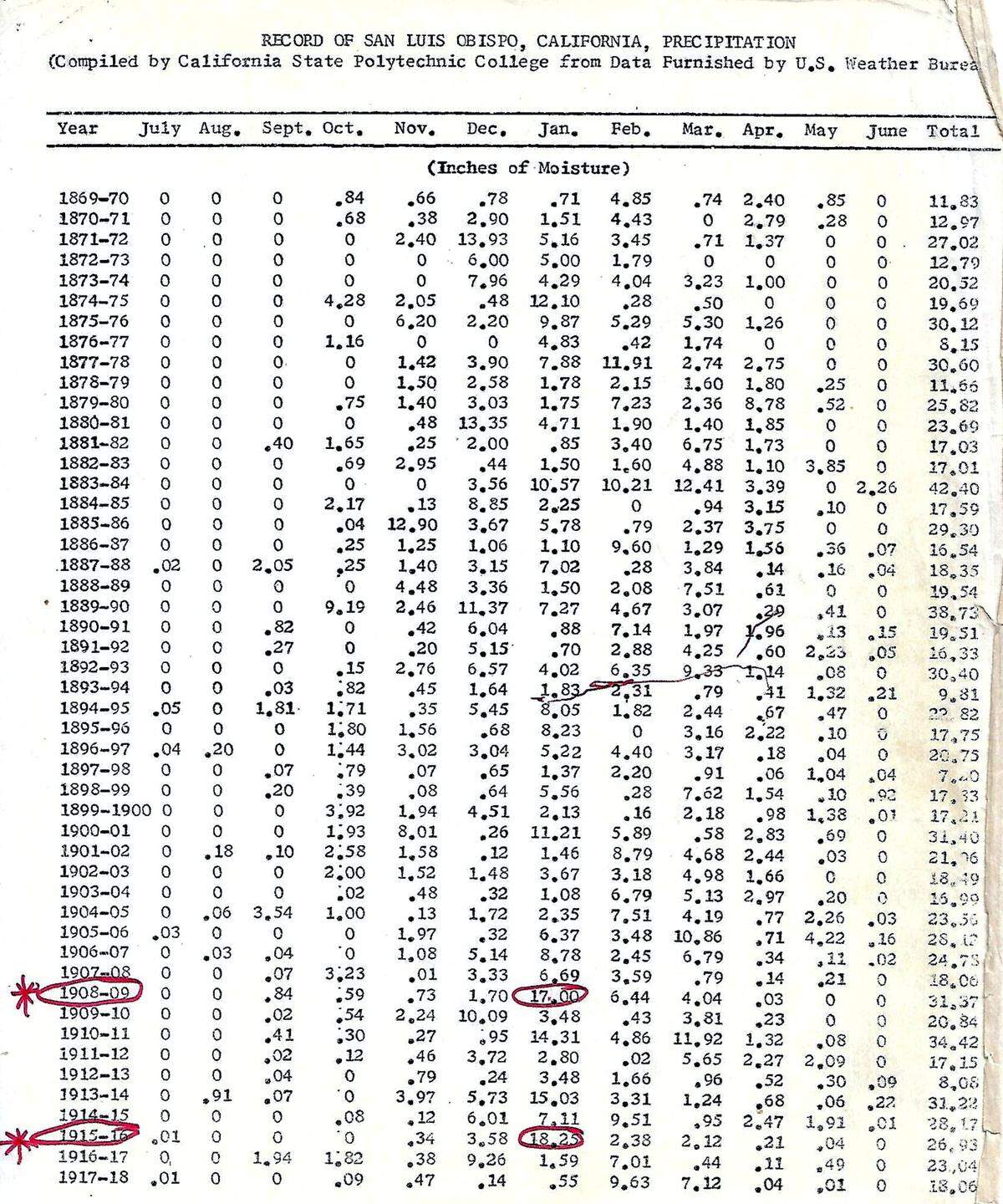
The first monthly recording in this data set occurred in October 1869 with a reading of 0.84 of an inch of rain. Only 11.83 inches of moisture was reported for that rainfall season (July 1 through June 30).
To put that in perspective, weather records did not start in downtown Los Angeles until July 1, 1877.
We are blessed to have one of the longest records of climatology in California, stretching back over 150 years. As our climate continues to change, these long-term records will become more critical.
But if Cal Poly was not established until 1901, where did the early data come from?
John Slayton of Azusa has researched the history of weather stations throughout the west. According to Slayton, frontier doctor W.W. Hayes moved to San Luis Obispo in 1866 and kept daily temperature and rainfall records that he sent to the Smithsonian Institution.
At the time, Joseph Henry, then secretary of the Smithsonian Institution in Washington, D.C., envisioned that storms could be predicted by telegraphing ahead of what was on the way.
In 1885, the U.S. Army Signal Corps, the forerunner of the National Weather Service, installed the weather station on top of the Andrews Hotel in downtown San Luis Obispo. When the hotel burned down, the weather station was moved to various downtown locations, including the Andrews bank building, from 1894 through 1927.
In 1927, the station was moved to Cal Poly.
For many years, the Cal Poly University Police Department recorded weather data, mostly because the officers were on duty around the clock.
If the temperature fell below freezing in the middle of the night, police contacted the Crop Science Department, which would take steps to protect sensitive plants from frost.
Today, students and staff from the ITRC maintain the Cal Poly weather station and assorted rain gauges. Their observations are officially archived and certified by the National Climate Data Center (NCDC).
NCDC was designated by the Federal Records Act of 1950 as the official United States archive for climate data records.
Weather data from this station can be viewed at www.itrc.org/databases/precip.
Siren tests
On Saturday, Aug. 22, the Annual Early Warning System Sirens Test will occur at noon and again at 12:30 p.m. No action is required. It is only a test. Additional emergency information can be found at www.ReadySLO.org.