
Now is the best time to catch California sunsets and sunrises. Here’s why
Along the California coast, the best time of the year for sunrises and sunsets is winter. Here’s why.
Obviously, the first reason is the days are the shortest, so you can enjoy a gorgeous sunset before dinner, or sunrise as you leave home for work, school or other activities, like photography.
The other reason is the winter weather patterns.
You see, along the California coastline, the fall and winter experience the highest occurrence of northeasterly winds that blow from the land out to sea. These winds descend from the higher elevations of the coastal ranges and flow downward along the mountain slopes toward the Pacific Ocean, pulled by the never-ending force of gravity.
If the air is mild at the top of the mountain range, it can be warm and bone dry by the time it reaches the beaches below due to compressional heating, keeping the marine layer out to sea and the skies sparkling clear and haze-free.
Along most of the California shoreline, they are also referred to as “offshore” winds. The winds that blow out of the northwest are called “onshore” winds; these winds often bring the gray-coastal stratus clouds with fog, mist and haze to coastal regions. However, the northwesterly winds can be offshore along the coastline that faces southward, like Santa Cruz, Cayucos, Avila Beach and southern Santa Barbara County.
These downslope or katabatic winds are called by different names throughout the world.
In Southern California, these downslope winds are called the “Santa Anas.” These famous winds may have gotten their name from the Santa Ana Mountains. However, some Southern Californians believe that the traditional name is Santanas. That name was occasionally used in early reports. In Northern California, these downslope winds are called “diabl”o winds.
Even relatively small geographic areas will have their own unique name for these winds, in southern Santa Barbara County, they’re referred to as “sundowners.” The downslope winds in San Luis Obispo County are called “Santa Lucias” after the Santa Lucia Mountains. In northern Santa Barbara County, they are named the San Rafaels after the San Rafael Range.
Whatever you may call these winds, they often lead to spectacular sunrise and sunsets as they keep the coast fog-free. Higher up in the sky, the jet stream, that fast-moving river of air which blows the strongest in winter, carries bands of cirrucumulus (high-level clouds) and altocumulus (medium-level clouds) across the skies.
During the day, most of visible light from the sun, the shorter wavelengths of blue and violet light, are scattered by the air we breathe to a much greater extent than the red and yellow hues — that’s why the sky is blue.
As the Earth rotates eastward, the sun’s light strikes the atmosphere at a lower and lower angle after midday toward sunset; in fact, the atmosphere is about 12 times denser at sunset than at midday. At sunrise and sunset, most of the sun’s light that is visible to the human eye is the longer wavelengths of the reds and yellows.
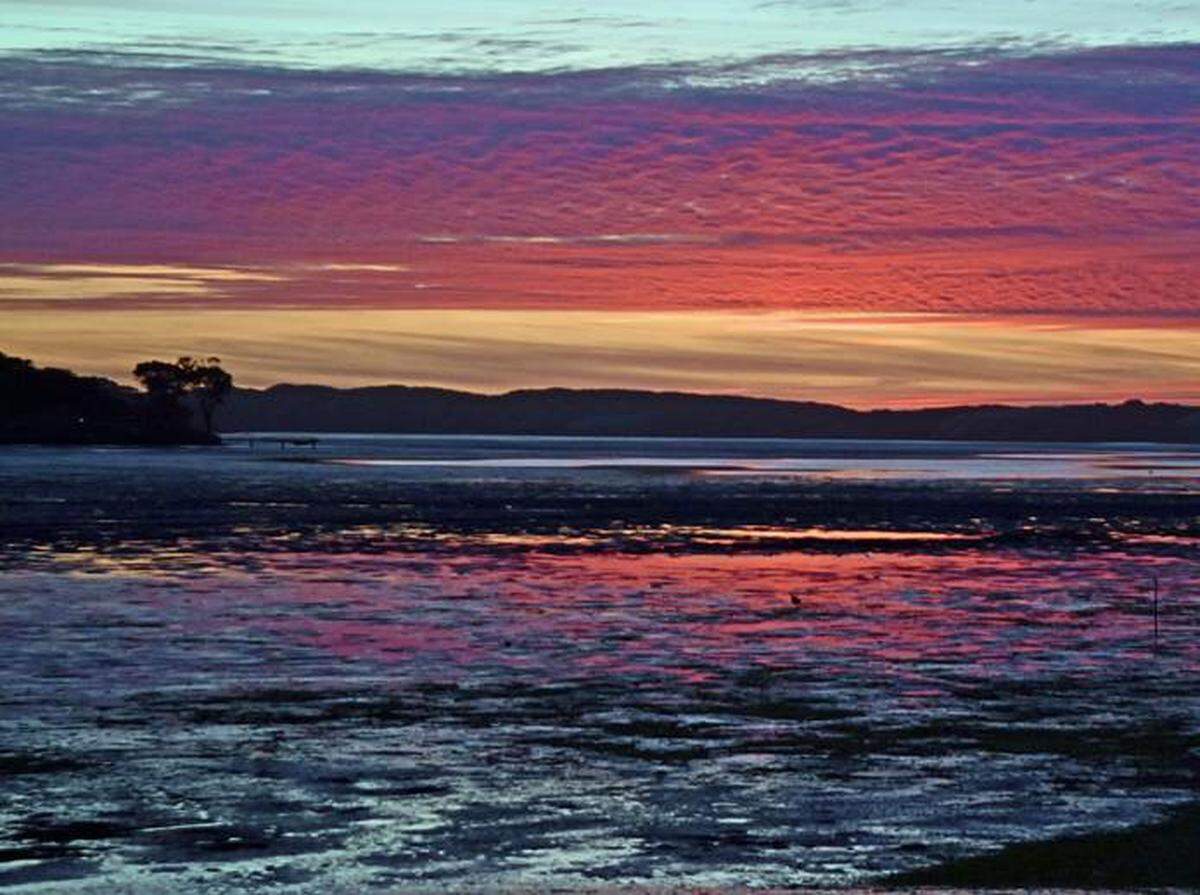
The most beautiful sunrises and sunsets occur when there are breaks in the clouds, which allows the sun’s rays to illuminate them to the maximum extent.
Last week, I took a photo of a sunset along Morro Bay at Baywood Park.
It was a low tide, which exposed the silvery-colored mudflats to the air. The clouds overhead turned to hues of red and orange, but the mudflats become a shade of vivid pink.
I contemplated this color, and it dawned/set on me, it was Madonna Inn Pink, the same color as their famous pink champagne cake. The white silver of the mudflats combined with the red of the clouds must have produced this intense color.
PG&E scholarships
PG&E announced that scholarship applications are now being accepted for college-bound high schoolers as well as current college and continuing education students. More than 150 awards totaling nearly $500,000 are available. PG&E scholarship information, including criteria and applications, is available on PG&E’s website. To be considered for a scholarship, all applications must be submitted by Feb. 7.
This story was originally published January 26, 2020 at 5:00 AM.