
Expect classic springtime weather this week. See the SLO County forecast
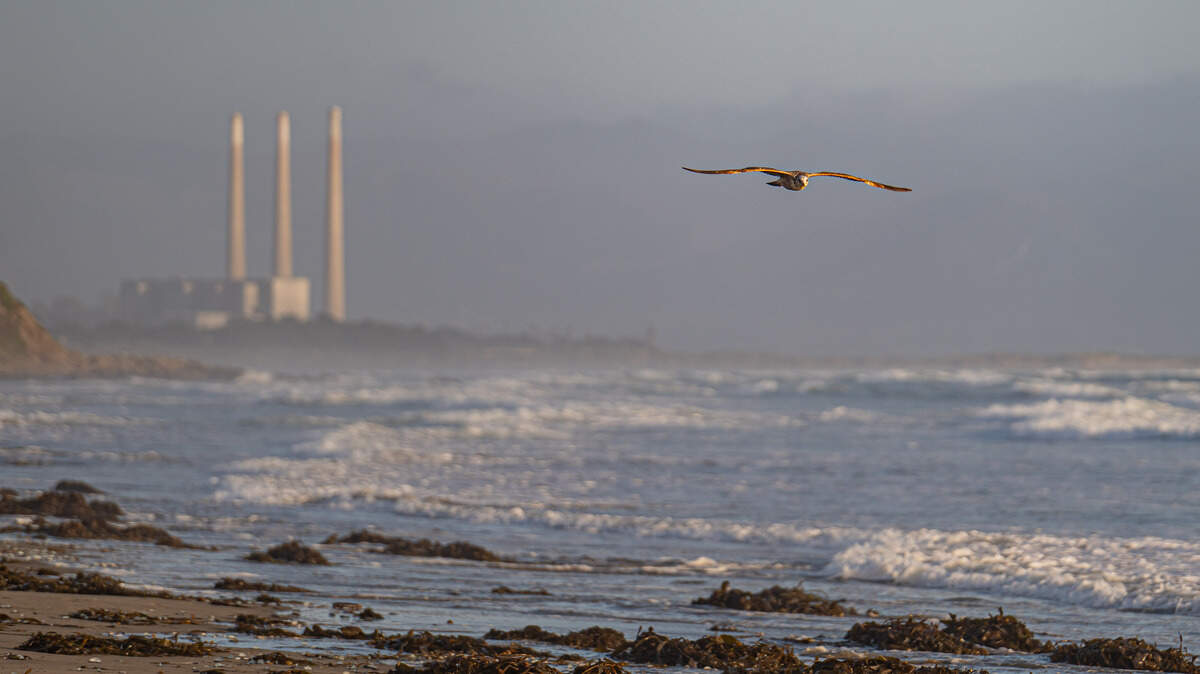
A timeless Central Coast spring weather pattern will continue through Wednesday, featuring gale-force northwesterly winds and mostly clear late mornings and afternoons. During the night and early morning, winds will diminish, allowing low marine clouds to spread inland.
By next weekend, the weather pattern is expected to transition toward summer-like conditions, with decreasing northwesterly winds and triple-digit temperatures developing across the inland valleys while persistent June Gloom keeps coastal areas cooler under extensive low clouds and fog.
A strong, 1,032-millibar Eastern Pacific High will center 1,400 miles to the west of the Central Coast, while a broad area of low pressure and its associated cold fronts will move through the Pacific Northwest with widespread rain and even snow in higher elevations.
In fact, one of these cold fronts should be strong enough to produce rain showers as far south as the Golden Gate Bridge, and maybe even Santa Cruz, Monday night into Tuesday morning.
For the Central Coast, this synoptic condition will produce strong to gale-force (25 to 38 mph with gusts to 45 mph) northwesterly winds during the afternoon and evening in the coastal regions through Wednesday. These winds are expected to be strong enough to mix out the temperature inversion layer, leaving behind mostly clear skies.
Temperatures over this time frame will range from the low-to-mid 80s in the inland valleys, including Paso Robles, while coastal valleys such as San Luis Obispo will only reach high 60s to the low 70s.
Along the beaches, temperatures will range between the high 50s to low 60s, although south-facing beaches such as Cayucos, Avila Beach and Shell Beach could warm into the high 60s.
High pressure will build over California on Thursday through next Monday while the Eastern Pacific High weakens. This condition will dramatically reduce the northwesterly (onshore) winds allowing persistent marine low clouds to develop in the coastal regions (June Gloom). Meanwhile, the inland valleys will reach triple-digit temperatures for the first time this year by next weekend.
Daytime highs will generally reach the 90s across inland valleys, including Paso Robles, on Thursday and Friday, hitting the low 100s by next weekend.
The coastal valleys such as San Luis Obispo will warm to the low 80s, reaching the high 80s next Saturday and Sunday. Beach communities will generally remain in the low 60s under overcast skies.
Surf report
A 7- to 9-foot northwesterly (300-degree, deep water) sea and swell (with a 7- to 11-second period) is expected through Wednesday, decreasing to 4 to 6 feet with the same period on Thursday.
A 2- to 4-foot northwesterly (290-degree, deep water) swell (with an 8- to 14-second period) is forecast along our coastline on Friday through next weekend.
The Southern Hemisphere has come alive with a series of intense storms.
Consequently, a series of long-period Southern Hemisphere swell trains will arrive along our coastline during the first half of June.
A 2- to 3-foot Southern Hemisphere (225-degree, deep water) swell (with a 15- to 17-second period) is forecast along the Central Coast this weekend.
A 1- to 2-foot Southern Hemisphere (200-degree, deep water) swell (with a 22-second period) is forecast to arrive along our coastline on Monday, building to 3 to 4 feet (with an 18- to 20-second period) on Tuesday.
This long-period swell is expected to peak Wednesday into Thursday at 3 to 5 feet (with a 16- to 18-second period). Wave heights in Southern California will be much higher.
Seawater temperatures will range between a chilly 49 and 51 degrees through Wednesday, warming to 53 and 55 degrees by next weekend.
On this date in weather history (June 7)
1816: A famous June snow occurred in the northeastern United States. Danville, Vermont, reported drifts of snow and sleet 20 inches deep. The Highlands were white all day, and flurries were observed as far south as Boston, Massachusetts. (David Ludlum)
2011: Between 2000 and 2011, it only rained three times in June at the Diablo Canyon nuclear power plant. On June 5, 2009, a slow-moving and vigorous upper-level, low-pressure system produced 0.37 inches of rain at the power plant and 0.44 inches in San Luis Obispo and in Los Osos. The wettest June on record occurred in 1991, when 0.8 of an inch fell in San Luis Obispo. Then, on June 7, 2011, the rain gauge at Cal Poly (home of record for climatology in San Luis Obispo) recorded 1.05 inches of rain, breaking the previous record set back in 1991. The nuclear power plant recorded 1.23 inches, which was also a record for June.
This week’s temperatures
LOWS AND HIGHS, PASO ROBLES
SUNDAY: 48, 82
MONDAY: 48, 83
TUESDAY: 51, 82
WEDNESDAY: 50, 87
THURSDAY: 55, 92
FRIDAY: 57, 98
SATURDAY: 60, 101
SUNDAY: 62, 103
LOWS AND HIGHS, SAN LUIS OBISPO AND COASTAL VALLEYS
SUNDAY: 44, 70
MONDAY: 50, 71
TUESDAY: 52, 72
WEDNESDAY: 53, 73
THURSDAY: 53, 81
FRIDAY: 54, 84
SATURDAY: 58, 86
SUNDAY: 60, 87
John Lindsey is a retired PG&E marine meteorologist. Email him at JohnLindseyLosOsos@gmail.com or follow him on X @PGE_John.