
Break out your umbrellas, SLO County: We may be in for some rain
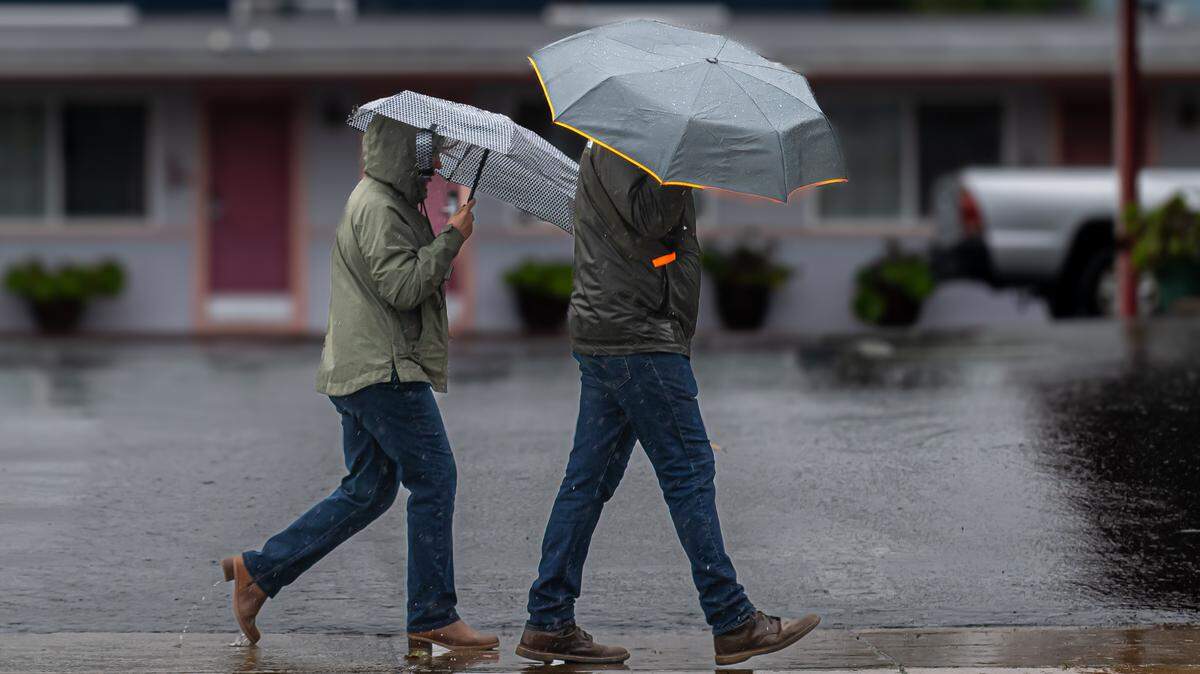
San Luis Obispo County may finally get some rain this week.
The Eastern Pacific High, long anchored off the California coast, is forecast to shift westward, settling north of Hawaii and strengthening to about 1,035 millibars.
This change should allow the storm track — and the desperately needed rain, snow and cooler temperatures it carries — to move southward into California later this week.
For most of the Central Coast, the last significant rainfall occurred on Jan. 4, and only a few coastal locations received light showers on Jan. 22.
My rain gauges in Baywood Park recorded the highest totals of just less than two-tenths of an inch. Otherwise, Paso Robles, San Luis Obispo and Santa Maria have remained dry for 35 days, one of the longest midwinter dry spells on record.
In addition to the dryness, temperatures have been unusually warm. At the San Luis Obispo County Regional Airport, the average high temperature during the first five days of February reached 80 degrees, which is about 15 degrees above normal.
A familiar weather pattern will continue through Monday, featuring moderate to fresh (13 to 24 mph) Santa Lucia (northeasterly) winds during the night and morning, shifting out of the northwest and strengthening to fresh to strong (19 to 31 mph) levels during the afternoon.
This pattern is expected to result in predominantly clear skies, except for intermittent low marine clouds developing along the coast during the late afternoon and evening, as well as periods of dense ground fog forming overnight in inland valleys like Paso Robles. Mornings will remain cool with mild afternoon temperatures.
Overnight lows through Monday will fall into the upper 30s to lower 40s in the inland valleys, including Paso Robles, and into the upper 40s and lower 50s in coastal valleys such as San Luis Obispo and along the beaches. Daytime highs across the Central Coast will generally reach the upper 60s to lower 70s.
On Tuesday, a 1,015-millibar low-pressure system and associated cold front will move through the Central Coast, bringing moderate to fresh (13 to 24 mph) southerly winds, periods of rain and cooler temperatures.
Behind the front, fresh to strong (19 to 31 mph) northwesterly winds and scattered showers are expected Tuesday night into Wednesday morning. Total rainfall from this system is forecast to range from one-tenth to one-half inch.
A transitory area of high pressure moving over the Great Basin will then bring moderate to fresh (13 to 24 mph) Santa Lucia winds and mostly clear skies, except for areas of inland valley fog, from Wednesday night through Friday morning. Onshore pressure gradients along the Central Coast will strengthen later, producing strong to gale-force (25 to 38 mph) northwesterly winds and cooler temperatures.
A 997-millibar storm system is forecast to approach the Central Coast next Saturday, Valentine’s Day, with increasing southerly winds and scattered rain showers. As this storm moves across the region later Saturday into Sunday, moderate gale-force to fresh gale-force (32 to 46 mph) southeasterly winds and periods of heavy rain are expected.
Total rainfall amounts are projected to range between 1 and 2 inches. Scattered showers may linger through Tuesday, Feb. 17.
During this period, daytime highs will only reach the 50s, with overnight lows in the upper 30s to lower 40s.
Snow levels in the Sierra Nevada Mountains are expected to fall to around 4,500 feet, with 4 to 7 feet of new snow possible at higher elevations.
Looking ahead, mostly dry conditions are expected to return during the latter half of February.
Surf report
Saturday’s 7- to 9-foot westerly (270-degree, deep water) swell (with a 14- to 16-second period) will decrease to 5 to 7 feet (with a 12- to 14-second period) by Sunday morning.
Increasing northwesterly winds off the California coastline will generate a 6- to 8-foot northwesterly (305-degree, deep water) sea and swell (with a 4- to 12-second period) on Sunday afternoon and night.
A 5- to 7-foot northwesterly (285-degree, deep water) swell (with an 8- to 18-second period) will develop on Monday and remain at this height, but with a gradually shorter period through Tuesday, decreasing to 4 to 6 feet (with an 11- to 15-second period) on Wednesday through Friday morning.
Gale force winds along the Central California coastline will generate a 6- to 8-foot northwesterly (310-degree, deep water) sea and swell (with a 5- to 15-second period) on Friday afternoon into next Saturday morning.
Gale force southerly winds will generate 8- to 10-foot southerly (190-degree, shallow water) sea and swell (with a 5- to 13-second period) next Saturday afternoon through next Monday.
Seawater temperatures will range between 60 and 62 degrees through Friday, lowering to 57 to 59 degrees next Saturday and Sunday.
On this date in weather history, Feb. 8
1953: A severe ice storm in the northeastern United States produced up to 4 inches of ice in Pennsylvania and 2 to 3 inches in southeastern New York State. In southern New England, the storm created a layer of snow up to 20 inches deep. The storm resulted in 31 deaths and $2.5 million of damage. (David Ludlum)
1990: High winds plagued the northwestern United States, hitting the state of Oregon the hardest. Two people were killed in Oregon, and 9 others were injured. The high winds downed 55 million-board-feet of timber, valued at more than $20 million. Winds gusted to 90 mph near Pinehurst, Idaho, and wind gusts reached 96 mph at Stevenson, Washington. (National Weather Summary) (Storm Data)
2021: The Santa Lucia (northeasterly) winds reached 35 mph sustained with gusts up to 54 mph at 7:15 a.m. at the Diablo Canyon Meteorological Tower. PG&E weather stations on the Cuesta Grade reported Santa Lucia winds gusting up to 52 mph during the morning. These offshore winds produced large temperature gradients between the inland and coastal valleys. The Paso Robles Municipal Airport reported 38 degrees at 7 a.m., while at the same time, the San Luis Obispo County Regional Airport reported a mild 57 degrees.
This week’s temperatures
LOWS AND HIGHS, PASO ROBLES
SUNDAY: 39, 74
MONDAY: 42, 68
TUESDAY: 42, 61
WEDNESDAY: 41, 60
THURSDAY: 39, 64
FRIDAY: 39, 65
SATURDAY: 37, 61
SUNDAY: 36, 55
LOWS AND HIGHS, SAN LUIS OBISPO AND COASTAL VALLEYS
SUNDAY: 51, 77
MONDAY: 52, 72
TUESDAY: 50, 63
WEDNESDAY: 48, 65
THURSDAY: 48, 67
FRIDAY: 49, 68
SATURDAY: 46, 64
SUNDAY: 45, 58
John Lindsey is a retired PG&E marine meteorologist. Email him at JohnLindseyLosOsos@gmail.com or follow him on X @PGE_John.