
What’s the deal with those jellyfish-like creatures washing up on SLO County?
A trough of low pressure along the California coast will maintain gentle winds, allowing a persistent marine layer with areas of fog and mist to develop overnight and in the mornings.
Expect below-average temperatures through Tuesday, followed by increasing northwesterly winds and clearing afternoon skies from Wednesday through next Sunday.
Observing marine life often helps explain what’s happening in the atmosphere.
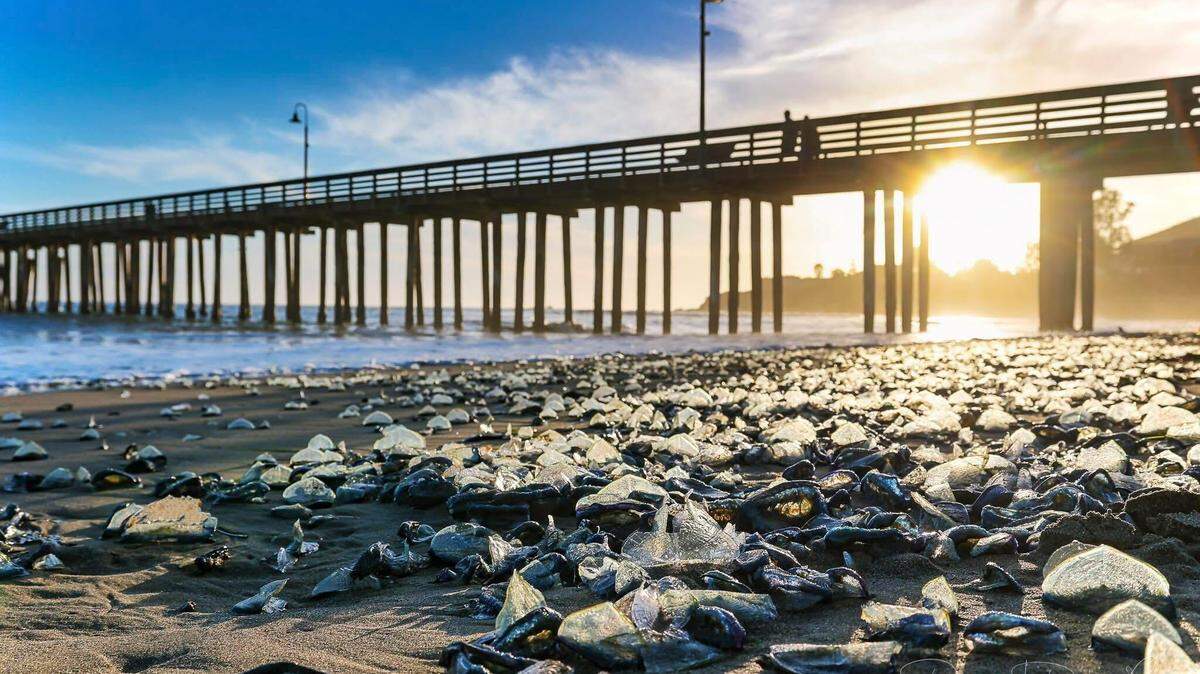
This April, due to persistent gentle and variable winds, our beaches have been inundated with countless velella velella — translucent, electric-blue, jellyfish-like creatures known as by-the-wind sailors. I’ve never seen so many in the back bay of Morro Bay.
Typically, these creatures don’t appear in large numbers along our shores until summer, when northwesterly winds ease.
Historically, April is the windiest month on the Central Coast. At the PG&E Diablo Canyon nuclear power plant meteorological tower, the average 24-hour wind speed in April is 13 mph from the northwest, followed closely by May at 12.5 mph. These strong northwesterly winds drive ocean currents from the coast out to sea (southwesterly), usually keeping velella velella offshore.
But this month, a prolonged pattern of light to gentle winds has reversed that current, causing an onshore (northeasterly) flow — bringing these vibrant creatures to our beaches in astonishing numbers.
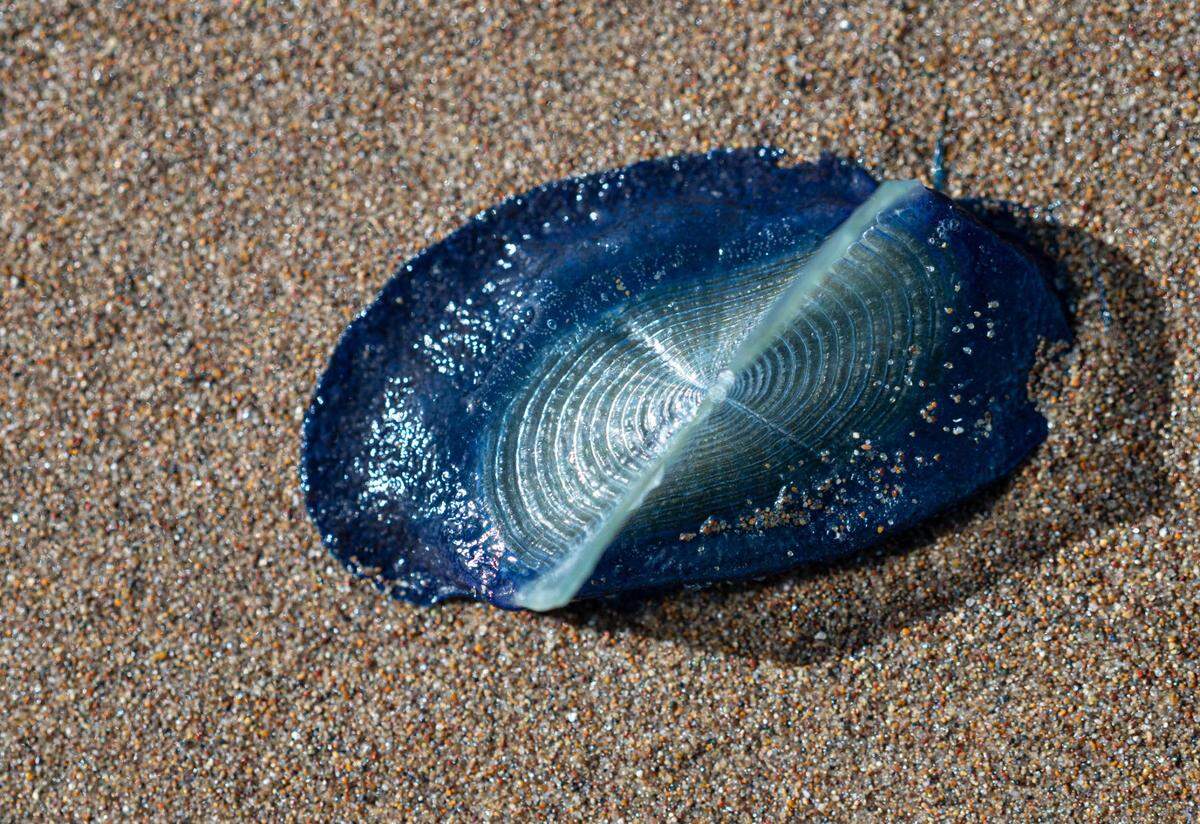
Though once thought to be siphonophores — colonies of specialized zooids — the velella velella is now classified as a single animal. Resembling miniature sailboats, they average about two inches in length and feature a stiff, angled, translucent sail that propels them across the water’s surface.
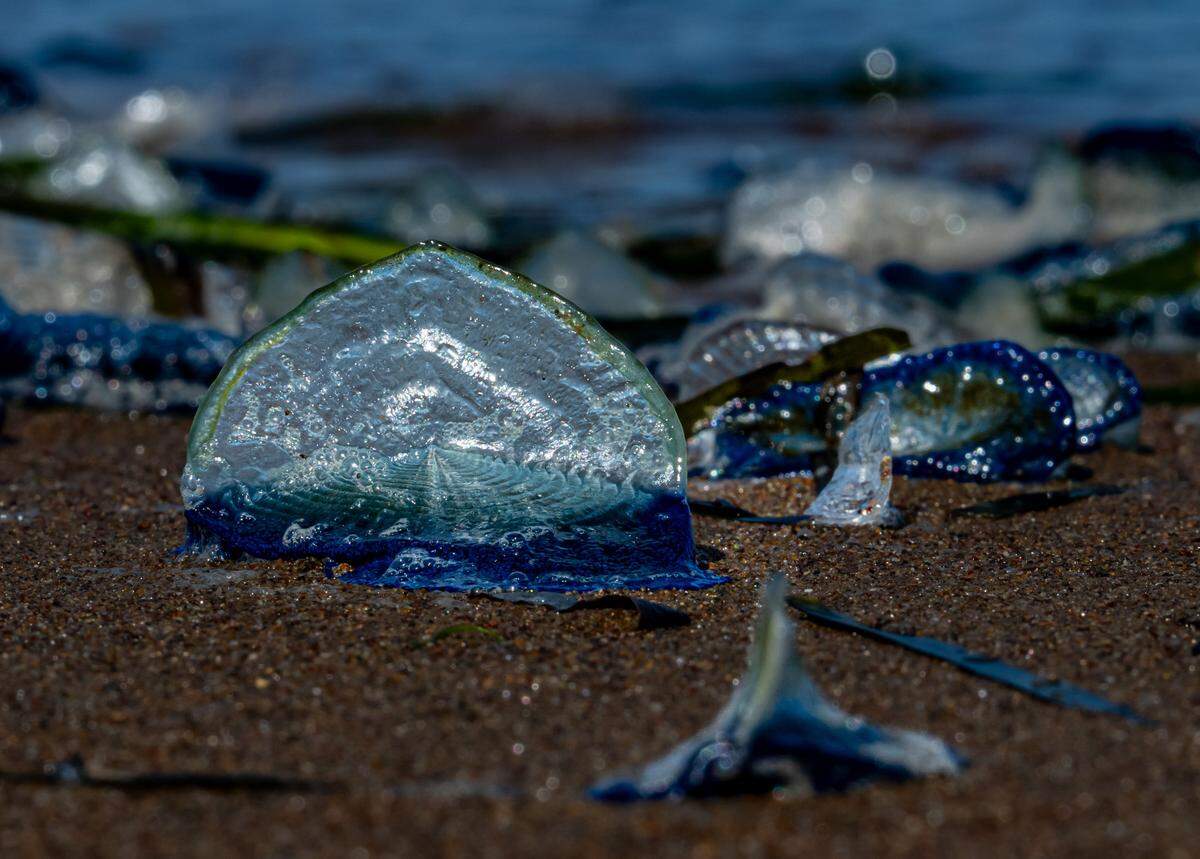
Not much is known about their full life cycle, but they seem to live less than a year and reproduce quickly.
In warm and temperate oceans across the globe, billions of these creatures thrive where the sea meets the sky. At sea, they can be seen clustering by the millions in long, slick-like rows.
Interestingly, some marine biologists believe two forms of velella velella exist in the North Pacific Ocean.
Along the west coast of North America, their sails are angled to catch prevailing north-to-south winds — steering them offshore.
In contrast, the population near Japan and Korea have sails angled in the opposite direction to navigate the region’s dominant south-to-north winds. In both cases, the sail’s orientation, like a boat’s rigging, determines whether they drift ashore or remain at sea.
A pattern of gentle variable winds during the overnight and morning, increasing out of the northwest from gentle to moderate (8 to 18 mph) levels later in the morning through the evening, will develop in response to a surface trough that will hug the California coastline through Wednesday morning.
This condition will create a deep and persistent marine layer along the coastline with overnight and morning dense fog, mist and even drizzle in the coastal regions.
Over the period, most beaches will only see a partial clearing in weather patterns reminiscent of summer. Further inland, the marine layer will clear later in the morning through the afternoon.
However, Easter Sunday morning may see gentle to moderate (8 to 18 mph) Santa Lucia (northeasterly) winds and primarily clear skies as a transitory area of high pressure moves over eastern California.
Temperatures will range from the mid to high 70s in the inland valleys (Paso Robles) and high 60s to low 70s in the coastal valleys (San Luis Obispo), while many of the beaches will only reach the high 50s. Overnight lows will drop to the 40s throughout the Central Coast.
A dry cold front will move through the Central Coast later Wednesday, creating a pressure gradient along the California coastline. In turn, fresh to strong (19 to 32 mph) northwesterly winds will develop on Wednesday afternoon with clearing skies during the afternoon.
A pattern of fresh to strong (19 to 32 mph) northwesterly winds developing during the afternoon, decreasing during the night and morning, will produce overnight low marine clouds with pockets of fog and mist, clearing during the afternoon. Temperatures will gradually warm during the week.
Gale-force northwesterly winds are expected to develop next weekend.
Long-range numerical models suggest a dry weather pattern through the first week of May.
However, forecasting springtime rain is notoriously tricky — longer days and increased sunshine add instability to the atmosphere, allowing weather patterns to shift rapidly.
Surf report
A 3- to 5-foot northwesterly (290-degree deep water) swell (with an 8- to 12-second period) is forecast on Saturday through Sunday, increasing to 4- to 6-feet with the same period on Monday through Wednesday morning.
Increasing northwesterly winds will generate increasing northwesterly sea and swell Wednesday through next weekend.
This northwesterly (300-degree deep water) sea and swell will increase to 5- to 7-feet (with a 7- to 15-second period) on Wednesday afternoon through Friday, building to 7- to 9-feet (with a 5- to 12-second period) next weekend.
Combined with this northwesterly sea and swell will be a 2- to 3-foot Southern Hemisphere (210-degree deep water) swell (with a 15- to 17-second period) on Tuesday through next Saturday.
Surface seawater temperatures will range between 51 and 53 degrees through Wednesday, decreasing to 49 and 51 degrees Thursday through next Saturday.
On this date in weather history (April 20)
1952: The tankers Esso Suez and Esso Greensboro crashed in a thick fog off the coast of Morgan City, Louisiana. The Greensboro bursts into flame. (David Ludlum)
1990: A fast-moving Pacific storm produced heavy snow in the central mountains and the Upper Arkansas Valley of Colorado, with a foot of snow reported at Leadville, Colorado. Thunderstorms produced wind gusts of 76 mph at Tulsa, Oklahoma, and heavy rain which caused flooding of Cat Claw Creek in Abilene, Texas. Lightning struck a building that housed a fish farm in Scott, Arkansas, killing 10,000 pounds of fish. Many of the fish died from the heat of the fire. (The National Weather Summary) (Storm Data)
This week’s temperatures
LOWS AND HIGHS, PASO ROBLES
SUN | MON | TUE | WED | THU | FRI | SAT | SUN |
44, 77 | 44, 78 | 45, 75 | 42, 71 | 41, 68 | 43, 70 | 45, 71 | 47, 73 |
LOWS AND HIGHS, SAN LUIS OBISPO AND COASTAL VALLEYS
SUN | MON | TUE | WED | THU | FRI | SAT | SUN |
48, 70 | 48, 70 | 49, 68 | 48, 65 | 46, 64 | 47, 67 | 48, 68 | 49, 70 |
John Lindsey is a retired PG&E marine meteorologist. Email him at JohnLindseyLosOsos@gmail.com or follow him on X @PGE_John.