
Foggy, cool mornings forecast for SLO County. What else to expect from the weather
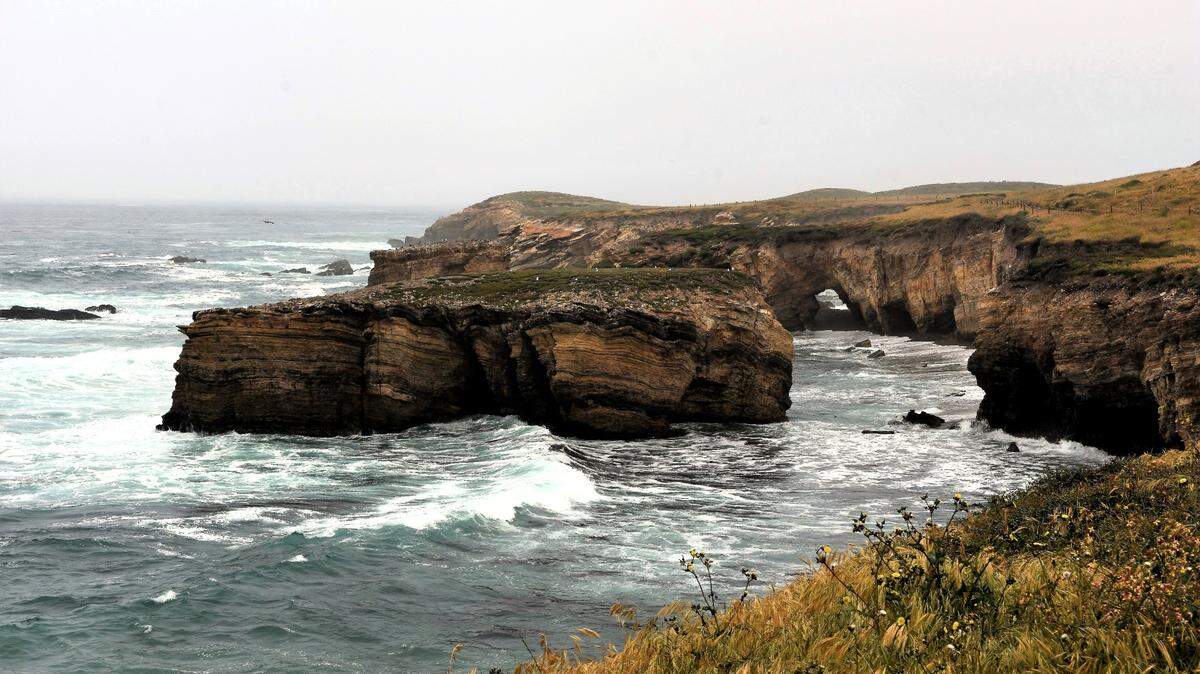
Over the decades, meteorological data recorded at Diablo Canyon nuclear power plant’s anemometers indicates that winds along the Pecho Coast predominantly blow from the northwest quadrant about 60% of the time.
Winds from the northeast (Santa Lucia) quadrant occur roughly 12% of the time, while winds from the southeast account for about 23%.
The remaining 5% is distributed evenly across other cardinal directions.
Wind direction is described based on its origin. For example, westerly winds blow from west to east and are referred to as “onshore,” meaning the air moves from the ocean to the land.
Conversely, easterly winds, blowing from east to west, are called “offshore,” as they travel from the land to the sea.
These offshore winds can cause allergies as pollen is driven to the coast; however, the nearly pollen-free northwesterly, onshore winds coming off the sea usually keep the pollen counts low along the coastline.
Northeasterly Santa Lucia winds are more prevalent in dry years, whereas wet years see an increase in prefrontal southeasterly winds.
This January, winds have predominantly blown from the northeast — about 80% of the time — with no rainfall recorded.
High-pressure systems over the Great Basin, possibly influenced by the current La Niña conditions, have pushed the jet stream and upper-level winds farther north into the Pacific Northwest, historically resulting in below-average rainfall for the Central Coast.
The Central Coast’s topography significantly impacts wind patterns.
Offshore winds here are typically downslope, known as katabatic winds — a term derived from the Greek word katabatikos, meaning “going downhill.”
These gusty Santa Lucia winds often occur at lower levels and are influenced by canyons, passes and gaps in the coastal mountain ranges.
In Southern California, similar winds are known as the Santa Anas, which are typically stronger as they descend from higher mountain ranges.
Canyons oriented toward the northeast can funnel and accelerate Santa Lucia winds, creating a Venturi effect.
Even slight shifts in wind direction — north or east by just a few degrees — can lead to rapid changes in wind speed and distribution.
For instance, passes oriented in a northerly direction may accelerate northerly winds while blocking easterly winds.
This variability in topography explains why wind speeds can differ significantly over short distances in the Central Coast’s coastal regions.
That being said, a shift in the winds will bring about a change in the weather this week.
Gentle to moderate (8 to 18 mph) northwesterly winds will allow areas with low marine clouds to develop in the coastal regions through Saturday.
High pressure over the Great Basin has weakened which will allow moderate to fresh (13 to 24 mph) northwesterly winds to develop during the afternoon.
This condition will bring low marine clouds with pockets of fog and mist to the coastal regions during late afternoon and evening.
Otherwise, moderate to fresh (13 to 24 mph) Santa Lucia (northeasterly) winds are forecast during the night and morning driving the marine layer off the sea and leaving behind clear skies.
This pattern is forecast to continue through next Saturday.
Overnight temperatures will dip into the high-20s to low-30s in inland valleys like Paso Robles and the high 30s to the low 40s in coastal valleys such as San Luis Obispo and along the beaches.
High temperatures will reach the mid-60s throughout the region through Wednesday, warming the low 70s on Thursday into next Saturday.
A more significant change in the weather pattern is forecast for the following week, as the Eastern Pacific High is forecast to move northward.
This condition may allow a low-pressure system and the associated cold front to produce increasing southerly winds and a chance of rain at the end of January.
Remember, given the long-range nature of these predictions, it’s wise to approach them with caution.
Surf report
An exceedingly long-period northwesterly (290-degree deep water) swell will arrive along our coastline Saturday night at 4- to 6-feet (with a 22- to 24-second period), building to 6- to 8-feet (with an 18- to 20-second period) on Sunday.
This swell will decrease to 5- to 7-feet (with a 14- to 17-second period) Monday and will remain at this height but with a gradually shorter period through Wednesday.
A 4- to 6-foot northwesterly (295-degree deep water) swell (with an 8- to 18-second period) is forecast along our coastline Thursday into next Saturday.
Surface seawater temperatures will range between 52 and 54 degrees through next Saturday.
On this date in weather history (Jan. 19)
1933: Giant Forest, California, received 60 inches of snow in just 24 hours, setting a state record, and the second highest 24-hour total snow record for the U.S. (David Ludlum)
1977: Snowflakes were observed at Homestead and Miami Beach in southern Florida. (David Ludlum)
1989: The high temperature for the day at Fairbanks, Alaska, was a frigid 41 degrees below zero, and the morning low of 24 degrees below zero at Anchorage, Alaska, was their coldest reading in 14 years. (National Weather Summary)
2010: A storm the day prior produced 1.21 inches of rain at Diablo Canyon with sustained winds of 40 mph and gusts reaching 56 mph at 11:00 a.m. The highest wind speeds were recorded at Condor Lookout in the Los Padres National Forest, located on Hi Mountain (elevation 3,198 feet), reaching 88 mph at 11:00 a.m. Meanwhile, Rocky Butte near San Simeon recorded 4.13 inches of rain.
2013: A very long period of northwesterly (290-degree deep water) swell peaked at 9.1 feet with a 22 second period this afternoon. This swell had some of highest energy levels in the 22 second section of the ocean wave energy spectrum 2472 cm² ever recorded at the Diablo Canyon waverider buoy. Note: The highest energy levels ever seen in the 22 second section of the ocean wave energy spectrum occurred on Dec. 23, 2024, when levels reached 7159 cm².
2021: A 1,002 millibar low-pressure system over the Southern California Bight combined with a 1,035 millibar high-pressure ridge over the Great Basin brought very gusty winds across the Central Coast. The Diablo Canyon Meteorological Tower reported east-northeasterly winds gusting to 53 mph at 10 a.m. The National Weather Service in Los Angeles reported 95 mph winds near Ventura.
This week’s temperatures
LOWS AND HIGHS, PASO ROBLES
SUN | MON | TUE | WED | THU | FRI | SAT | SUN |
29, 63 | 31, 62 | 31, 64 | 31, 64 | 32, 68 | 33, 70 | 34, 67 | 36, 65 |
LOWS AND HIGHS, SAN LUIS OBISPO AND COASTAL VALLEYS
SUN | MON | TUE | WED | THU | FRI | SAT | SUN |
38, 63 | 41, 63 | 43, 65 | 44, 66 | 44, 70 | 44, 71 | 46, 68 | 47, 67 |
John Lindsey is a retired PG&E marine meteorologist. Email him at JohnLindseyLosOsos@gmail.com or follow him on Twitter @PGE_John.