
After rainy weekend, windy weather to sweep across SLO County. See the forecast
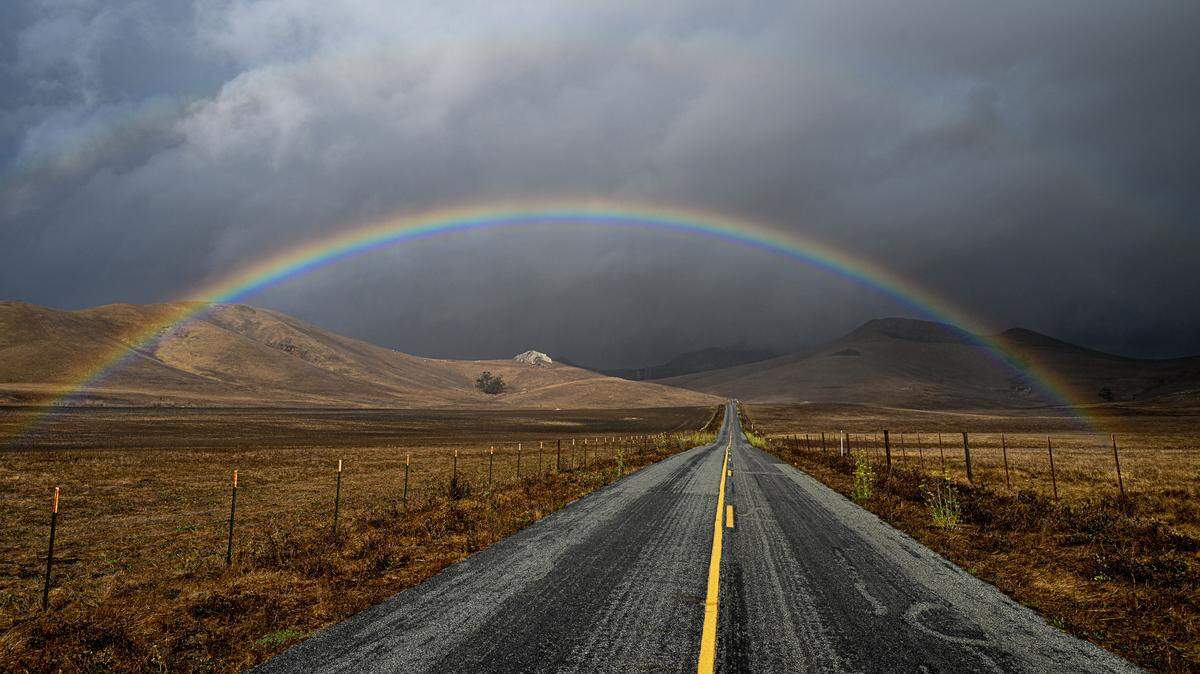
This mainly dry December will see rain this weekend as a fast-moving cold front sweeps southward through the Central Coast with southerly gales and rain.
A cold front enhanced by robust upper-level winds was expected to move over San Luis Obispo County late Saturday morning and Santa Barbara County in the early afternoon with strong to gale force (25 to 38 mph with gusts to 50 mph) southerly winds and rain.
Total rainfall amounts were predicted to range between 0.33 and 0.75 of an inch in San Luis Obispo County and between 0.25 and 0.50 in Santa Barbara County.
In the cold front’s wake, fresh to strong (19 to 31 mph) and sometimes gusty Santa Lucia (northeasterly) winds were forecast for Sunday. These offshore winds will produce mainly clear skies and areas of dense morning fog in the inland and coastal valleys.
An upper-level trough will follow on Monday with increasing northwesterly winds, increasing clouds and a chance of a few scattered rain showers.
Temperatures will struggle to reach the low 60s on Monday.
An extensive area of high pressure will move into the Great Basin, creating fresh to strong winds (19 to 31 mph) and, at times, gusty Santa Lucia (northeasterly) winds Tuesday into Wednesday.
Over this period, wind gusts could reach 55 mph in specific hotspots, including Highway 41 from Morro Bay High School toward Atascadero about halfway up the hills; the coastal canyons like Diablo Canyon; and parts of eastern San Luis Obispo, including Cal Poly, San Luis Obispo High School and French Hospital Medical Center.
This condition will create mostly clear skies, along with areas of low clouds and fog in the inland areas with overnight temperatures dipping into the mid-30s in the inland valleys (Paso Robles) and the mid-40s in coastal valleys (San Luis Obispo) and along the beaches.
We are at the time of the year when the coastal temperatures are warmer than the inland areas. Daytime highs will range from the high 60s to the low 70s in the coastal regions and the mid-60s in the inland locations.
Gentle southerly winds on Thursday into Friday will allow areas of low, marine clouds and pockets of fog to move in the coastal regions overnight and in the morning.
Strong to gale force (25 to 38 mph) northwesterly winds and mostly clear skies will develop next Saturday into Sunday.
For the following week, the American and European numerical model indicates dry weather through Christmas.
Surf report
Gale force southerly winds will generate 4- to 6-foot southerly (195-degree shallow water) seas Saturday morning.
A 10- to 12-foot northwesterly (295-degree deep water) swell (with a 7- to 14-second period) will arrive along our coastline on Saturday afternoon and remain at this height and period through Saturday night, decreasing to 6- to 8-feet (with an 8- to 12-second period) on Sunday.
A 4- to 6-foot northwesterly (310-degree deep water) sea and swell (with a 5- to 11-second period) will develop along our coastline on Monday due to increasing northwesterly winds.
A 6- to 8-foot northwesterly (290-degree deep water) swell (with an 8- to 17-second period) is forecast on Tuesday into Wednesday morning, followed by 5- to 7-foot northwesterly (295-degree deep water) swell (with an 8- to 22-second period) on Wednesday afternoon and night.
This swell will build to 6- to 8-feet (with an 18- to 20- second period) on Thursday and will remain at this height on Friday into Saturday morning (but with a 14- to 17-second period).
A 9- to 11-foot northwesterly (300-degree deep-water) sea and swell (with a 5- to 15-second period) is expected next Saturday and Sunday.
Surface seawater temperatures will range between 54 and 56 degrees through next Saturday and Sunday.
On this date in weather history (Dec. 15)
1924: The temperature at Helena, Montana, plunged by 88 degrees in 34 hours. The mercury plummeted from 63 degrees to 25 degrees below zero. At Fairfield, Montana, the temperature plunged 84 degrees in just 12 hours, from 63 degrees at noon to 21 degrees below zero at midnight. (David Ludlum)
2010: A rare tornado struck the small town of Aumsville, Oregon, tearing roofs off buildings, hurling objects into vehicles and homes and uprooting trees. No one was injured, but the destruction left behind was severe. The National Weather Service classified the tornado as an EF2 with wind speeds of 110 to 120 mph, and they said the tornado’s damage trail was five miles long and 150 yards wide. Fifty houses in Aumsville and the surrounding county area were affected, with 10 of them being unsuitable for occupancy. (KATU)
2017: A very dry air mass combined with clear skies allowed the Paso Robles Municipal Airport to break two temperature records in less than nine hours the day prior, a record low of 22 degrees followed by a record high of 73 degrees for a 51-degree-temperature swing! The San Luis Obispo County Regional Airport hit 83 degrees, breaking its record for the third day in a row. The previous record of 81 degrees was set in 1988.
2020: A cold front dissipated as it traveled from north to south through San Luis Obispo and Santa Barbara counties. The greatest amount of rain occurred in the San Simeon and Cambria area. The Walter Ranch in the Santa Lucia Mountains above Cambria recorded the most rain at 0.81 of an inch.
2021: The northwesterly winds peaked at 43 mph sustained with gusts up to 55 mph. Black ice was reported on Highway 101 on the southside of the Cuesta Grade, creating dangerous driving conditions in the morning.
This week’s temperatures
LOWS AND HIGHS, PASO ROBLES
SUN | MON | TUE | WED | THU | FRI | SAT | SUN |
35, 58 | 33, 59 | 37, 67 | 37, 67 | 37, 67 | 36, 66 | 35, 63 | 34, 62 |
LOWS AND HIGHS, SAN LUIS OBISPO AND COASTAL VALLEYS
SUN | MON | TUE | WED | THU | FRI | SAT | SUN |
43, 59 | 42, 60 | 46, 65 | 46, 70 | 46, 71 | 45, 71 | 47, 64 | 46, 62 |
John Lindsey is a retired PG&E marine meteorologist. Email him at JohnLindseyLosOsos@gmail.com or follow him on Twitter @PGE_John.
This story was originally published December 15, 2024 at 5:00 AM.