
Fall is here, but a new round of triple-digit heat is headed to SLO County
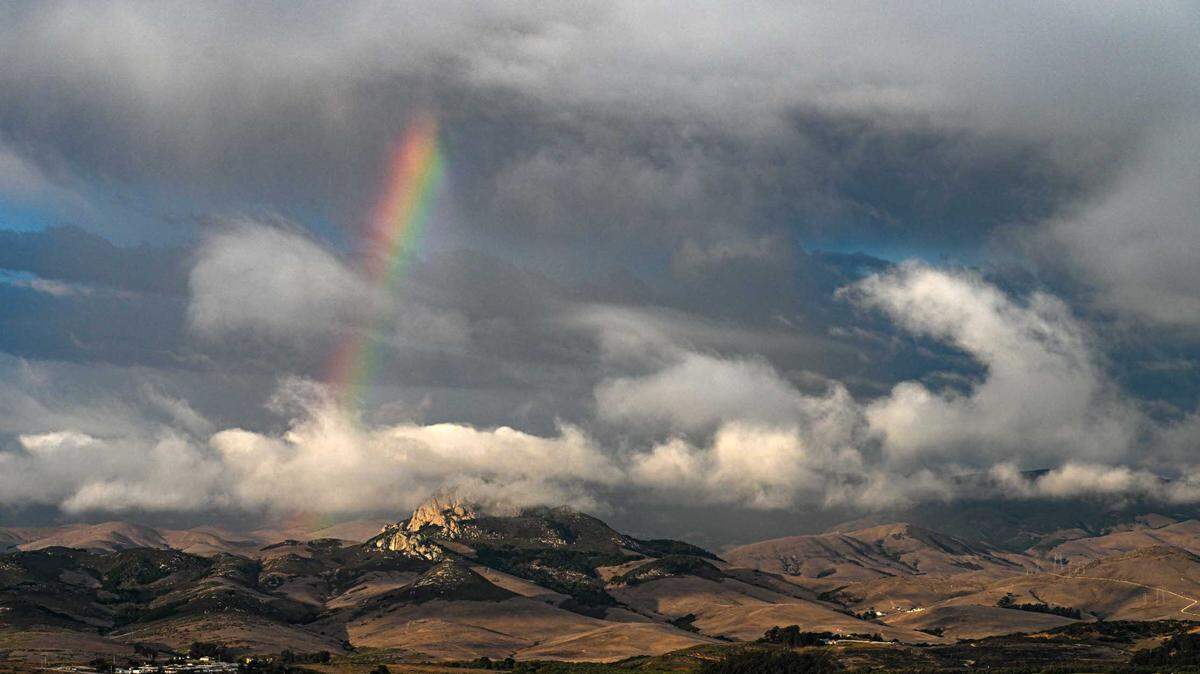
My daughter Chloe mentioned that it feels more like fall, even though the temperatures remain in the 70s. She said the air felt different, drier, and more like what she would experience in the mountains, even though the temperatures were about the same.
She’s right!
The air feels crisp because of the lower humidity levels. When the air mass moves offshore, it descends from the Santa Lucia Mountains toward the Pacific and then warms from compressional heating. As a result, the relative humidity drops.
This lower humidity makes it feel dry, like fall, rather than summer air.
In the fall, our weather begins to be dominated by an area of high pressure that builds at the surface over the Great Basin — the area between the Sierra Nevada range to the west and the Rocky Mountains to the east. This occurs as the air mass cools and becomes denser due to the shorter days.
This condition usually produces Santa Lucia northeasterly (offshore) winds. These winds bring relatively dry air to our shoreline, pushing the marine layer out to sea.
During fall, the warmest temperatures along the Central Coast start to switch from the inland areas to the coastal regions.
Uncharacteristically, the start of this fall feels more like “June Gloom,” with plenty of low marine clouds, pockets of fog and drizzle, and cooler temperatures in the coastal regions; however, changes are expected this week.
Moderate to fresh (8 to 18 mph) northwesterly (onshore) winds this weekend will continue to produce low marine clouds at night and in the morning, clearing to the beaches by late morning and afternoon.
The inland valleys (Paso Robles) range between the high 80s and low 90s, with the coastal valleys (San Luis Obispo) reaching the 70s.
The beaches will range between the high 50s and the low 60s.
A gentle Santa Lucia (northeasterly) wind pattern unfolds Monday into Tuesday for warmer temperatures, especially away from the beaches, as high pressure builds overhead.
The inland valleys (Paso Robles) will reach triple-digit levels, while the coastal valleys (San Luis Obispo) will hit the 90s. The beaches will range between the low to mid-60s under mostly overcast skies as these offshore winds may not be strong enough to push the marine layer out to sea.
Gentle southerly winds are forecast later Tuesday through Thursday. With them, monsoonal moisture will move northward over the Central Coast.
There will be increasing mid- to high-level clouds and cooler temperatures but higher humidity levels, plus a slight chance of scattered rain showers and even a few thunderstorms, primarily over the eastern regions of San Luis Obispo and Santa Barbara counties.
Increasing northwesterly winds from Friday through Sunday will produce cooler temperatures and clear skies. In fact, these northwesterly winds may reach gale-force levels by next Sunday.
The long-range models do not indicate any significant rain as the storm remains far to the north of the Central Coast.
Surf report
Increasing storm activity in the Gulf of Alaska will produce a 5- to 7-foot northwesterly (290-degree deep-water) swell (with an 8- to 14-second period) along our coastline this weekend through Monday.
A 2- to 4-foot northwesterly (290-degree deep-water) swell (with an 8- to 20-second period) is forecast along our coastline on Tuesday into Wednesday, building to 4 to 6 feet (with an 8- to 17-second period) on Thursday into Friday.
Increasing northwesterly winds later Friday through next Sunday will generate a 5- to 7-foot northwesterly (310-degree deep-water) sea and swell (with a 5- to 14-second period).
Combined with this northwesterly swell will be a 1- to 2-foot southern hemisphere (230- degree deep-water) swell (with a 16- to 18-second period) our coastline on Tuesday through Saturday.
Surface seawater temperatures will range between 58 and 62 degrees through Friday, cooling to 56 to 59 degrees next Saturday and Sunday.
On this date in weather history (Sept. 29)
1959: A storm produced 28 inches of snow at Colorado Springs, Colorado. (David Ludlum)
1988: High pressure brought freezing temperatures to parts of Vermont and New York State. Burlington, Vermont, dipped to 30 degrees, and Binghamton, New York, reported a record low of 34 degrees. The high-pressure system also brought cold weather to the Central Rocky Mountain Region. Alamosa, Colorado, reported a record low of 18 degrees, and Gunnison, Colorado, was the cold spot in the nation with a morning low of just 5 degrees above zero. (National Weather Summary)
2021: Gusty Santa Lucia winds at around midnight produced 70 degree temperatures before dropping to the mid-50s this morning at Diablo Canyon nuclear power plant.
This week’s temperatures
LOWS AND HIGHS, PASO ROBLES
SUN | MON | TUE | WED | THU | FRI | SAT | SUN |
50, 91 | 50, 100 | 59, 103 | 59, 94 | 54, 85 | 55, 84 | 52, 85 | 53, 84 |
LOWS AND HIGHS, SAN LUIS OBISPO AND COASTAL VALLEYS
SUN | MON | TUE | WED | THU | FRI | SAT | SUN |
55, 78 | 56, 86 | 61, 93 | 59, 80 | 56, 76 | 55, 75 | 57, 76 | 56, 78 |
John Lindsey is a retired PG&E marine meteorologist. Email him at JohnLindseyLosOsos@gmail.com or follow him on Twitter @PGE_John.
This story was originally published September 29, 2024 at 5:00 AM.