
Our air conditioners might get a rest this week, SLO County. Forecast calls for cooler temps
It’s official, this past July was California’s hottest month ever.
In fact, according to National Weather Service, last month’s average temperature across the state was 81.7 degrees, besting the previous record of 79.8 degrees set in July 2021. As I wrote last week, San Luis Obispo County nearly recorded its hottest July, while Santa Barbara County was slightly below average.
The coastal regions of the Central Coast remained significantly cooler than the inland areas of the state due to the persistent northwesterly winds and the marine layer these winds help produce. If we had experienced Santa Lucia winds, air temperatures would have also been scorching along coastal regions.
“May gray,” “June gloom,” “No-sky July,” and “Fogust” are some of the terms locals use to describe persistent overcast conditions along the beaches of San Luis Obispo and Santa Barbara County.
But why does this happen?
As the northwesterly winds blow parallel to our coastline, the friction of the wind causes the ocean’s surface water to move, and the Coriolis effect turns it to the right or offshore. As the surface water moves away, deep and cold subsurface water rises to the surface to take its place along the immediate shoreline.
This process is called upwelling, and it creates our frigid seawater temperatures.
As the northwesterly winds move the airmass over the cold ocean’s surface toward our shore, it becomes chilled, like a gigantic natural air conditioner. If the marine air is cool enough, it reaches its dew-point temperature, producing a gray wall as moisture condenses.
Think of a cold glass of iced tea on a hot day when the water vapor in the air condenses on the outside of an icy drink. The exact process occurs along our coastline, except the water vapor condenses on microscopic dust or salt particles near the temperature inversion layer, producing marine stratus clouds.
The colder the seawater temperature, the more likely condensation will occur.
Fog comprises tiny water droplets suspended in the air column only about 0.025 of an inch in diameter. There may be thousands of droplets in 1 cubic inch of air. Depending upon atmospheric conditions — barometric pressure, temperature, and relative humidity — a cubic mile of fog may hold millions of gallons of water. Tiny fog droplets stick to leaves and pine needles, clumping together and forming larger drops that fall to the ground.
The extent of the marine layer is often determined by the height of its temperature inversion.
Due to changes in atmospheric pressure, inversion layers can occur anywhere from a few feet above the ocean surface up to thousands of feet in altitude. The marine stratus can surge into the inland valleys if the inversion layer is high enough.
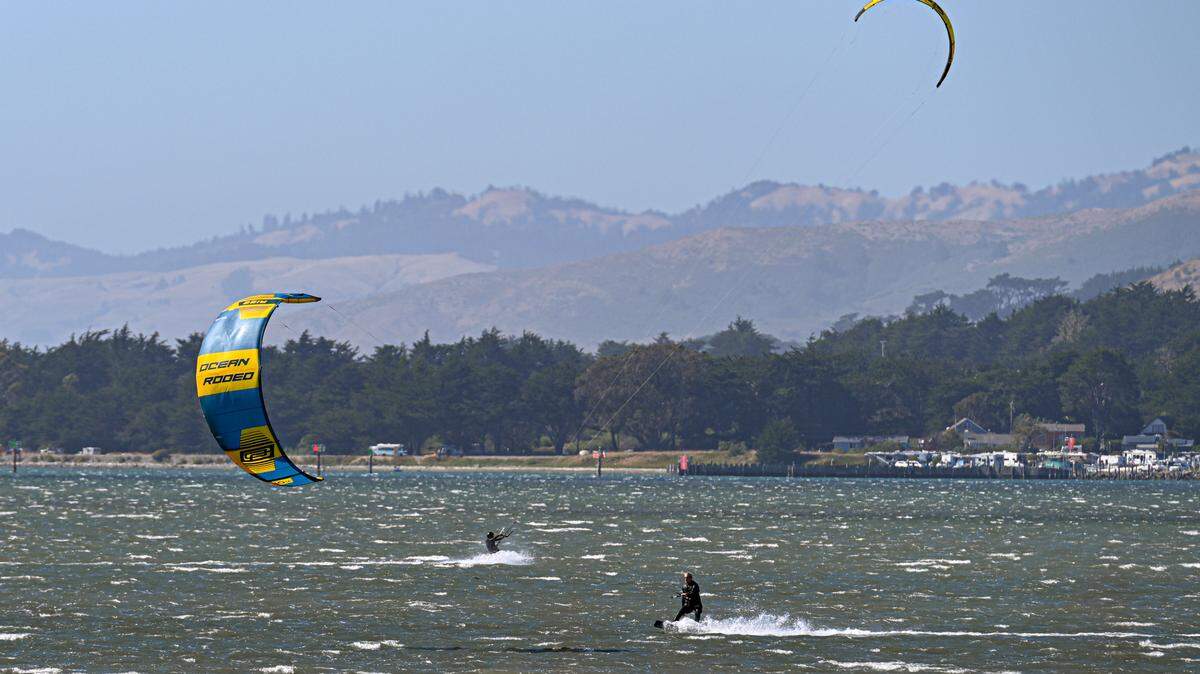
If the onshore winds are between gentle and fresh, 8 to 24 mph, the mist from the Pacific can sweep in like a ghostly blanket moving through the trees. However, if the afternoon northwesterly winds are strong enough, they tend to mix out the temperature inversion layer, leaving behind windy and clear skies. That’s one of the reasons we often have foggy overnights but clear afternoons.
For this week, fresh to strong (19 to 31 mph) northwesterly winds are our forecast during the afternoon, decreasing during the night and morning. This pattern will allow marine low clouds with pockets of fog and mist to develop overnight, clearing during the afternoon in the coastal regions. This onshore flow will also help to keep the inland valleys at seasonal norms, as cooler air filters through the passes and gaps of Santa Lucia mountains and Salinas Valley.
The inland valleys (Paso Robles) will warm to the low to mid-90s, quickly cooling during the evening. The coastal valleys (San Luis Obispo) will reach the mid to high 70s in the coastal valleys (San Luis Obispo). Temperatures along the beaches will reach the 60s, except for Cayucos, Avila Beach and Shell Beach, which will get the low 70s.
A significant amount of monsoon moisture will move into the desert southwest this week; however, only variable mid- to high-level clouds are expected for our area.
Surf Report
Strong to gale-force (25- to 38 mph) northwesterly winds off the California coast will generate 6- to 8-foot northwesterly sea and swell (with a 5- to 11-second period) along our coastline through next Sunday.
Combined with this northwesterly swell, will be a 1- to 2-foot southern hemisphere swell (with a 14- to 16-second period) on Monday through Thursday.
Surface seawater temperatures will range between 52 and 55 degrees through next Sunday.
On this date in Weather History (Aug. 11)
The “Dog Days” officially come to an end on this date, Aug. 11, having begun the third day in July.
1987: An early evening thunderstorm in Wyoming produced hail up to 2 inches in diameter from Alva to Hulett. Snow plows had to be used to clear Highway 24 south of Hulett, where hail formed drifts two feet deep. (The National Weather Summary)
1989: One of the most severe convective outbreaks of record came to a climax in southern California after four days. Thunderstorms deluged Benton, California, with 6 inches of rain two days in a row, and the flooding resulted in damage to homes and highways. (Storm Data)
This week’s temperatures
LOWS AND HIGHS, PASO ROBLES
SUN | MON | TUE | WED | THU | FRI | SAT | SUN |
61,97 | 55,93 | 53,91 | 54,93 | 55,94 | 56,96 | 58,95 | 57,96 |
LOWS AND HIGHS, SAN LUIS OBISPO AND COASTAL VALLEYS
SUN | MON | TUE | WED | THU | FRI | SAT | SUN |
60,81 | 56,76 | 54,76 | 55,78 | 57,78 | 68,80 | 57,76 | 56,77 |
John Lindsey is a retired PG&E marine meteorologist. Email him at JohnLindseyLosOsos@gmail.com or follow him on Twitter @PGE_John.