
SLO County weather: Heavy fog, drizzle coming to coast while inland areas heat up again
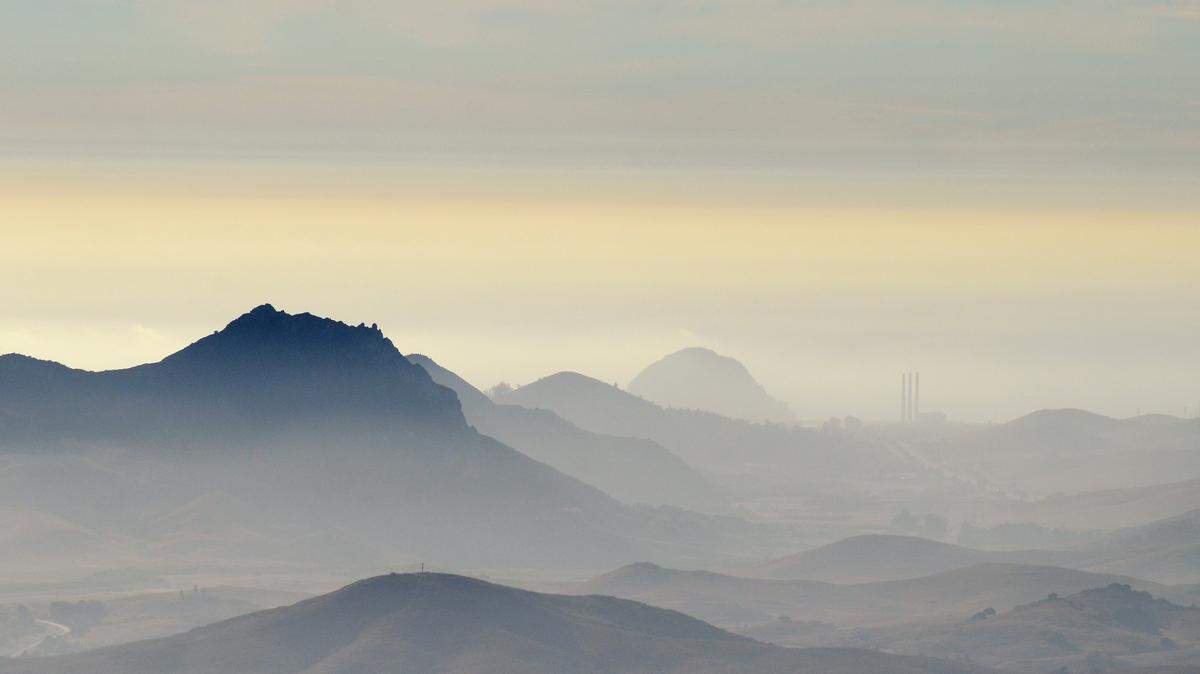
You may have heard or read the terms “May gray,” “June gloom,” “no-sky July” and “Fogust” to describe the persistent marine layer that often develops along the coastal regions of California during late spring and summer.
Typically, the coastal marine clouds give way to mostly blue skies by September until the first storms of the year arrive. However, this September will start with marine stratus clouds that will produce pockets of heavy drizzle/light rain and dense fog.
During the Industrial Revolution, in London, they called it “pea soup fog,” which was yellowish or greenish in color and caused by the heavy smoke from coal burning to heat homes and power factories mixed within the moist air from the River Thames that runs through the city.
Zoe Hendricks of Los Osos coined “Souptember” to describe the thick overcast fog that town sees in late summer.
A 565-decameter upper-level low-pressure system will develop over the Central Coast on Saturday into Sunday.
At the surface, a weak cold front will move southward through San Luis Obispo and Santa Barbara counties. This condition will produce partly to mostly cloudy skies with areas of heavy drizzle and dense fog, especially Saturday night into Sunday morning.
Strong to gale-force (25 to 38 mph) northwesterly winds will follow on Sunday and Labor Day afternoon, which will create clearing skies. However, the marine layer will redevelop Sunday night into the following morning with fog and mist.
High temperatures on Sunday will range from the low 60s along the coastline, except on the southerly facing beaches of Cayucos, Avila, and Shell Beach, which will run from the high 60s to the low 70s.
The coastal valleys (San Luis Obispo) will hit the low 70s on Sunday. The inland valleys (Paso Robles) will only reach the high 70s. Labor Day will see the inland valleys warm to the mid-80s and the coastal valleys to the mid-70s.
The northwesterly winds will gradually decrease Tuesday into Friday, resulting in a deeper and more persistent marine layer in the coastal regions, while the inland areas will warm to the low 90s under mostly clear skies.
The long-range models indicate monsoonal moisture will continue to move northward into far eastern California, Arizona, and New Mexico. The Central Coast is expected to remain dry. There is no indication of any Santa Lucia (northeasterly/offshore) wind events developing through the first half of September.
Surf report
Strong to gale-force (25 to 38 mph) northwesterly winds will generate a 4- to 6- foot northwesterly (310-degree, deep-water) sea and swell (with a 5- to 17-second period) on Sunday, increasing to 5- to 7-feet (with a 5- to 15-second period) on Monday into Tuesday.
A 3- to 5- foot northwesterly (295-degree, deep-water) swell (with an 8- to 12-second period) is expected along our coastline on Wednesday through Friday.
Combined with this northwesterly swell will be a 1- to 3-foot Southern Hemisphere (195-degree, deep-water) swell (with a 16- to 18-second period) on Sunday through Friday.
Seawater temperatures will range between 56 and 59 degrees through Tuesday, increasing to 57 to 59 degrees on Wednesday through Friday.
This week’s temperatures
LOWS AND HIGHS, PASO ROBLES
SUN | MON | TUE | WED | THU | FRI | SAT | SUN |
53, 79 | 52, 86 | 56, 90 | 56, 88 | 56, 90 | 54, 88 | 57, 95 | 58, 96 |
LOWS AND HIGHS, SAN LUIS OBISPO AND COASTAL VALLEYS
SUN | MON | TUE | WED | THU | FRI | SAT | SUN |
58, 73 | 56, 76 | 57, 78 | 56, 76 | 57, 78 | 55, 77 | 58, 80 | 59, 81 |
John Lindsey is a retired PG&E marine meteorologist. Email him at JohnLindseyLosOsos@gmail.com or follow him on Twitter @PGE_John.