
Did SLO violate election laws with sales tax mailer? Here’s what city, former councilman say
A former San Luis Obispo City Council member is accusing the city of violating rules regarding fair political practices with a mailer about the city’s sales tax measure.
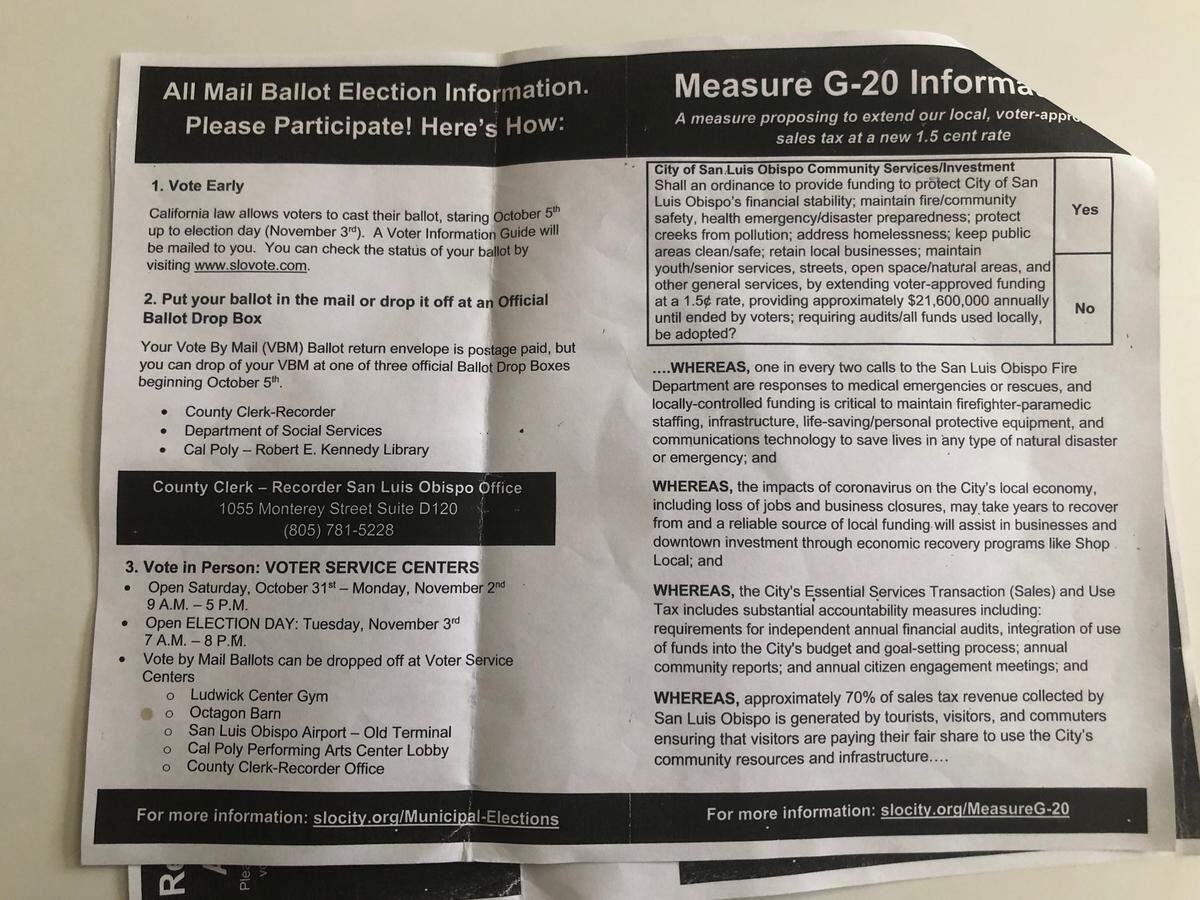
Local residents received a mailer the included information about Measure G-20 — the city’s proposal to increase the city’s sales tax by 1 cent, and renew an existing half-cent tax, for voter consideration a 1.5-cent sales tax increase.
T. Keith Gurnee, who ran unsuccessfully for San Luis Obispo mayor in 2018 and previously served on the City Council in the 1970s, said that the mailer expresses advocacy for the sales tax, and a government agency is prohibited from campaigning on an election issue.
But city officials say the flyer only provided information and deny Gurnee’s allegation that it violated any election policy.
Gurnee, who wrote the ballot argument against Measure G, compared the city’s messaging to that of Measure H in Los Angeles County, where public-sponsored ads resulted in a $1.35 million settlement after a taxpayer watchdog group was filed a complaint to the Fair Political Practices Commission.
“What’s most disturbing is (SLO) city’s spending of your taxpayer funds to send out official-looking city mailers this past week advocating passage of Measure G-20 and generating public fears if it fails,” Gurnee wrote in an email. “This thinly-veiled political hit piece was a direct violation of the Fair Political Practices Commission (FPPC) rules and the Government Code prohibiting the use of public funds for political purposes.”
San Luis Obispo city attorney Christine Dietrick said the mailer was purely informational, including facts about the sales tax measure that came from a resolution formed by the SLO City Council.
“There’s no prohibition on accurate ballot info,” Dietrick said. “There are direct excerpts of the resolution adopted by the council from a valid council meeting. There’s explicit language (in the mailer) that it’s not advocating.”
The City Council voted in July to put Measure G-20 on the ballot, citing a variety of spending needs and a projected $8.6 million shortfall in 2020-2021 due to coronavirus economic impacts. Future financial impacts are anticipated as well.
Dietrick said the Los Angeles County situation is much different, and the city took efforts to ensure the public is aware of its neutral position. SLO’s mailer included the following: “Election voting information is being provided as a public service by the City of San Luis Obispo. The city has no position of support or opposition to the information provided.”

What Measure G-20 mailer says
Sent to San Luis Obispo residents during the first week of October, the mailer is titled “Election Update and Information on Voting in the November 3rd All-Mail Ballot Election.”
The city includes all of the language of Measure G-20, as articulated on the ballot that voters see, noting the estimated $21.6 million generated annually by the sales tax would go to uses including financial stability, safety, homelessness, streets and open spaces.
The flyer quotes four “whereas” stipulations from the City Council’s resolution detailing reasons for putting the measure on the ballot, saying, “Locally-controlled funding is critical to maintain firefighter-paramedic staffing, infrastructure, life-saving/personal protective equipment, and communications technology to save lives.”
It also cites “the impacts of coronavirus on the city’s local economy,” which may take “years to recover from” and notes that 70% of sales tax revenue collected by San Luis Obispo is “generated by tourists, visitors and commuters.”
The mailer explains that voters may choose to submit their ballots early, from Oct. 5 through election day on Nov. 3.
Did city of SLO violate election laws?
Gurnee said the mailer includes only points that support the passage of the sales tax.
“Just two months ago, the FPPC imposed a $1.35 million fine against the County of Los Angeles for doing what SLO is doing right now. Perhaps the city doesn’t mind spending your tax money to pay such a fine,” Gurnee wrote. But Gurnee told The Tribune doesn’t wish a fine on the city to further impact its budget.
Gurnee said he was aware of an attorney considering a complaint related to San Luis Obispo’s Measure G-20 messaging, but declined to reveal the lawyer’s name.
Dietrick said that the city’s role was to provide impartial education to the public on the measure, and disputes any notion the mailer is a campaign-related brochure.
“The line is advocacy versus information,” Dietrick said. “This provides public information about what this measure is so people are aware of it. It’s clearly an information flyer about the election and applicable and permissible use of public funds.”
Measure H, which was passed by voters in 2017, created a quarter-cent sales tax to fund homeless services and short-term housing in Los Angeles County. The Howard Jarvis Taxpayers Association filed a complaint against the county with the FPPC for alleged use of public funds for campaign purposes, according to the Sacramento Bee.
The Los Angeles County Board of Supervisors hired TBWB Strategies, a firm that specializes in conducting campaigns designed to pass local ballot measures, to conduct a public education campaign and advertising surrounding the ballot measure, Bee reporter Kim Bojorquez wrote.
“Television commercials ran in cable new stations advertising the measure included the slogans, “Real help. Lasting Change” and “Measure H on the March 7 Ballot. Are you ready? Vote March 7,” Bojorquez wrote. “Information about Measure H also ran on Spanish-language radio stations across Los Angeles and encouraged listeners to visit an official website to get more information.”
Under an agreement approved in August by the FPPC, Los Angeles County must pay a $1.35 million settlement, one of the largest penalties imposed by the commission, the Bee reported.
How would SLO sales tax funds be used?
Gurnee was critical of San Luis Obispo’s proposed sales tax, saying that the city previously has not spent much sales tax funding on capital projects.
“And what about the city’s failed past promises to spend previous sales tax revenues on capital projects?” Gurnee wrote. “Instead, they were spent mostly on general routine maintenance activities and operational expenses.”
Gurnee said that since passage of Measure G in 2014 the amount spent on true capital projects has is only 4%
But Greg Hermann, San Luis Obispo deputy city manager, wrote in an email that the funds were budgeted at approximately 70% for capital projects and 30% for operating uses.
Capital projects include neighborhood street paving, bicycle and pedestrian improvements and improvements to parks and recreation facilities, Hermann said.
The city has spend millions in funds over the years on street improvements, flood protection and open space preservation that the city considers capital spending, and identifies its spending in publicly posted budgets, Hermann said.
In 2019, that included $2.5 million in street resurfacing as part of the Laurel Lane project, reducing vehicles by speeds 7% and fatal collision risk by 28%, Hermann said.
The City Council votes on the allocation of the funding, after receiving recommendations from the Revenue Enhancement Oversight Commission, a citizen advisory body.
Operating expenses include rangers for open space areas, police officers and flood control staff.
“Annual community reports based on independent, financial audits, including the breakdown of capital and operating spending, are available on the city’s website at www.slocity.org/localrevenue,” Hermann said.
This story was originally published October 13, 2020 at 1:32 PM.
%20Cropped.jpg)