
Atascadero voters to decide two issues: raising the sales tax and fixing roads
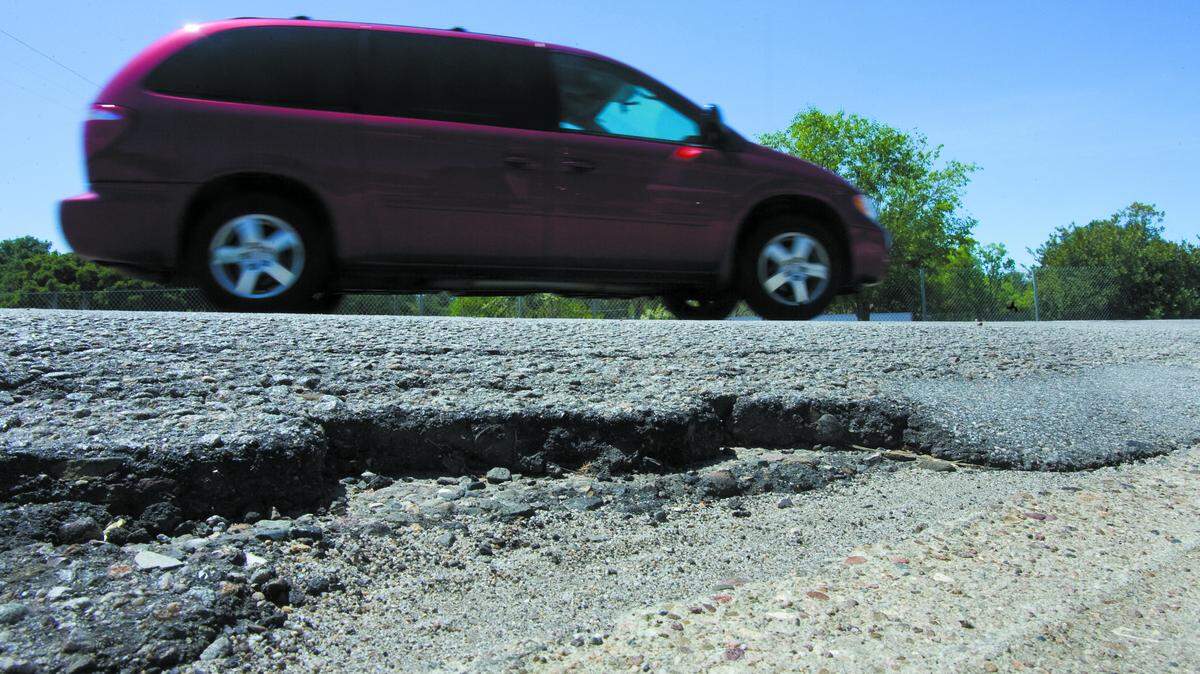
Are Atascadero voters willing to pay more at the cash register for the next decade or so to boost their city’s revenue for road repairs?
That’s the big question going before the city’s voters on Nov. 4 with a pair of tax increase measures expected to generate $1.7 million to $2 million annually for 12 years.
The city has 139 miles of roadways to maintain but currently structures its annual road budget to do major roadwork on less than 4 percent of them, plus fill potholes. And, according to a city study, more than half of the city’s streets are in dire condition.
City officials view the increased sales tax as a new revenue source to pay for roadwork. But voters are divided over whether to believe the money will actually be spent on street repairs because the sales tax measure is paired with an advisory measure that doesn’t legally bind the city to spend the new revenues on roads.
Measure F-14 will ask voters whether to raise the city's sales tax by half a percent — bringing it up to 8 percent from the state’s base rate of 7.5 percent — with the funds going to the city’s general fund.
Its companion, Measure E-14, will ask whether voters want city leaders to direct that new revenue toward fixing more of the city’s roads.
Both measures take a simple majority vote to pass.
Voters divided
The dual-measure approach is one that many cities take, including Paso Robles in 2012 when its voters chose a general sales tax increase, also for roads, since it requires a lower threshold to pass at the polls than the alternative of a specific tax.
A general sales tax needs a simple majority for approval while a specific tax — which legally restricts the money to a particular use — requires a two-thirds vote to pass.
Consultants hired by the city predicted that not enough Atascadero voters would support a specific tax but would approve a general tax measure paired with an advisory measure for road repairs.
Measure F-14 would require the city to create a citizen oversight committee, publish an annual report and provide independent financial audits on how the sales tax increase would be spent.
Still, a general public mistrust of government has emerged this election season as a popular reason for some to plan on voting against the measures.
“The bottom line is it can be used for any other use determined necessary by the City Council,” said Atascadero resident Michael Sherer, who said he’ll vote against the tax increase. “My concern is that eventually it will be absorbed into the general fund instead of paving roads.”
The city’s general fund also pays for salaries as well as services such as police, fire and parks.
But resident Kim Croft said she supports the measures as a way to get more money for road repairs.
“Without the increase, we are going to be put in a position that our roads will continue to deteriorate without maintenance,” she said. “We will literally end up with roads that will crumble.”
Deteriorating roads
Atascadero has 139 miles of roadways to maintain but enough money each year to do major roadwork on just two to five miles of those, plus a year-round pothole-filling program on all 139 miles as needed.
The city spends $1.5 million on road maintenance annually, with the funds coming from a state gas tax charged at the pump and state and local grant funds.
The new revenue, should voters approve it, is expected to generate about twice that each year, adding up to a bump of about $20 million total at the end of the 12-year period.
Currently, approximately 74 miles of the city’s roads — just more than half — are categorized as being in “poor” and “bad” condition, according to a city road report.
Roads with that rating “would have lots of cracking. The surface pavement would be wearing and you’d see lots of rock showing through the top surface, as opposed to it being smooth,” city Public Works Deputy Director Dave Athey said. “There are a lot of roads that are in that shape right now.”
An example of a road in “poor” condition would be El Camino Real from San Anselmo to Del Rio roads, he said.
Elsewhere, 21 miles, or 15 percent of roads, are listed as being in “good” condition; while 44 miles, or 32 percent of roads, as being in “fair” condition, the report says.
The city has a schedule in place that pairs the worst roads with possible fixes for the amount of money the city has budgeted for road repairs, so Athey said the tax money would allow the city to get to some projects more quickly, though not all.
One such project would be repaving San Gabriel Road, Athey said, which is still several years away under the current budget.
On par with other cities
Since 2002, the City Council has made it a priority to focus available funds on the downtown as well as major arterial and collector roads that people use to maneuver through town.
New revenue could mean more focus on residential areas, rural collector roads and west-side streets, the report says. It would also mean more preventive work to help extend the life of existing pavement.
The city also has 30 additional miles of road that it doesn’t maintain because they are maintained by neighborhood districts such as subdivisions. Some roads aren’t maintained because they didn’t meet city standards when Atascadero incorporated in 1979, which frustrates some residents. Those roads also aren’t maintained by San Luis Obispo County.
Bringing Atascadero’s sales tax rate to 8 percent would keep the city on par with the county’s six other cities that have passed similar measures. The county’s unincorporated areas remain at the state’s 7.5 percent base tax on sales receipts.
If approved, the tax hike would show up in Atascadero on April 1, 2015.
This story was originally published September 12, 2014 at 8:16 PM with the headline "Atascadero voters to decide two issues: raising the sales tax and fixing roads."