SLO County board ends use of video in public comment after graphic display
The San Luis Obispo County Board of Supervisors stirred the pot at Tuesday’s meeting with a controversial amendment to their Rules of Procedure, inviting public debate as to whether the change was an attempt to limit free speech.
On Tuesday, the board approved a motion 3-2 adding language to its meeting rules restricting the use of county equipment and preventing obscene speech and imagery during the public comment period.
The rule change follows a recent board meeting on July 9 at which public commenters displayed sexually explicit photographs and videos in objection to the county’s Pride Month declaration, causing disorder in the meeting room.
The board voted according to partisan lines, with Supervisors Bruce Gibson, Dawn Ortiz-Legg and Jimmy Pauling casting yes votes and Supervisors John Peschong and Debbie Arnold in dissent.
The last time the board revised the Rules of Procedure was in January 2023.
When presenting the motion to the board, County Counsel Rita Neal noted that there is a statewide trend of public meetings becoming more disruptive.
Peschong said that the amendment to the board’s Rules of Procedure was a direct response to the “pornography that was shown” at the July 9 meeting, which he had walked out on in protest.
Despite his disapproval of the offensive imagery from the previous meeting, Peschong voted against the rule change, exemplifying the division of the board and greater community over issues of free speech.
“I do think that we may be going a little bit too far,” he said.
What does the new rule do?
According to the amended rule, no speakers will be able to use any of the county’s video, audio or other multi-media equipment other than a microphone to make a digital presentation during public comment, with the exception of applicants and appellants.
Public commenters will still be able to give physical handouts to the board and hold up images for the board, but they would not be allowed to broadcast it on the county’s audio/visual equipment.
The new rules were a direct response to the events of the July 9 meeting, during which members of the public showed graphic images and shared misinformation about the LGBTQ+ community during public comment.
Gibson called the rule changes “a minimal restriction on the ability of the public to comment on the proceedings before this board” and said that he believes it is “absolutely appropriate to mitigate what we can expect to be increasing threats of the kind of behavior that we saw on the 9th.”
Other additions to the rules include clarifications that public commenters may not yield their time to other speakers or speak a second time on behalf of someone else; that remarks should be directed to the board as a whole and not to any individual supervisor or attendee; that slanderous, obscene or threatening remarks or materials will not be tolerated at meetings; and that the board retains the right to remove anyone being willfully disruptive from the meeting upon a second warning and a recess.
The board also agreed to codify a meeting code of conduct and adopt language consistent with the Brown Act, California’s open meetings law that mandates a set of rules that local government must adhere to so that meeting are not held in secret.
Are the new restrictions a limitation of free speech?
The proposed amendment was meant to address the disruptive display from July 9 and put guard rails in place to prevent obscene material and hate speech at future board meetings, but multiple members of the public felt that the measures were a limitation of their freedoms.
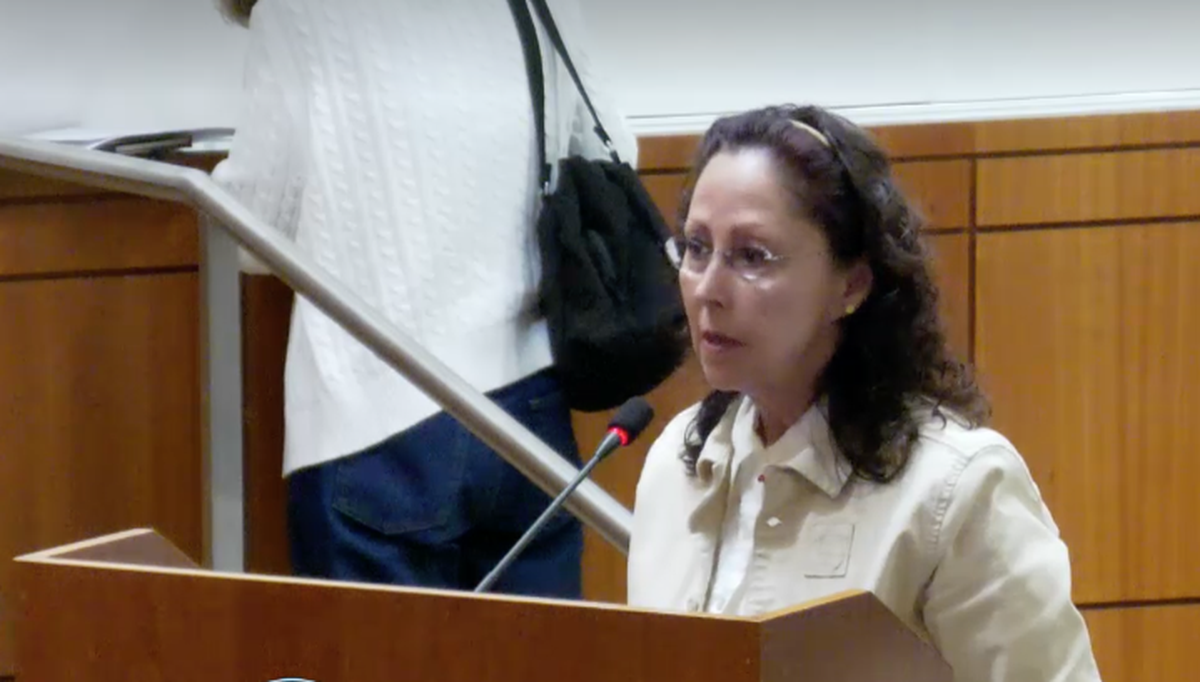
Commenter Murray Powell of Templeton called the rule changes a “violation of free speech.”
“Pictures are worth a thousand words,” Powell said in defense of the importance of using county equipment to present images during the public comment period of meetings.
San Miguel resident Darcia Stebbens agreed.
“Visually, it does make an impact,” she said during public comment. “I find it quite ironic that we have a limitation of First Amendment rights during public comment, especially ironic that we’ve just paid for as taxpayers and citizens of this county, a whole new audio-visual system that we’re now limited in use.”
Paulding pointed out the constitutionality and common practice of restricting use of county equipment at public meetings under the First Amendment.
“Prohibiting the use of county equipment would be a valid restriction on public comment as long as it is content- and viewpoint-neutral, and would make the meetings more efficient and would limit disruptions and unruly conduct,” he pointed out. “This is common practice in other cities and counties.”
But others still thought the rule change was an overreaction.
“This problem came as one individual put up material that violates community standards,” said Mike Brown, a representative of the Coalition of Labor, Agriculture and Business of SLO County.
“This is just a one-off,” Brown said. “I think what’s really happening here is that you’re seizing on that incident to use it as an excuse to put in more restrictions that don’t have anything to do necessarily with the ... video.”
Brown criticized multiple sections of the rule changes, specifically that members of the public should be able to address their individual public servants to hold them accountable, and questioned the board’s authority to define what kind of language will be tolerated at meetings.
“Slanderous is in the eye of the beholder,” Brown said. “How do you know if it’s slanderous or not?”
Paulding, who called the display at the July 9 meeting “patently offensive,” disagreed.
“The idea that this was a one-off thing and it won’t happen again in the future isn’t consistent with the reality that we are a very polarized country right now. We’re a polarized community,” Paulding said. “I think we should expect more of that and plan accordingly.”
Paulding also suggested incorporating the board’s code of civility directly into the Rules of Procedure, to which Powell could be heard from the back of the room saying “Are you kidding me” in reaction.
Board votes 3-2 to approve the changes
Ultimately, the board approved the changes in a 3-2 vote.
In his approval, Gibson reiterated the importance of preventing harmful information and uncivil behavior from derailing county meetings.
“It may be rare, but I do believe it needs to be mitigated,” he said.
Gibson emphasized to attendees that appearance at public comment is not the only opportunity to provide information to the board.
Agenda and items are published nearly a week ahead of time and anything submitted to the board in the period prior to the meeting enters the formal record, he said.
“I am very disappointed in anybody thinking that, somehow, that we’re trying to limit public comment,” Ortiz-Legg said. “By no means is that happening here.”
Ortiz-Legg, who voted for the change, called out the potential for misinformation in this day and age of fake news.
“In today’s world with the kind of media capabilities and AI capabilities ... we have no idea whether anything’s accurate,” she said. “What matters is your voice.”