SLO County supervisors reject plan to build housing around synagogue
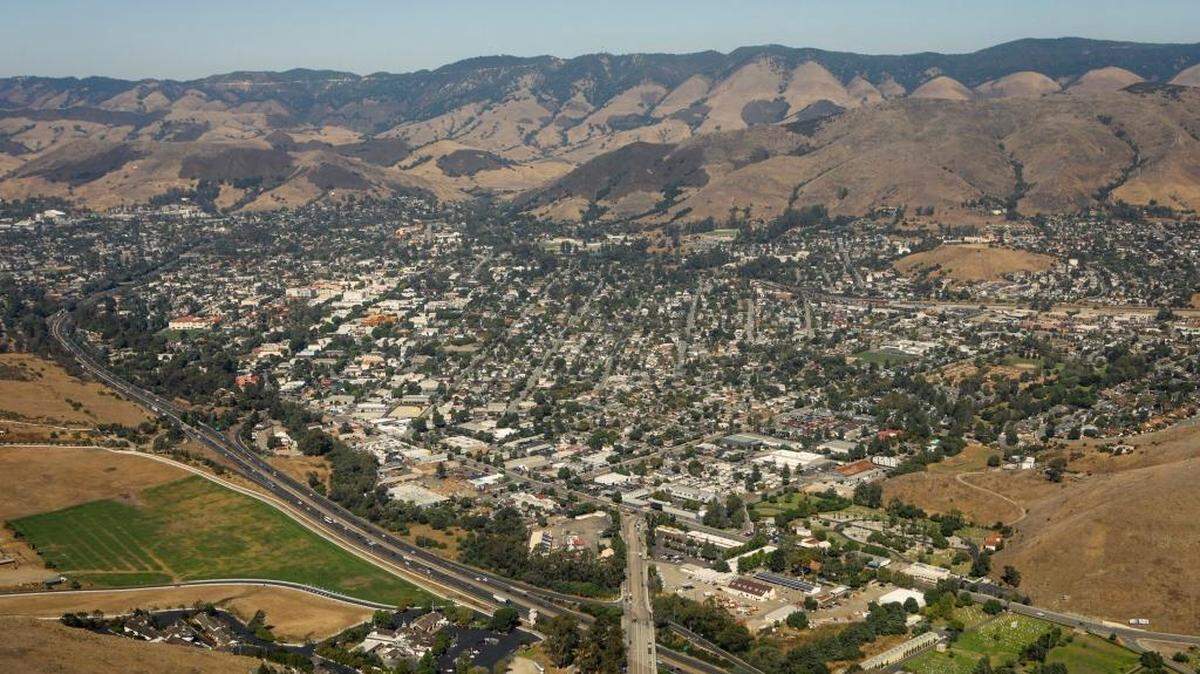
At the end of Los Osos Valley Road lies a 92-acre plot of land that could help ease San Luis Obispo’s critical housing shortage.
Congregation Beth David owns the property, while real estate developer John Rourke holds the lease.
Rourke and the synagogue’s congregation want to split the land into eight parcels, with a plan to develop housing and potentially a mixed use project on part of the property.
In March, the San Luis Obispo County Planning Commission rejected the project.
Rourke and Congregation Beth David appealed the decision, asking the San Luis Obispo County Board of Supervisors to send the project back to county staff to be revised and reconsidered.
On Tuesday, the board voted unanimously to uphold the Planning Commission’s decision to reject the project, arguing that San Luis Obispo County zoning code doesn’t allow the property to be divided into smaller parcels.
Project would build housing near SLO synagogue
The property, located at the intersection of Foothill Boulevard and Los Osos Valley Road, is about a half mile outside of San Luis Obispo city limits.
Congregation Beth David manages the 20-acre parcel surrounding the synagogue, and Rourke manages the other 72 acres, he said.
Rourke currently rents the land for cattle grazing and dry farming, he told The Tribune after Tuesday’s meeting.
The project would divide the property into four 2.5-acre parcels for housing, one 5.92-acre parcel for affordable housing and a mixed use development and one 20-acre parcel for the synagogue, as well as two larger parcels measuring 20.12 acres and 35.93 acres, respectively, that don’t yet have a designated use, the staff report said.
“People feel like there’s going to be some massive eyesore,” Rourke told the Tribune, but he said the project is smaller than that.
Rourke wants to build four to five houses on the property, along with a shopping center on the land closest to Foothill Boulevard similar to San Luis Obispo Public Market at Bonetti Ranch, he told The Tribune.
Affordable housing would be built into the shopping center, he said.
SLO County says LOVR property cannot be divided
According to San Luis Obispo supervising planner Cheryl Ku, county zoning law doesn’t permit Rourke and Congregation Beth David to divide the 92-acre property off Los Osos Valley Road into smaller parcels.
Zoning code provides two ways to decide the minimum parcel size allowed on a property, Ku said at the meeting.
One method used for deciding parcel size is based on land capacity decided by soil classifications set by the Natural Resources Conservation Service, Ku said.
Land containing Class 1 and 2 soils can have minimum lot size of 20 acres if 90% of the total average is irrigated row crops, Ku said.
Land with Class 3 and 4 soils must have 40-acre to 80-acre lots, she explained, while land with Class 6, 7 and 8 soils must have 320-acre plots, Ku said.
The synagogue’s land contains Class 2 and 3 soils, Ku said.
As a result, if the property was divided — the parcels would have to be a minimum of 80 acres, she explained.
Another method of determining parcel size is based on land use. On property zoned for agriculture, land used for dry farm crops must have a minimum parcel size of 160 acres, Ku said.
Meanwhile, land used for irrigated row crops such as strawberries can have a minimum parcel size of 20 to 40 acres.
According to Ku, the county has not seen evidence that irrigated crops have been successful on the land, Ku said. As a result, the synagogue’s land must have a parcel size of at least 160 acres, she said.
Rourke said that property was once used to grow strawberries, but added that the farmer ended the operation because he couldn’t find enough labor — not because the crop failed.
Rourke said he should be allowed to divide the land into 20-acre parcels.
According to Ku, county code seeks to ensure that land zoned for agriculture is able to support agriculture. The project proposed by Rourke and the synagogue wouldn’t do that, she added.
“If we were to allow the appellant’s interpretation in this case, we’d be converting ag land to non-ag land because the resulting parcels would be too small to support meaningful production,” Ku said.
What about affordable housing?
The board agreed with county staff and struck down the project, explaining that county zoning code prevents Rourke and the synagogue from dividing their 92-acre property.
Rourke, however, said that the state’s Density Bonus Law requires the county to accommodate the project because it includes affordable housing.
The law exempts developers from certain development standards, such as height requirements for buildings, if their project includes affordable housing.
The county argued that the law doesn’t apply to zoning codes, such as minimum parcel size.
“If a parcel is not sub-dividable, nothing in state law regarding density bonuses kicks in,” San Luis Obispo County Supervisor Bruce Gibson said.
Rourke disagreed, and said zoning codes are included.
The law stipulates that “where there is a ‘range’ of densities, the highest density in that range shall prevail,” according to a letter from Rourke’s attorney Andrew Fogg to the board.
This would mean that the county must allow Rourke and the synagogue to divide the property into 20-acre parcels, he said.
Now that the board denied the appeal, Rourke told The Tribune that his next step is suing the county in state court for defying the state’s Density Bonus Law.
This story was originally published July 19, 2023 at 1:02 PM.