How should SLO County sheriff use tear gas, machine guns? Report required under new law
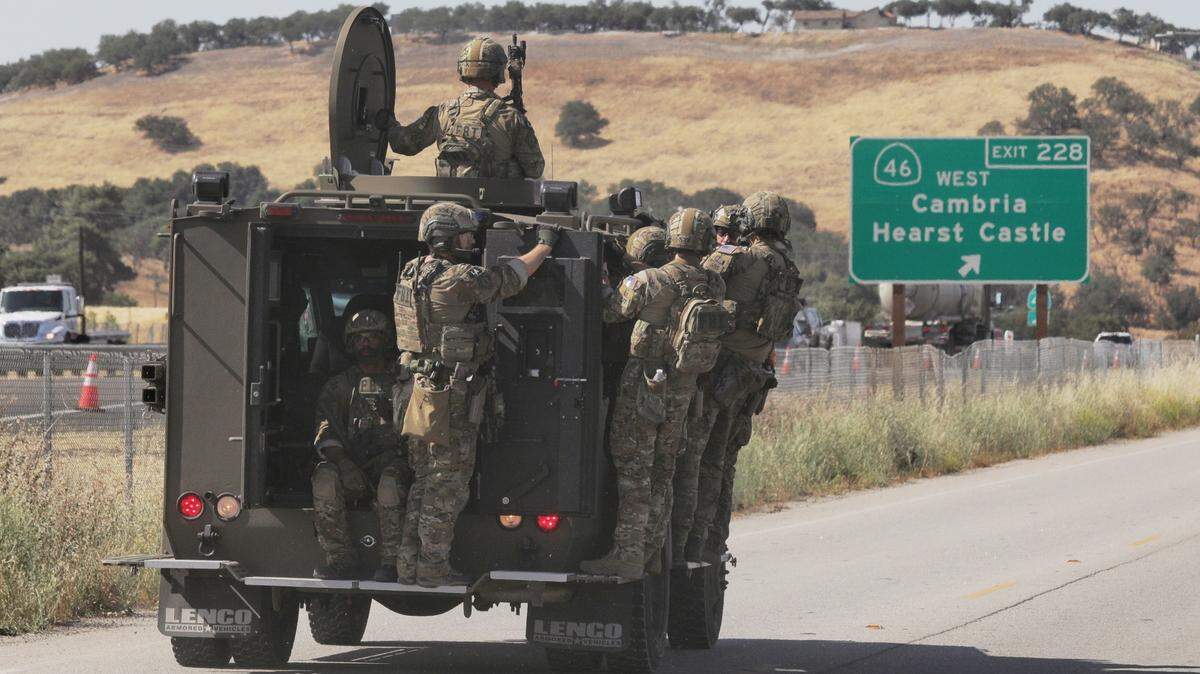
Tear gas, specialized firearms and armored vehicles appear on a 1,077-item list of so-called “military equipment” owned by the San Luis Obispo County Sheriff’s Office.
At the San Luis Obispo County Board of Supervisors meeting on Tuesday, the Sheriff’s Office introduced an ordinance that empowers the board to deny further use of military equipment based on how it was used each year, as required by a new state law.
An annual report from the Sheriff’s Office is also required by the new ordinance.
The report must include:
- A list of the Sheriff’s Office’s military equipment,
- A summary of how the agency used the equipment,
- Complaints made about the equipment or its use,
- Equipment costs, from purchase to storage,
- Internal audits — such as “information about violations of the military equipment use policy, and any actions taken in response,” the report said, and
- The amount of equipment the Sheriff’s Office plans to obtain during the next year.
“The report is a living document that you approve every year,” county Undersheriff Jim Voge told the board at Tuesday’s meeting.
After reviewing the report each year, the board can vote on whether or not the Sheriff’s Office can continue to use the equipment.
The Sheriff’s Office must also seek board approval to receive new military equipment, Voge said.
Assembly Bill 481, signed into law by Gov. Gavin Newsom on Sept. 20, 2021, requires all law enforcement agencies in the state to craft a military equipment use policy like the ordinance introduced by the San Luis Obispo County Sheriff’s Office.
The law defines equipment as “military” based on its characteristics, such as “firearms and ammunition of .50 caliber or greater,” the report said.
As a result, some of the items defined as military equipment never belonged to the military, Sheriff’s Office Chief Deputy Nathan Paul said.
The policy is intended to “safeguard the public’s welfare, safety, civil rights and civil liberties,” the ordinance reads, and create a new layer of oversight of the Sheriff’s Office.
“I do appreciate the legislation to begin with,” Supervisor Dawn Ortiz-Legg said. “It’s exactly what people are asking for — transparency.”
This ordinance doesn’t ask the board to approve the purchase of new military equipment this year. Instead, the board will vote on requiring the Sheriff’s Office to publicly catalog its equipment, which is mandated by AB 481.
“We’re simply complying with state law,” Supervisor Bruce Gibson said.
The Sheriff’s Office has reported its equipment to different agencies before, sending an annual report on its firearms to the San Luis Obispo County Audit-Controllers Office — but it wasn’t as easy for the public to view those reports as it will be with the new annual report.
Paul noted that the Sheriff’s Office already has policies in place informing the use of its equipment.
“That’s not something new,” Chief Deputy Nate Paul said. “The whole idea is to do things correctly and safely.”
The board will vote on the ordinance on Sept. 13.
Should SLO County Sheriff’s Office use armored vehicles, machine guns?
The San Luis Obispo County Sheriff’s Office owns 47 different types of military equipment, including armored vehicles, drones, grenade launchers, machine guns, semiautomatic rifles and tear gas.
During the public comment section of Tuesday’s meeting, two people called the equipment unnecessary and voiced concerns that its use could cause violence in the community.
Atascadero resident Eric Greening said using military equipment changes the “ethos” of local law enforcement.
“The ethos is of dealing with enemies, not with community,” Greening said.
He said the Sheriff’s Office should focus on deescalation tactics rather than the use of military equipment.
Atascadero resident Michelle Magid agreed.
“Some of the equipment makes sense to me to keep officers safe. Drones, humvees,” Magid said. “Yes, let’s put barriers between officers and lethal situations. But let’s not give officers the ability to create more lethal situations.”
Weapons such as grenade launchers, chemical grenades and semiautomatic rifles don’t make sense for San Luis Obispo County, Magid said, adding that 2020 arrest of Black Lives Matter activist Tianna Arata by the San Luis Obispo Police Department and the death of San Luis Obispo County Jail inmate Andrew Holland have eroded her trust in local law enforcement agencies.
“I do not trust the SLO (Police Department) or the Sheriff’s (Office) as a whole to correctly assess human behavior in critical incidents, nor do I trust all of them to respond with the reasoning capacity of secure, rational adults,” Magid said.
Supervisor Lynn Compton on Tuesday shared her support for the use of military equipment.
“I want to have these tools available to you to protect us when we need that protection,” Compton said. “I don’t have a problem with anything that’s on that list.”
Supervisor John Peschong also voiced his support.
He said military equipment aided the Sheriff’s Office during the manhunt for Mason Lira, a homeless man who ambushed the Paso Robles Police Department, killed another homeless man and wounded four officers. The Sheriff’s Office followed Lira into the Salinas Riverbed and killed him during a shoot-out.
Speaking after Tuesday’s meeting, county Sheriff Ian Parkinson noted that the M-ATV, an armored all-wheel drive vehicle that originally belonged to the military, was the first vehicle deployed in the riverbed during the shootout. When Lira shot an officer, the officer sheltered in the M-ATV, Parkinson said.
Parkinson said that officers use military equipment to protect themselves.
“Our deputies don’t get paid to die,” Parkinson said.
Still, equipment isn’t exclusively used to defend officers. Local law enforcement agencies fired rounds of tear gas on Black Lives Matter protesters in June 2020 hours after they blocked traffic on Highway 101.
Parkinson said agencies would have to judge whether or not the use of tear gas has “been applied properly” on an event-by-event basis.
Paul added that tear gas is more commonly used on barricaded subjects — such as when suspects lock themselves in a building to evade arrest. Instead of entering the building and creating more “confrontation,” officers can deploy tear gas into the building and force the suspect to exit, Paul said.
Rev. Stephen Vines, president of the San Luis Obispo County chapter of NAACP, suggested that the county form a citizens’ commission to review military equipment alongside the Board of Supervisors.
This oversight would keep the Sheriff’s Office “more cognizant about how they deal with the community and how they’re using policies and procedures, and know that they’re not going to get away with a lot of stuff,” Vines told The Tribune on Monday.
Parkinson said Tuesday that a citizens’ commission shouldn’t have the power to deny the Sheriff’s Office use of certain equipment because those community members aren’t trained to use the equipment or know when it’s needed.
“I just don’t think their expertise is going to be there,” Parkinson said. “Sharing input is something that can be done every day with the Board of Supervisors.”
Vines advised law enforcement agencies to be cautious about their choices of weaponry.
“Policing is not waging war on a community,” Vines said. “They’re to serve and protect, not to wage war.”
This story was originally published August 24, 2022 at 3:23 PM.