
‘Rocket’ creature found in 1963 revealed as new species — and is already extinct

As new species are discovered around the world, others are disappearing without a trace.
Amphibians are facing existential threats on a global scale, leading some researchers to believe they’ve discovered a new species only to find out the animal is already extinct.
In 1963, two researchers in Brazil collected a single small frog about 340 miles south of where the species was thought to live, according to a study published Sept. 19 in the peer-reviewed journal Zootaxa.
The frog was part of a collection later deposited in the Smithsonian Institution Archives, but with no other confirmation of the species in that region, many researchers believed the record to be “almost certainly erroneous,” according to the study.
The researchers noted that the frog was collected from a “big field full of anthills and cow-chewed grass clumps,” and the area was described as having trees, fields, wetlands and streams, study author Taran Grant told McClatchy News in an email.
Today, however, the site is highly developed, Grant said, and what was once natural is now a mix of residential and commercial development within the city of Curitiba.
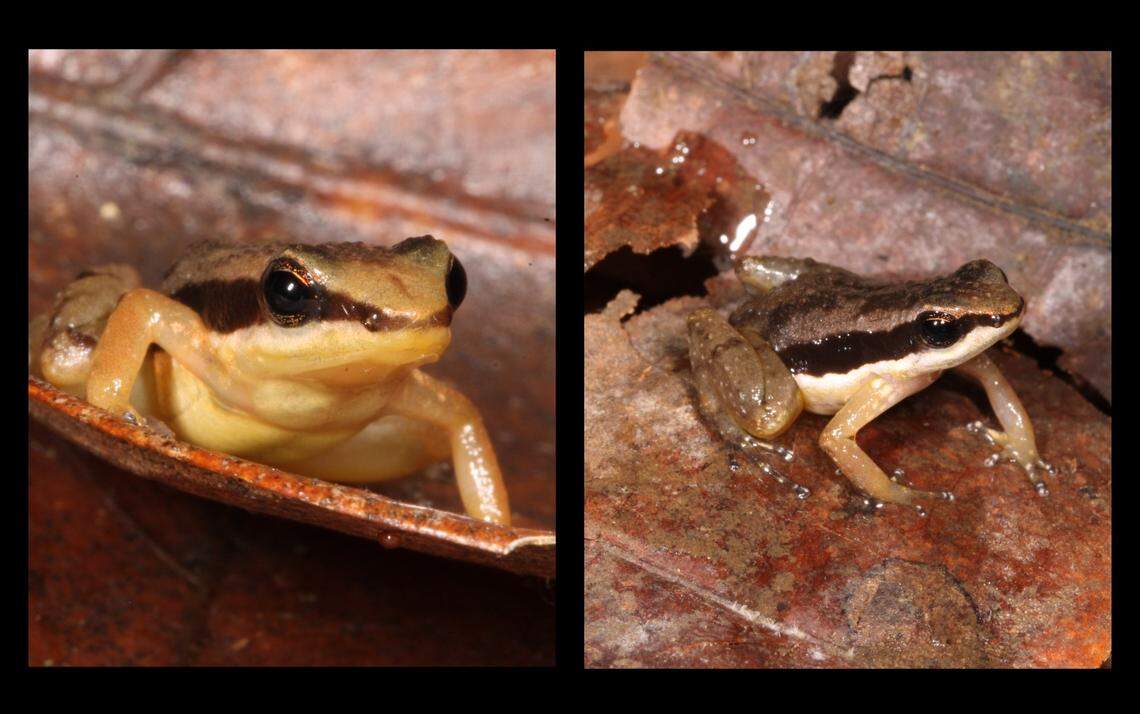
New research shows that it wasn’t a frog far from home, but rather a completely new species — and it’s already extinct.

Dryadobates erythropus was described from “severely dehydrated and extremely fragile” frog remains, Grant said.
The frog is about a half-inch long, according to the study, and dark brown in color after decades of preservation.
The species name of the rocket frog is “derived from Greek erythros (red) and pous (foot), Latinized as pus, from the Portuguese term pé-vermelho (red-foot), a colloquial nickname for people in rural areas of Paraná, originating from the farmers who often worked barefoot on the characteristic red soil of the northern part of the state,” according to the study.
It’s not good news for the red-foot rocket frog.
No other specimens have been collected in the past six decades, Grant said, and the “only known” habitat for the species has been destroyed since the frog was first found. The evidence suggests that the species has gone extinct in the time it took to correctly identify it.
“In addition to establishing the presence of Dryadobates significantly further south in the Atlantic Forest than previously known, (the red-foot rocket frog) is the fourth species in this lineage to have gone extinct in the past 60 years — all within the span of 15 to 20 years, between the mid-1960s and mid-1980s,” Grant said.
It also suggests that there could have been other species living in the area between Angra dos Reis and Curitiba that went extinct before they could ever be discovered, Grant said.
Researchers said there are a few factors contributing to the large-scale amphibian loss around the world.
First, habitat degradation, like what happened to the natural habitat of the red-foot rocket frog, is the “most immediately obvious potential explanation” for this species loss, as well as in other localities, according to the study.
Amphibians are also threatened by Batrachochytrium dendrobatidis, or Bd, a chytrid fungus that has been found in southeastern Brazil before, according to the study. The fungus was found in tadpoles from 1979 to 1987, suggesting it could have contributed to the end of the red-foot.
Lastly, “global amphibian declines over the last 40 years are strongly associated with exposure to extreme weather events,” researchers said. Heavy frosts were reported in the 1970s, as well as other climate-driven changes, that could have harmed an already small population.
“Given that the drivers of these recent extinctions are unclear, it is imperative that information be collected on the natural history, distribution and local abundance of (living) populations of Dryadobates to identify and mitigate threats to their survival,” researchers said.
Curitiba is in southeastern Brazil, near the Atlantic coast.
The research team includes Grant and Paulo Durães Pereira Pinheiro.
This story was originally published September 23, 2025 at 10:42 AM with the headline "‘Rocket’ creature found in 1963 revealed as new species — and is already extinct."
