Odd-colored shark appears on deep-sea camera in first-of-its-kind sighting
Scientists in the Azores Islands, Portugal, dropped a baited underwater camera and let it sink thousands of feet down in the Atlantic Ocean. Later, they hauled it up and reviewed the footage.
To their surprise and excitement, the camera recorded an odd-colored shark in a first-of-its-kind sighting.
A team of researchers dropped baited remote underwater video cameras, or BRUVs, off the coast of the Azores in October as part of an “annual fish scientific survey,” according to a study published Aug. 6 in the peer-reviewed journal Marine Biodiversity. The cameras were baited “with salted and chopped sardines,” then left to record marine life for about nine hours.
Of the many hours of BRUV footage, one clip caught the team’s attention.
The roughly 30-second-long video showed a pale white shark “slowly passing by the camera” at the edge of its range, the study said.
Researchers identified the animal as a leucistic false catshark, the first such record.
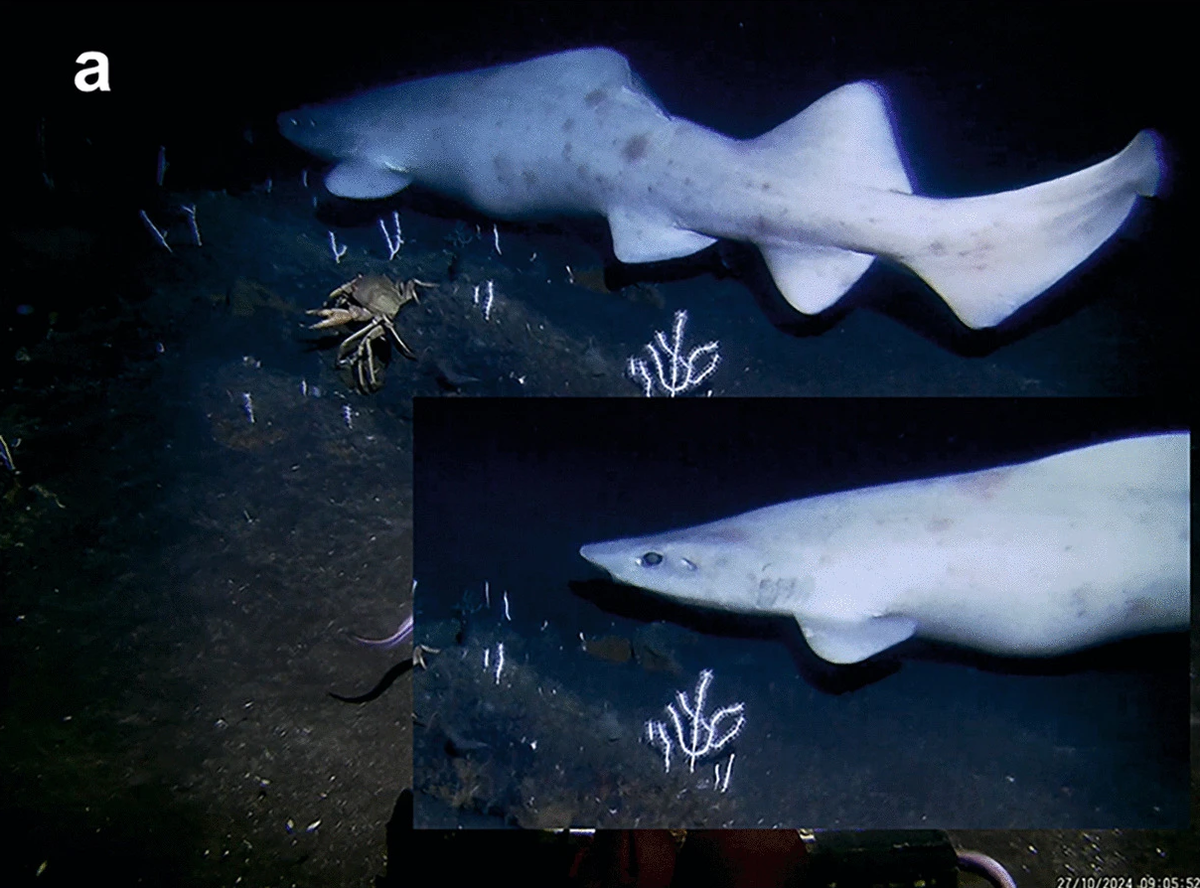
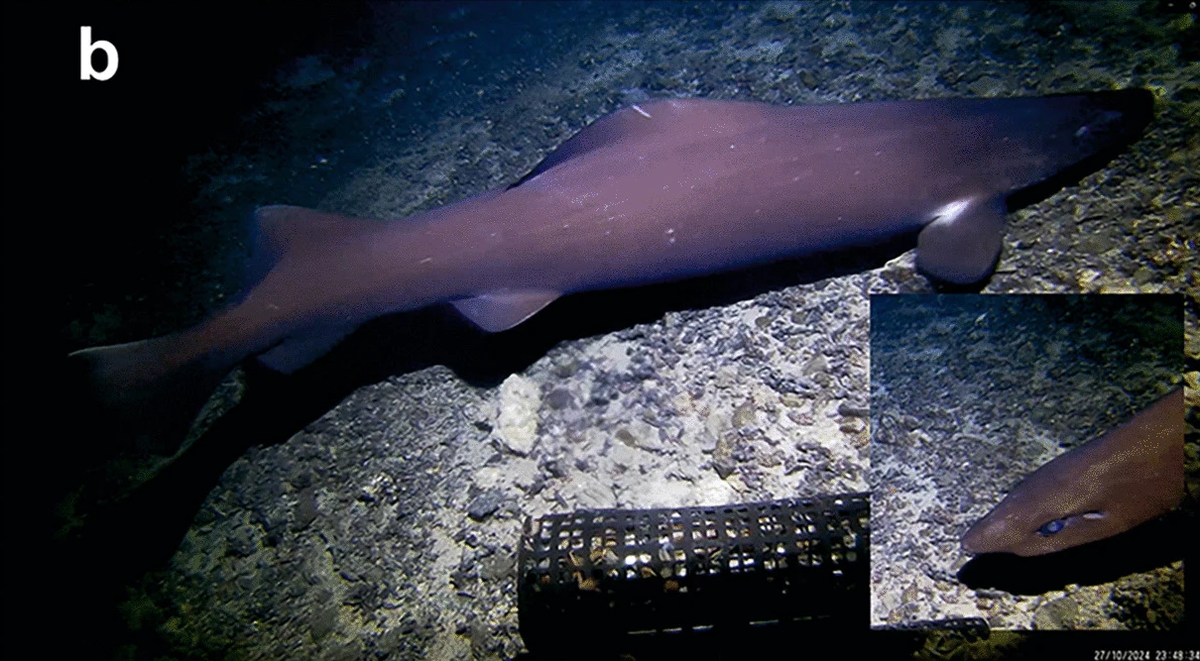
False catsharks, or Pseudotriakis microdon, are a species of “large,” deep-sea predators “with a patchy worldwide distribution,” the study said. Normally, these sharks are “uniform dark brown to blackish” in color.
Photos show a typical false catshark in the Azores and the unusual leucistic shark, both seen at depths of more than 4,000 feet.
Leucism is a genetic condition that causes a “partial loss of pigmentation, resulting in white, pale, or patchy coloration of the skin” while maintaining a normal eye color, researchers said. Leucism can be confused with albinism, the genetic condition that “results in a total lack of normal pigmentation” in the body and eyes.
Generally, “albinism and leucism conditions are considered to be quite rare among chondrichthyans,” or cartilaginous fishes, a group that includes sharks, the study said.
Many assume that the pale coloring of albino or leucistic animals negatively impacts “their ability to find prey, evade predators or may hamper sexual maturity and reproduction,” researchers said.
In the case of the leucistic false catshark, it “seemed to be in good health” with a “distended belly, suggesting that it had recently eaten or was pregnant,” the study said. Researchers concluded that the white shark probably did not face any additional risks due to its abnormal coloring because other deep-sea fish “naturally show whitish colorations.”
The Azores are a chain of islands in the Atlantic Ocean and roughly 900 miles west of mainland Portugal.
The research team included Diana Catarino, Eva Giacomello, Pau Robles and Laurence Fauconnet.
This story was originally published August 25, 2025 at 8:50 AM with the headline "Odd-colored shark appears on deep-sea camera in first-of-its-kind sighting."