
‘Fearsome’ predator roamed ocean 26 million years ago. It’s just been discovered

A fossil found along the coast of Australia has revealed the existence of a “fearsome” predator that roamed the Earth’s oceans millions of years ago.
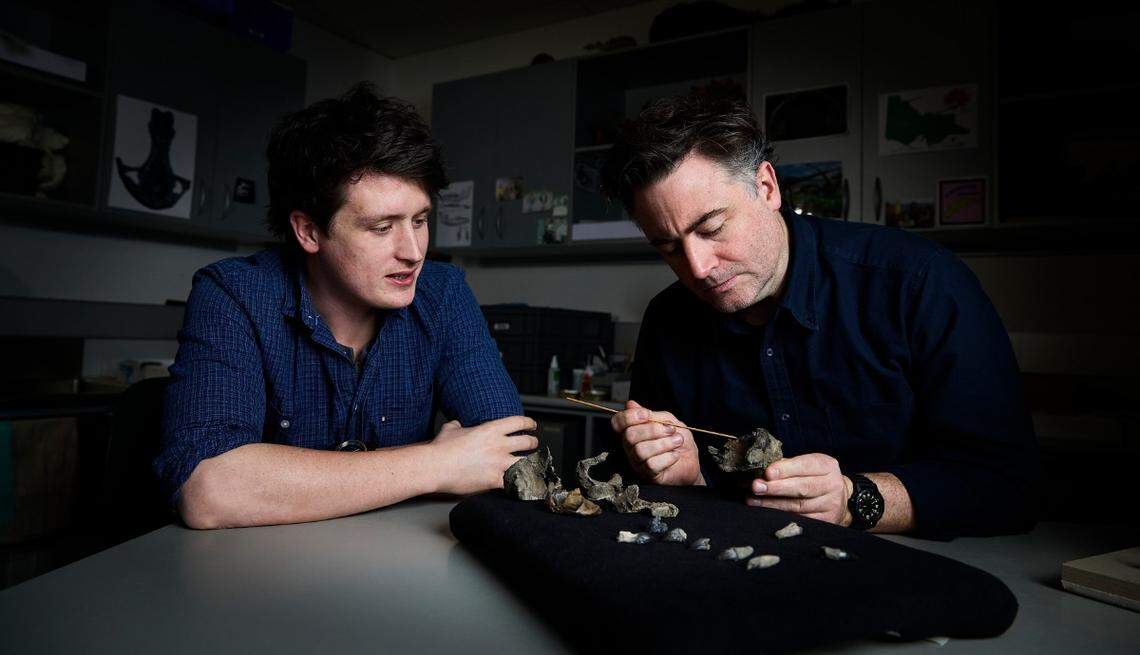
The prehistoric remains — consisting of a partial skull with teeth and ear bones — were discovered on the rocky shores of Victoria by Ross Dullard, a local resident, in 2019.
Realizing he had stumbled upon something noteworthy, he donated the fossil to Museums Victoria. Scientists there soon determined it belonged to a previously unknown species, which they named Janjucetus dullardi in honor of Dullard.
The new species — an early relative of baleen whales — is described in detail in a study published on Aug. 12 in the Zoological Journal of the Linnean Society, and an accompanying press release from Museum Victoria.
Unlike modern whales, Janjucetus dullardi was small in stature, measuring about the length of a dolphin.
However, it possessed razor-sharp teeth, large eyes and it could move at an extremely fast speed, researchers said.
“It’s essentially a little whale with big eyes and a mouth full of sharp, slicing teeth,” Ruairidh Duncan, one of the study authors, said in the release. “Imagine the shark-like version of a baleen whale – small and deceptively cute, but definitely not harmless.”
“It would have been a compact, yet fearsome sight in the warm, shallow seas of ancient Victoria,” the release said.
The sea creature belonged to a group of early whales known as mammalodontids, which lived about 23 to 30 million years ago, during the Oligocene Epoch. The fossil itself, which belonged to a juvenile individual, dates back 26 million years.
It’s the third mammalodontid to be discovered in Victoria — once a hotbed of whale biodiversity — and just the fourth ever to be found worldwide, according to researchers.
Further, this latest species is noteworthy due to its lack of echolocation structures, researchers said. Instead, the prehistoric creature would have hunted based on sight alone.
“This fossil opens a window into how ancient whales grew and changed, and how evolution shaped their bodies as they adapted to life in the sea,” Erich Fitzgerald, one of the study authors, said in the release.
The other study authors were James Rule, Travis Park, Alistair Evans and Justin Adams.
This story was originally published August 14, 2025 at 12:07 PM with the headline "‘Fearsome’ predator roamed ocean 26 million years ago. It’s just been discovered."