Student connects two fossils from different museums to reveal new ancient species
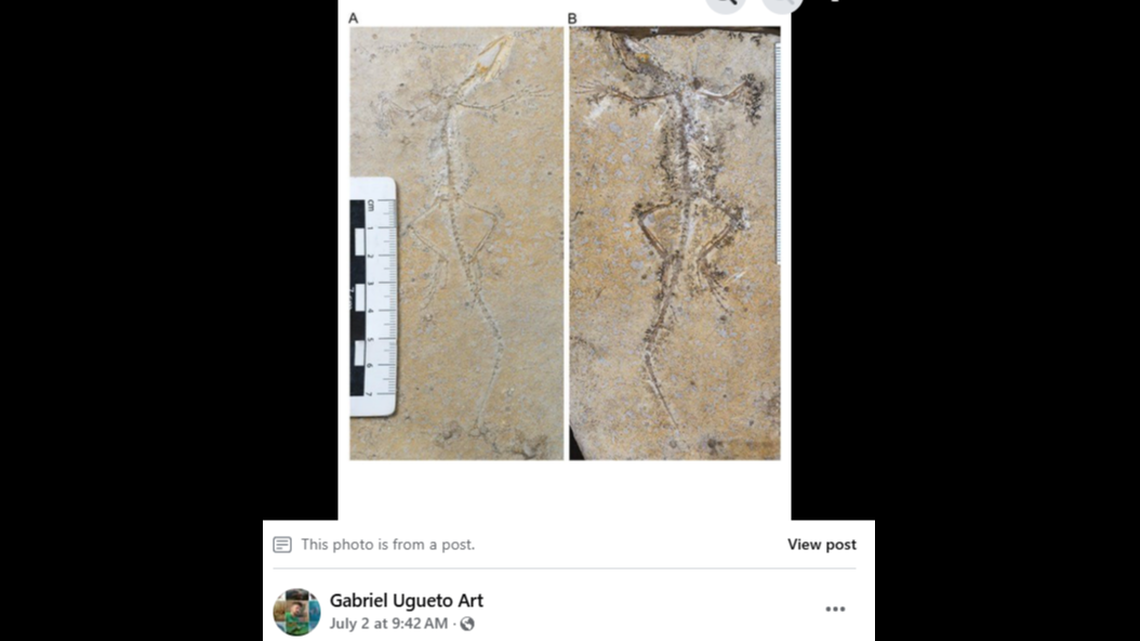
Victor Beccari, a PhD student, was studying reptile fossils at London’s Natural History Museum when he came across a familiar skeleton.
The prehistoric lizard-like creature he was looking at, called a rhynchocephalian, seemed to perfectly match the outline of a fossil he’d seen in the Senckenberg Natural History Museum in Frankfurt, Germany.
Additional analysis revealed the fossils were not just similar but two halves of the same fossil separated nearly 100 years ago, according to a July 2 news release from the Natural History Museum.
“It seems that someone in the 1930s decided to double their profit by selling both halves separately,” Beccari said in the release. “As they didn’t tell either buyer that there was another half, the connection between the two fossils had been lost until now.”
The fossil at the Senckenberg Natural History Museum was identified as Homoeosaurus maximiliani, but with the two halves put together, researchers discovered it was a new species.
Sphenodraco scandentis was an arboreal species from the Late Jurassic period in present-day Germany, according to a study sharing the findings published July 2 in the Zoological Journal.
Artist Gabriel Ugueto shared on Facebook a reconstruction of what the new species may have looked like based on the fossil record.
The team noticed that the specimen’s “teeth were in a different orientation to Homoeosaurus’s,” and its hip bones had a completely different structure, according to the release.
Sphenodraco scandentis had long finger bones that resemble those of modern gliding lizards, suggesting it spent most of its time in the trees, experts said.
Sphenodraco scandentis “appears to be the earliest tree-living rhynchocephalian ever discovered,” according to the release.
This story was originally published July 7, 2025 at 11:45 AM with the headline "Student connects two fossils from different museums to reveal new ancient species."