‘Emerald’ creature – with eyes like ‘fire’ — discovered in Thailand. See new species

Looking at branches criss-crossing the dense rainforest in Thailand, a pair of small, red eyes looks back at you.
They belong to a 2.5-foot snake, blended perfectly with its green surroundings.
It slithers down a tree, and you catch a glimpse of a red and white stripe running the length of its body.
Native to the forests of Thailand, Myanmar, Laos and China — in the infamous “Golden Triangle” considered to be a “biodiversity hotspot” — the snake was identified by a group of researchers, who published the finding in the journal Vertebrate Zoology on April 4.
It’s a new species.
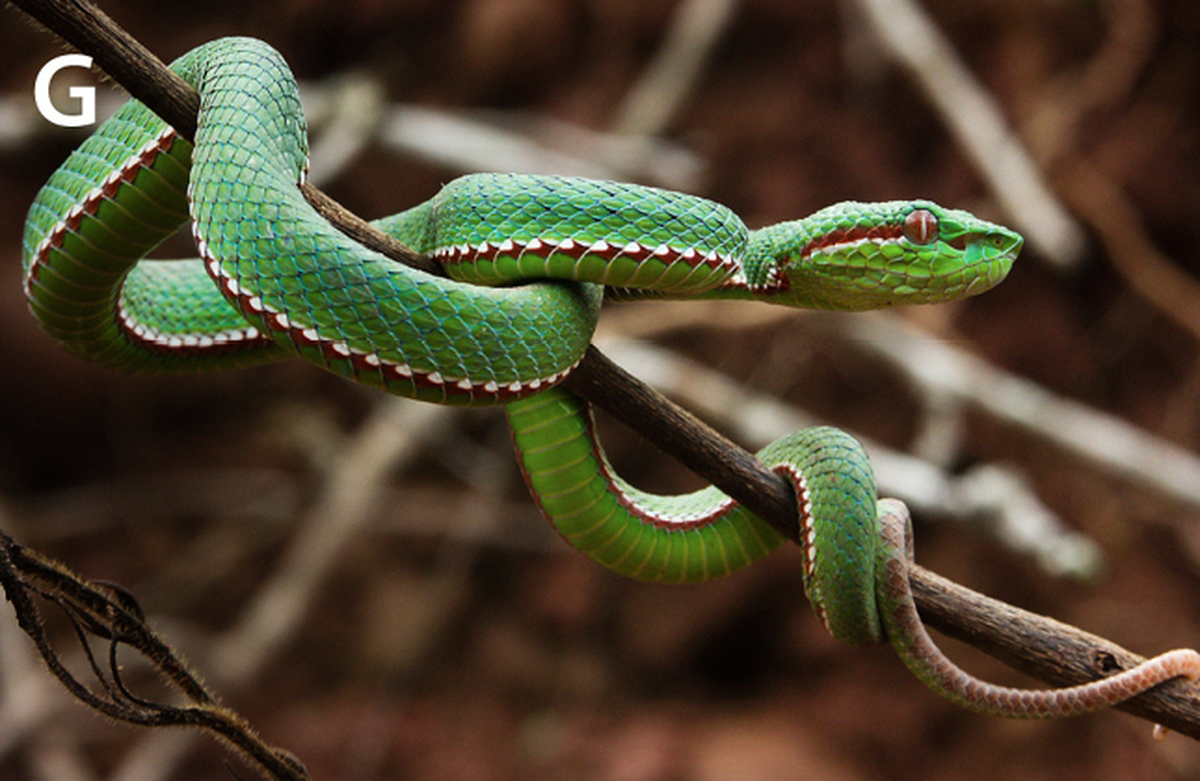
The snake, a type of pit viper, is saturated in color.
“In life or in freshly preserved animals, the body is uniform bright green, grass-green, emerald-green or deep green,” the researchers said.
Down the side of its body, a “bicolored” strip of bright red and white separates the top half of the snake from the bottom, according to the study.
While most of its body is perfectly adapted to blend in with the natural wall of green in the rainforest, its eyes pierce through.
“The eye is bright red, fire-red or deep red in specimens of both sexes,” according to the study.
.png "Pitviper -- T. Smith (2).png")
The new species, compared to other pit vipers, has slightly smaller males while females are a bit bigger than others, according to the study.
It also has fewer ventral, or belly, plates that cover the stomach, the researchers said.
The snake’s name, Trimeresurus lanna, pays homage to an ancient kingdom that once ruled the same land.
The Lan Na Kingdom, also known as the “Kingdom of a Million Rice Fields,” was centered in modern-day Thailand starting in the 13th century and maintained power for 500 years, the researchers said.
“The territories and cultural influence of the Lan Na Kingdom spread from easternmost Myanmar to northern Laos and southernmost present-day Yunnan of China, a geographic area that matches well the range of the new species,” according to the study.
The “Lanna green pitviper,” its common name, was one of two new species included in the study.
.png "Pitviper -- T. Smith (3).png")
Pit vipers are a subfamily of venomous snakes that have heat-sensing organs in between their eyes and nose, according to the American Museum of Natural History.
The organ looks like a gap in the scales covered by a membrane and allows the snakes to triangulate the location of possible prey, even in the dark, the museum says.
The “Lanna green pitviper” was first identified in Doi Inthanon National Park, in northwestern Thailand.
This story was originally published April 5, 2024 at 2:55 PM with the headline "‘Emerald’ creature – with eyes like ‘fire’ — discovered in Thailand. See new species."