Drone captures ‘previously unknown’ behavior in great white sharks off California
For most people, a large sail-shaped gray fin slicing through the surface of the ocean likely brings to mind the same foreboding two-note song.
It starts slow — a low E note followed by a low F —and builds faster and faster to a menacing musical climax meant to mimic the chaos of a great white shark attack.
What people may not know is that a white shark’s first fin is a remarkable tool used for stabilizing and, based on new observations, as “possible investigatory structures,” according to a study published Sept. 9 in the Journal of Fish Biology.
Researchers said the behavior exhibited by two Carcharodon carcharias, also known as great white sharks, was previously unknown.
Both observations were made during aerial shark surveys with drones off the coast of California.
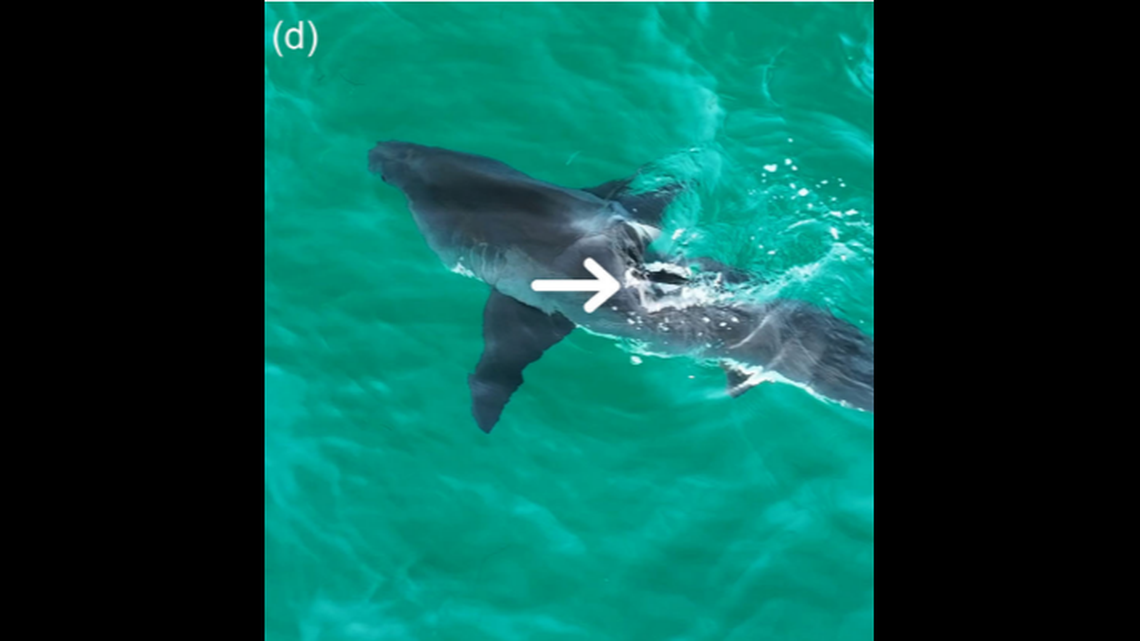
During the first sighting, researcher Carlos Gauna recorded a white shark near Goleta approaching “an unidentified surface object,” according to the study.
It first bumped the object with its snout — a well-documented investigative tactic among white sharks. It then swam past it, and, once it was parallel with the surface piece, rotated its dorsal fin on its axis and batted the object before swimming away and returning its fin to its original position, according to the study.
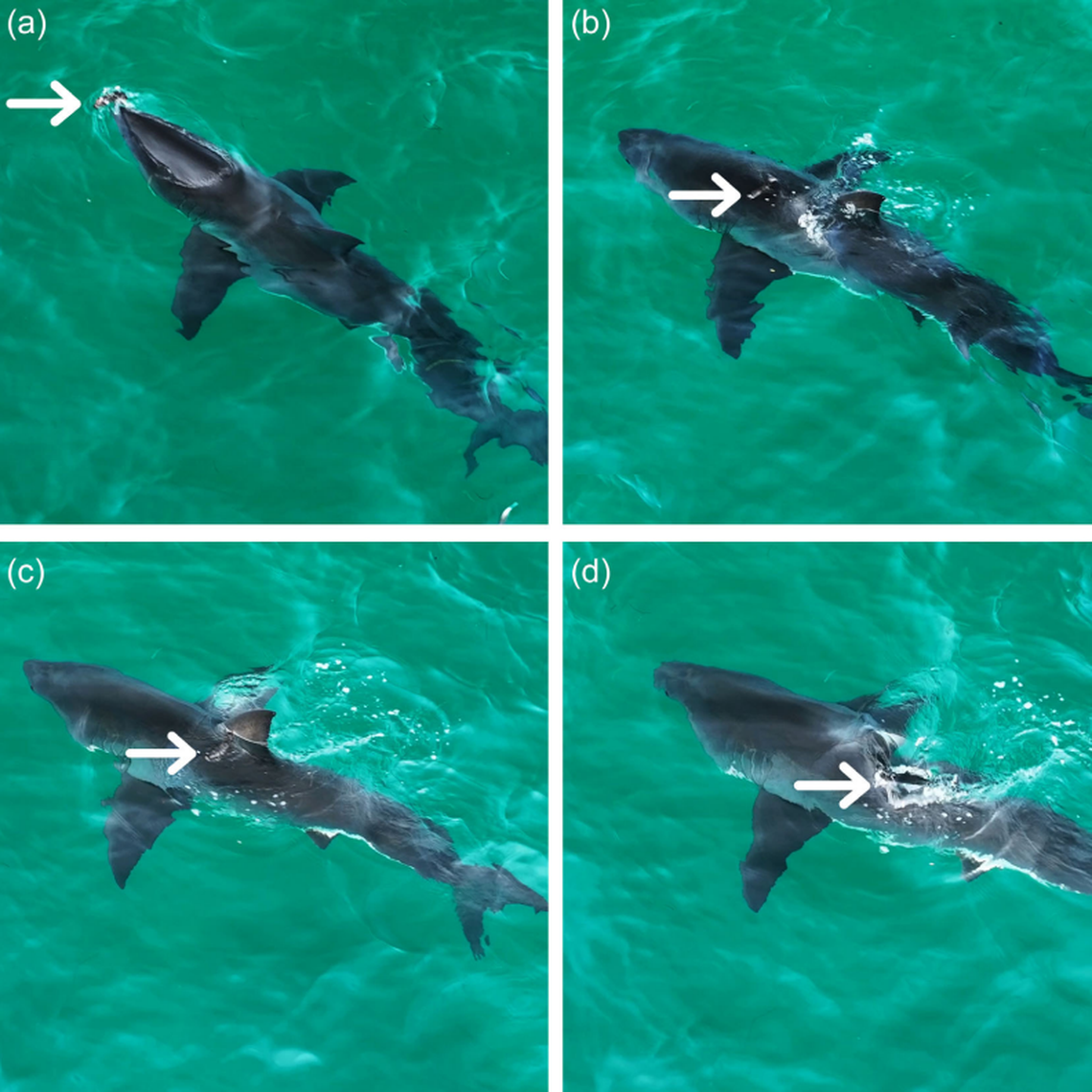
In another sighting, a second shark off the coast of Santa Barbara encountered an unidentified surface object and swam directly at it. When it made contact with the object, the shark rotated its dorsal fin toward it, then moved the fin back to its original upright position, researchers said.
Researchers said when white sharks swim forward, they create “a bow wave” that makes “snout–object contact”— their more common investigative technique — impossible. “The dorsal fin is the next part of their bodies that can provide a “tactile confirmation,” according to the study.
Beyond confirmation that their dorsal fins are highly dynamic and flexible, researchers said, observationssuggest white sharks may use them to investigate objects through physical contact.
“Another possibility is that the dorsal-fin movement is purely a response to the contact with the object,” researchers said. “Nonetheless, similar to the first scenario, the dorsal fin rotated on its axis showing that this functional capability and behaviour occurs in multiple individual white sharks.”
The research team included Carlos Gauna and Phillip C. Sternes.
This story was originally published September 12, 2025 at 1:14 PM with the headline "Drone captures ‘previously unknown’ behavior in great white sharks off California."