Rains lift SLO County out of drought conditions. How full are lakes and reservoirs?
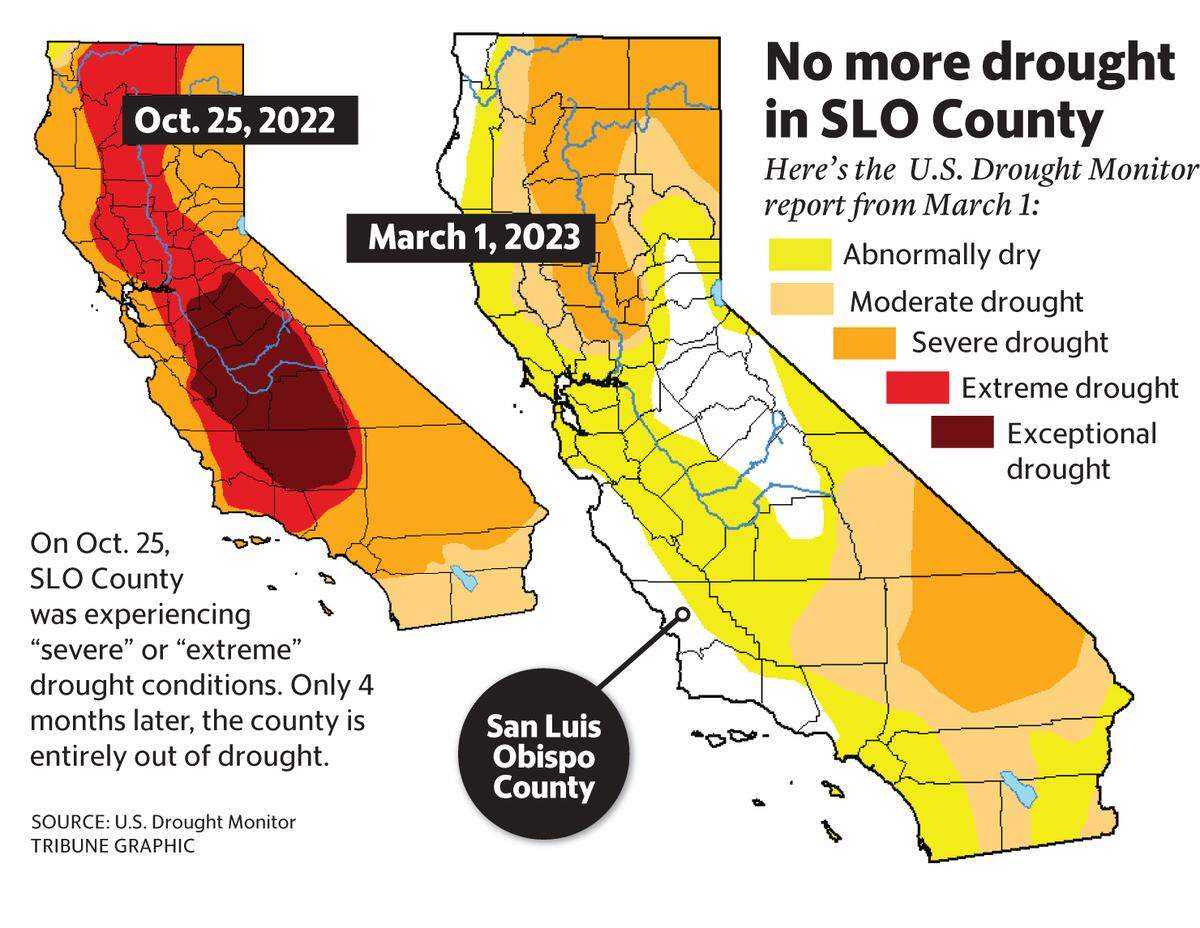
For the first time since November 2020, San Luis Obispo County is no longer considered to be experiencing drought conditions — thanks to strong storms that dumped rain on the region.
That’s according to the U.S. Drought Monitor, a partnership between the National Drought Mitigation Center at the University of Nebraska-Lincoln, the U.S. Department of Agriculture and the National Oceanic and Atmospheric Administration.
As of Feb. 28, the eastern half of San Luis Obispo County is experiencing “abnormally dry” conditions, the latest analysis from the Drought Monitor said.
The western half is not experiencing any drought conditions at all.
It’s important to note, however, the conditions reported by the Drought Monitor don’t mean drought is eradicated.
According to the California Department of Water Resources, the state’s drought dates back more than 1,000 years.
But for now, there’s room for relief.
SLO County cities see above average rainfall amounts
Storms have brought repeated rounds of much-needed rainfall to San Luis Obispo County, saturating soil, refilling reservoirs and creeks and bringing hope for a wildflower superbloom.
Two main tenants of measuring how an area is faring in a drought is to look at how much rain it has received and how full its reservoirs have gotten.
San Luis Obispo County fared pretty well in terms of rainfall during the months of January and February.
Each month had numerous rainstorms that brought several inches of rain to the region.
Paso Robles, for example, received nearly 3 inches of rainfall in February, according to the National Oceanic and Atmospheric Administration.
That’s about on-par of its historical February rainfall amount of 3.23 inches, NOAA’s data show.
Other areas, such as San Luis Obispo, Cambria and the Arroyo Grande area, saw more rain fall in February than normal for the month.
The Lopez Lake area saw 156% of its typical February rainfall of 3.53 inches, while Santa Margarita saw 101% of its typical for the month of 6.88 inches, according to NOAA.
La Panza, a site off Highway 58 north of the Carrizo Plain, measured 251% of its normal February precipitation.
NOAA data show that 3.69 inches of rain fell there over the course of the month when normally just 1.47 inches are measured in February.
Rocky Butte, typically one of the rainiest spots in the county in the mountains northeast of Cambria, measured 6.52 inches of rain in February — 171% of its normal of 3.82 inches, according to NOAA.
If San Luis Obispo County cities were graded on how quickly they could receive their yearly normal amount of rainfall, then nearly every one would be an A+ student, according to data from the county Public Works Department.
Nearly all regions in the county have seen more rainfall since Jan. 1 than they typically see in an entire year.
Only San Simeon is lagging behind, having received 23.01 inches of rain. That’s 96% of its historical norm of 24 inches, according to the county.
Local reservoirs filling up, overflowing with water
How has the rain impacted water levels at local lakes and reservoirs?
Santa Margarita Lake is one of the big stars in terms of capacity.
The reservoir northeast of San Luis Obispo has been overflowing since Jan. 9 — a huge improvement from where it was before the New Year, at 62% capacity, according to the county.
Lopez Lake near Arroyo Grande is a key reservoir that feeds the South County cities. Perilously low before the winter storms came, the county had enacted its “low reservoir response plan” and cut water deliveries to cities including Arroyo Grande and Pismo Beach.
On Jan. 1, the lake was at 24% capacity.
As of Friday, the reservoir was at 63% capacity and rising, according to the county’s data.
Lake Nacimiento in the northern reaches of San Luis Obispo County is sitting at 90% capacity, up from 32% at the beginning of the year.
Meanwhile, Whale Rock Reservoir near Cayucos, which feeds the city of San Luis Obispo, Cal Poly and the California Men’s Colony, went from 72.1% capacity at the beginning of the year to 92.5% as of Friday, according to the city of San Luis Obispo.
Weather forecast calls for more rainstorms
It doesn’t look like the rain is going to stop coming.
San Luis Obispo County residents can expect some showers on Saturday afternoon and through the evening, according to the National Weather Service.
Rain is also forecast to fall Sunday, but skies may clear by the end of the day, the agency said.
Rainfall over the weekend will likely be light, not measuring more than an inch, the NWS said.