‘Mini Miracle March’ rain pulls SLO County out of drought — at least for now
The Central Coast’s rainy March brought San Luis Obispo County back from the brink of a drought brought on by a very dry winter.
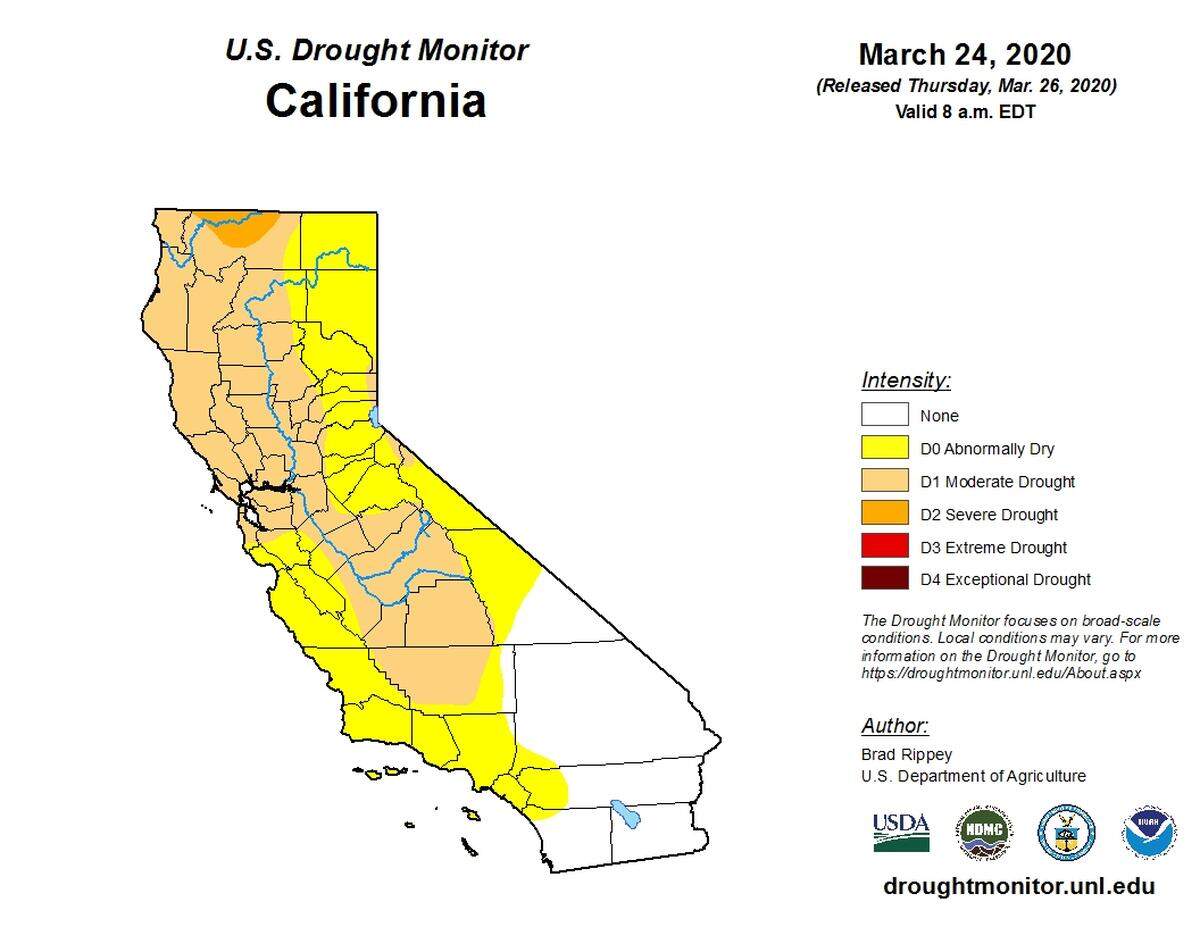
U.S. Drought Monitor maps released on Thursday show the county is now classified as abnormally dry after previously experiencing moderate drought conditions following a nearly rainless February.
The Drought Monitor uses data from the National Oceanic and Atmospheric Administration (NOAA) and other federal agencies to assess conditions on a scale of no drought to D4, or exceptional drought.
Much of San Luis Obispo, Santa Barbara, Ventura and Los Angeles counties were previously experiencing moderate drought conditions, as were most areas of the Central Valley.
Now, most of those coastal areas are abnormally dry, while large chunks of inland counties — including Kern, Kings and Fresno counties — are still experiencing moderate drought conditions.
The county slipped back into moderate drought on March 10, before bouncing back out two weeks later.
As a whole, about 40% of California is still facing drought conditions of some kind. Seventy-five percent of the state is abnormally dry, and about 25% of areas aren’t experiencing drought conditions of any kind.
SLO County gets a ‘Mini Miracle March’
Drought conditions have lessened due to a marked rainfall improvement from February to March.
The San Luis Obispo and Paso Robles airports received 0% of their normal precipitation in February, according to the National Weather Service.
However, rain and storms swept across the Central Coast in March, dumping 6 inches of rain on Cal Poly and more than 3 inches of precipitation on the Paso Robles Airport, said John Lindsey, a PG&E meteorologist.
Lindsey said most areas of the Central Coast that previously had received only one-third of their average rainfall at the beginning of March. Those locations have now gotten half to two-thirds of their average precipitation.
“I probably wouldn’t classify this month as a ‘Miracle March,’ like the one we saw in 1991, but perhaps a ‘Mini Miracle March,’” Lindsey wrote in his Weather Watch column. “The snowpack in the Sierra Nevada has significantly increased but still remains lower than average.”
How long SLO County can remain out of drought conditions, however, remains unclear. With the rainy season drawing to close, a county’s current designation may be short-lived.