
A time of piers, wharfs and railroads
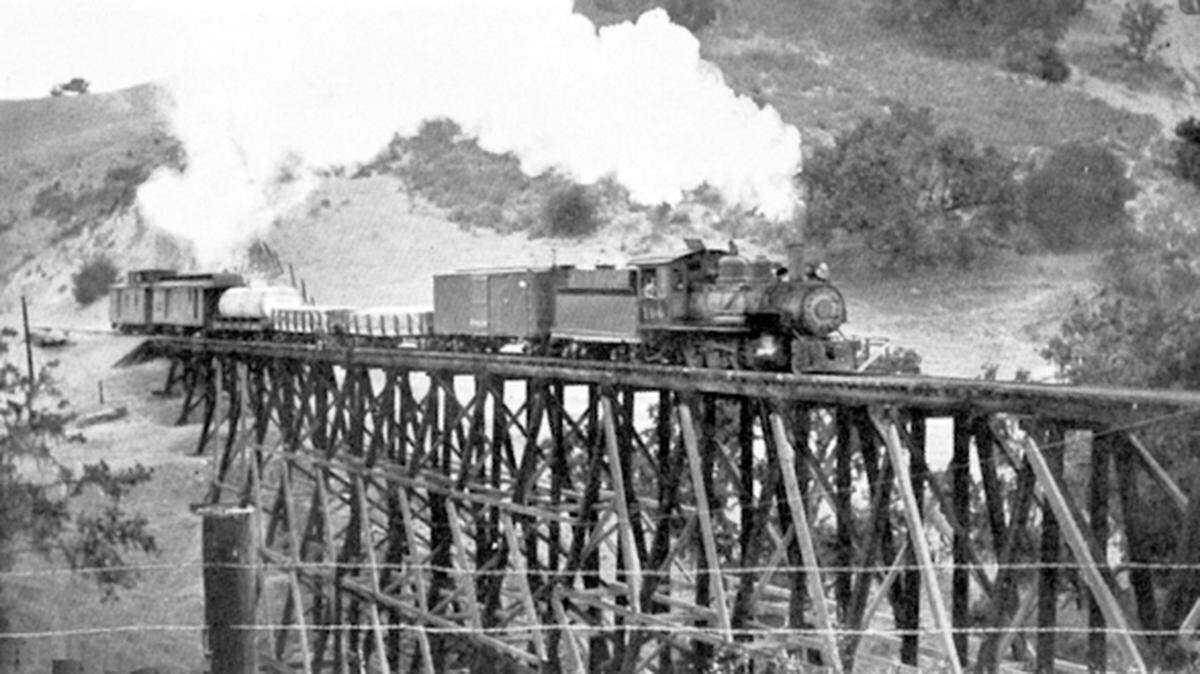
The Central Coast was isolated both by land and sea. What we know as El Camino Real, mostly the path of Highway 101, was rugged, wagon-wheel-rutted trails that were impassible in wet months. San Luis Obispo lacked a good natural harbor. This led to many difficulties.
Sometimes, the results were comic, such as when Walter Murray arrived in San Luis Bay at the mouth of San Luis Creek in 1853. The small boat rowing him ashore capsized in the powerful surf.
The ship’s captain, instead of helping Murray, up to his neck in water, simply threw the leather bags of mail, saying “Here, you take this to town!”
There could be tragic consequences. In that same year, Sen. Henry Tefft, William G. Dana’s son-in-law and a signatory of the California constitution, drowned while trying to swim ashore from his sailing vessel in rough waters.
The Franciscan missionaries had developed an assistencia, literally an assistant mission at Rancho San Miguelito where San Luis Creek emptied into the Pacific. They maintained several adobe buildings at the site and used it for the mantanza, or cattle slaughter. The hides would be prepared and the lard poured into barrels for loading onto the ships of English, Yankee and French traders and the Sitka, an Alaska-based Russian-American Company.
The trade ended when the Mexican government secularized the missions in the 1830s. Rancho San Miguelito, nearly 49 square miles, was granted to Miguel Avila by Gov. Juan Bautista Alvarado in 1842.
Like all the Californios, Avila suffered heavy losses during the drought of 1863-64. In 1867, his son, Don Miguel, laid out the town of Avila. He sold lots to a group led by John Harford of the lumber firm of Schwartz, Harford and Co., the Goldtree Brothers and A. Blochman & Co. of San Luis Obispo and San Francisco.
These merchants formed a syndicate called the “People’s Wharf Company” in December 1868. They constructed an 1,800-foot wharf just south of the mouth of San Luis Creek, approximately 100 yards south of the present-day Avila Pier. A narrowgauge, horse-drawn railway was laid on the wharf to bring cargo onshore.
The recession of the 1870s hurt business. So too, did competition from Capt. David P. Mallagh’s “Cave Landing,” built at the foot of the bluff over what is nowadays referred to as “Pirates’ Cove.”
The partners quarreled. In November 1872, Blochman sued the Goldtrees, and the presiding judge ordered the company dissolved. The holdings were sold at an auction in front of the warehouse on the beach.
Capt. John Harford salvaged much of the wreckage. He constructed a new wharf, which was completed in 1875. It extended 540 feet from the rockstrewn shore into water averaging 15 feet in depth. He laid a 15-pound horse rail from the wharf to Capt. Mallagh’s road from Avila to El Camino Real.
Most of the actual construction on the “Harford” or “Old Port Wharf” was undertaken by Chinese labor gangs, supervised by Wong On “Ah Louis,” with whom Harford formed a long-lasting working arrangement.
San Francisco businessman Charles Goodall saw the value of converting the operation into a steam railway by laying a track into San Luis Obispo. He bought Harford out for $30,000.
Goodall extended the wharf to 1,500 feet. The first service to the wharf’s end commenced on Dec. 11, 1876.
The Pacific Coast Railroad connected Arroyo Grande, Los Berros, Nipomo, Santa Maria, Los Alamos and Los Olivos.
The railroad ceased running at the end by the Great Depression. Its landmarks along the right of way still exist from the Old Port Wharf and the Bob Jones Trail to the water tower at Mattie’s Inn in Los Olivos.
Elliot Marshall of San Luis Obispo has created “A self-guided automobile tour of the Pacific Coast Railway.” It’s available online without charge at http://goo.gl/GZs8xy.
This story was originally published January 19, 2015 at 6:03 AM with the headline "A time of piers, wharfs and railroads."