
The Central Coast and the legacy of the Mother Lode, part 1
Gold fever profoundly affected San Luis Obispo County and the environment of all California. During the Gold Rush, the world was rushing to the Mother Lode and the counties of the Bay Area.
The huge increase in population created a seller’s market for the numerous herds of cattle and sheep in the now largely depopulated Central Coast and Southern California ranches.
Basque sheep herders had been brought to California at the end of the mission period. By the early 1850s their saddlebags were filled with gold. They grew rich driving cattle and sheep up the coastal trails and over the passes into the San Joaquin Valley where they were sold in the feed lots of Stockton.
There, in what came to be called “Fat City,” the trail-weary animals would be fattened on grain and beer mash and shipped on barges up the Stanislaus River to Sonora, Columbia and Jamestown. A steer might fetch as much as $200 on the hoof.
Samuel Clemens, later better known as Mark Twain, watched the loading of cattle onto the barges along the Stockton docks. He observed that the steers were so inebriated from the beer mash that they were insensitive to their future as beef steak in “Jimtown,” the miners’ name for Jamestown.
California’s river systems were essential for transportation in the Gold Rush era. Ironically, it was the quest for the precious metal that destroyed these rivers.
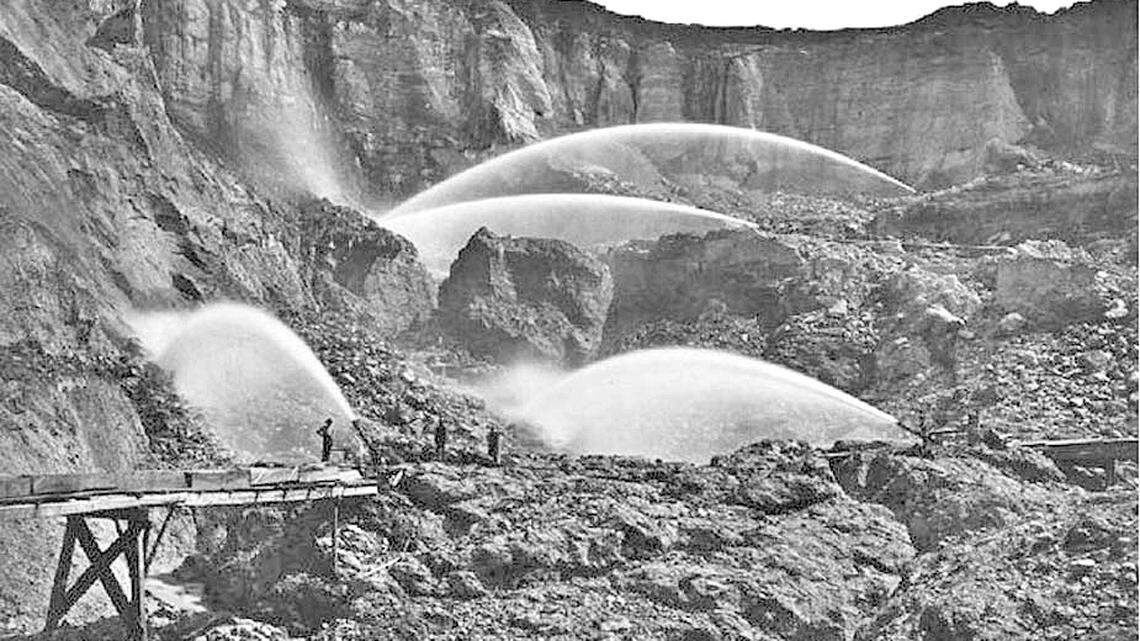
The placer miners who sifted gold ore from the sand deposited in the river bottoms were replaced by industrial scale hydraulic mining. Wooden flumes brought water from higher levels in the Sierra Nevada to the hard rock gold-bearing mountainside. A giant “Monitor” or nozzle would aim the water at the cliff faces.
In his epic History of California, Hubert Howe Bancroft reported how an eight-inch Monitor could throw 185,000 cubic feet of water in an hour at a velocity of 150 feet per second. The water ripped through the rock, reducing it to gravel.
Soon the river beds were becoming filled with sediment. The former water borne highways were no longer navigable. As newly formed sandbars clogged the rivers and streams, the likelihood of flooding the Sacramento and San Joaquin valleys increased.
The resulting flood of 1861-62 was the most devastating in California history.
William H. Brewer, who in 1860 was invited by Josiah D. Whitney to become the chief botanist of the California Division of Mines and Geology, wrote: “The great central valley of the state is under water — the Sacramento and San Joaquin Valleys — a region 250 to 300 miles long and an average of at least twenty miles wide, a district of five thousand or six thousand square miles, or probably three to three and a half millions of acres! Although much of it is not cultivated, yet a part of it is the garden of the state. Thousands of farms are entirely under water — cattle starving and drowning.”
The environmental catastrophe was there for all to see. The flooding was only part of the story. As early as the time of statehood, Sept. 9, 1850, medical doctors began noticing a significant number of cases of mercury poisoning.
In Part Two next week, the history of that episode will return us to the Central Coast.
***
Readers are invited to join the San Luis Obispo Mission Museum docents on a trip on the “Times Past Highway through the Mother Lode.” We will be visiting the important and colorful sites of California’s Gold Rush era from “Jimtown” and Sonora to Grass Valley and Nevada City. The tour will be from Oct. 15-17. Contact Silver Bay Tours at 772-3409.
This story was originally published September 13, 2014 at 5:56 PM with the headline "The Central Coast and the legacy of the Mother Lode, part 1."